Urban Wetland Degradation and Migratory Bird Pattern Shifts
Source:Indian Express ↗
Why It Matters
The drastic drop in flamingo numbers serves as a critical ecological indicator of deteriorating urban wetland health. It underscores the intersection of macroeconomic climate change (altering migration patterns) and local anthropogenic pressures (pollution, landfilling), both of which are central to the GS-3 syllabus on environmental conservation and the ecological impacts of urbanization.
Summary
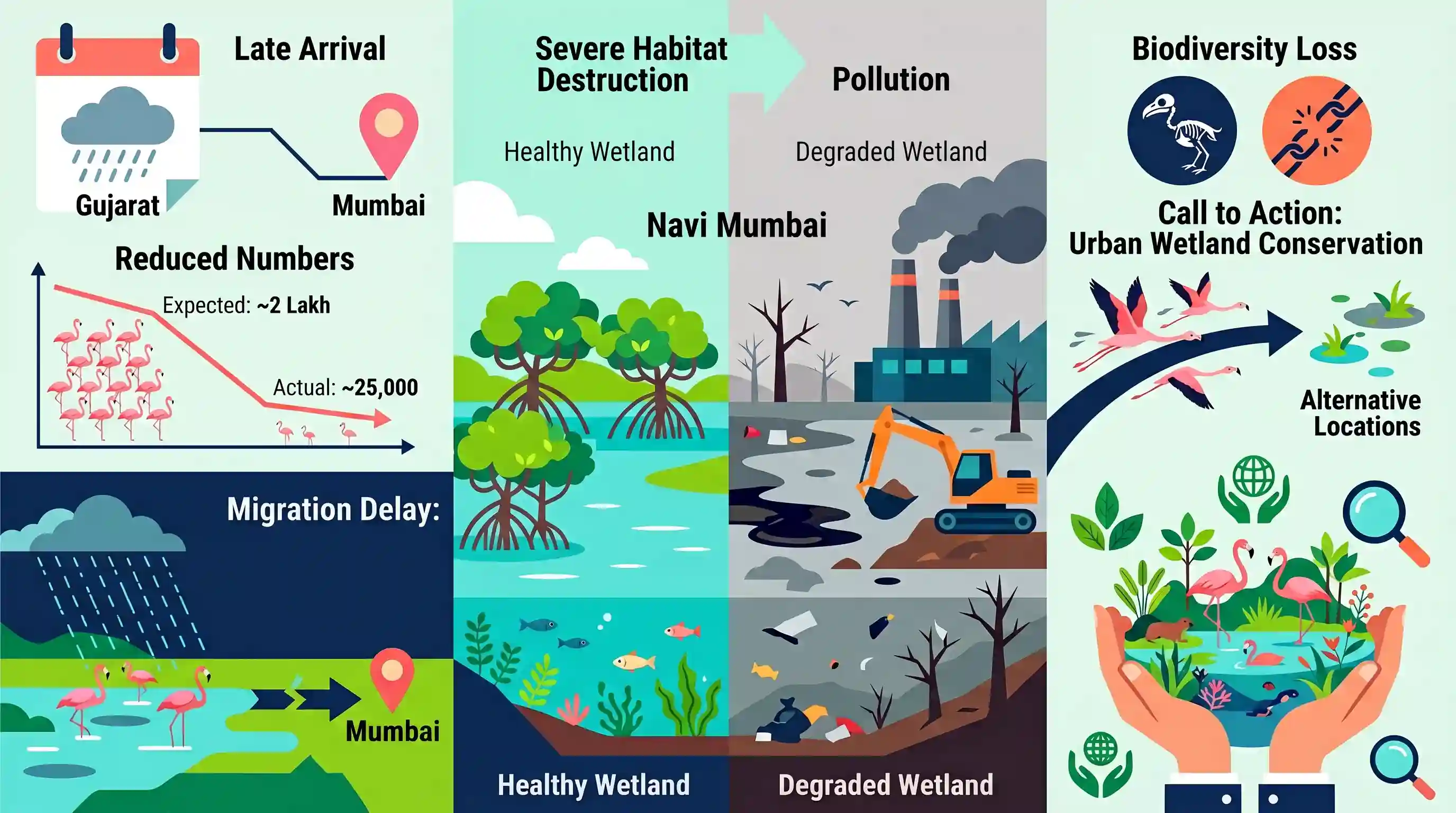
Greater and Lesser Flamingos have arrived months late and in drastically reduced numbers in the Mumbai Metropolitan Region (MMR). Environmentalists attribute the delay to an extended monsoon in Gujarat, which disrupted their typical winter migration schedule. Furthermore, the sharp decline in their numbers—from an expected 2 lakh to just 25,000—is blamed on severe habitat destruction. Rampant pollution, landfilling, and the stagnation of wetlands and mudflats in Navi Mumbai have made traditional feeding grounds inhospitable, forcing the birds to seek alternative locations and highlighting the urgent need for urban wetland conservation.
Key Points
- Greater and Lesser Flamingos arrived in the Mumbai Metropolitan Region months later than their usual October-November window.
- The flamingo population arriving in MMR has dropped drastically, from a typical 2 lakh birds to an estimated 25,000.
- The delay in migration is attributed to an extended monsoon in Gujarat, which altered the birds' typical wintering behavior.
- Rampant pollution, landfilling, and subsequent moss formation have destroyed mudflats and wetlands in Navi Mumbai, making them inhospitable to the birds.
- The ecological degradation forces migratory birds to seek alternative habitats, threatening Navi Mumbai's identity as 'Flamingo City'.
Important Terms
Lesser Flamingo

The smallest flamingo species, characterized by its deep red bill and pink plumage. It is a colonial breeder primarily found in India and Africa.
UPSC context
GS Paper III: Conservation. Tests knowledge of its 'Near Threatened' status and significance in the Central Asian Flyway.
Greater Flamingo
The largest and most widespread flamingo species, featuring white-pink plumage. It is the state bird of Gujarat and inhabits diverse fresh and brackish wetlands.
UPSC context
GS Paper III: Biodiversity. Relevant for prelims questions on migratory species, state symbols, and habitat distribution in India.
Thane Creek Flamingo Sanctuary (TCFS)
A 16.9 sq km protected area in Maharashtra, designated as a Ramsar site in 2022. It serves as a vital urban wintering ground for thousands of flamingos.
UPSC context
GS Paper III: Conservation. Key for topics on Ramsar sites, urban biodiversity, and coastal ecosystem protection.
Mudflats
Coastal wetlands formed in intertidal zones by the deposition of fine silts and clays. They serve as essential foraging grounds for migratory birds like flamingos.
UPSC context
GS Paper I/III: Geography/Environment. Significant for understanding coastal ecology and the impact of urbanization on intertidal habitats.
NatConnect Foundation
A Navi Mumbai-based environmental NGO that uses RTIs and advocacy to protect wetlands and mangroves. It spearheaded the 'Flamingo City' campaign.
UPSC context
GS Paper II/III: Governance/Environment. Illustrates the role of civil society in environmental litigation and urban ecological conservation.
Sagar Shakti
The marine wing of the NGO Vanashakti, dedicated to preserving coastal wetlands, mangroves, and intertidal zones in the Mumbai Metropolitan Region.
UPSC context
GS Paper III: Environment. Represents grassroots advocacy for Coastal Regulation Zone (CRZ) compliance and biodiversity protection.
Prelims Trap
"Both Greater and Lesser Flamingos are classified as 'Near Threatened' under the IUCN Red List."
Greater Flamingos are actually 'Least Concern'. UPSC frequently swaps or conflates the IUCN statuses of closely related species to create incorrect statements.
Static Concepts Connected
How do Greater and Lesser Flamingos differ ecologically and in conservation status?
- Conservation Status: Greater Flamingo is 'Least Concern'; Lesser Flamingo is 'Near Threatened' (due to its high dependence on specific alkaline/saline lakes).
- Physical Traits: Greater is the largest species with a pale pink, black-tipped beak; Lesser is the smallest with a distinctive dark crimson beak.
- Plumage Source: Both derive their characteristic pink plumage from carotenoid pigments found in their diet of crustaceans and blue-green algae.
What is the ecological function of coastal mudflats?
- Nutrient Cycling: They host benthic microflora and macrofauna that serve as the primary food source for migratory wading birds.
- Flood Mitigation: Acting as natural sponges, they absorb tidal surges and urban floodwaters, buffering coastal megacities from extreme weather events.
- Pollutant Filtration: Often termed the 'kidneys of the earth', they trap sediments and filter out heavy metals and urban runoff.
Cross-Topic Patterns
Climate Anomalies & Migratory Flyways
Extended monsoons in Gujarat altering Mumbai arrival times highlights how localized climate anomalies disrupt the broader Central Asian Flyway schedules.
Urbanization vs. Ramsar Commitments
The destruction of Navi Mumbai wetlands via landfilling directly conflicts with India's international obligations to protect the adjacent Thane Creek Ramsar site ecosystem.

Expect a 2026 question linking Central Asian Flyway navigation, shifting monsoon patterns, and mudflat ecology at Thane Creek Ramsar.
Linked PYQs · 3
Linked PYQs · 3
- 2018MainsGS3
What is wetland? Explain the Ramsar concept of 'wise use' in the context of wetland conservation. Cite two examples of Ramsar sites from India.
- 2023MainsGS3
Comment on the National Wetland Conservation Programme initiated by the Government of India and name a few India's wetlands of international importance included in the Ramsar Sites.
- 2022PrelimsGS1
"If rainforests and tropical forests are the lungs of the Earth, then surely wetlands function as its kidneys." Which one of the following functions of wetlands best reflects the above statement?
