Systemic Subversion of Public Exams and Recruitment Integrity
Source:The Hindu ↗
Why It Matters
This topic highlights critical systemic vulnerabilities in India's public recruitment and testing infrastructure. It connects institutional design, governance, administrative security, and ethical public service values to socio-economic challenges like youth unemployment and demographic dividend development. The enactment of legislative measures (such as the Public Examinations Act, 2024) makes this a highly contemporary area of inquiry for GS Paper 2, 3, and 4.
Summary
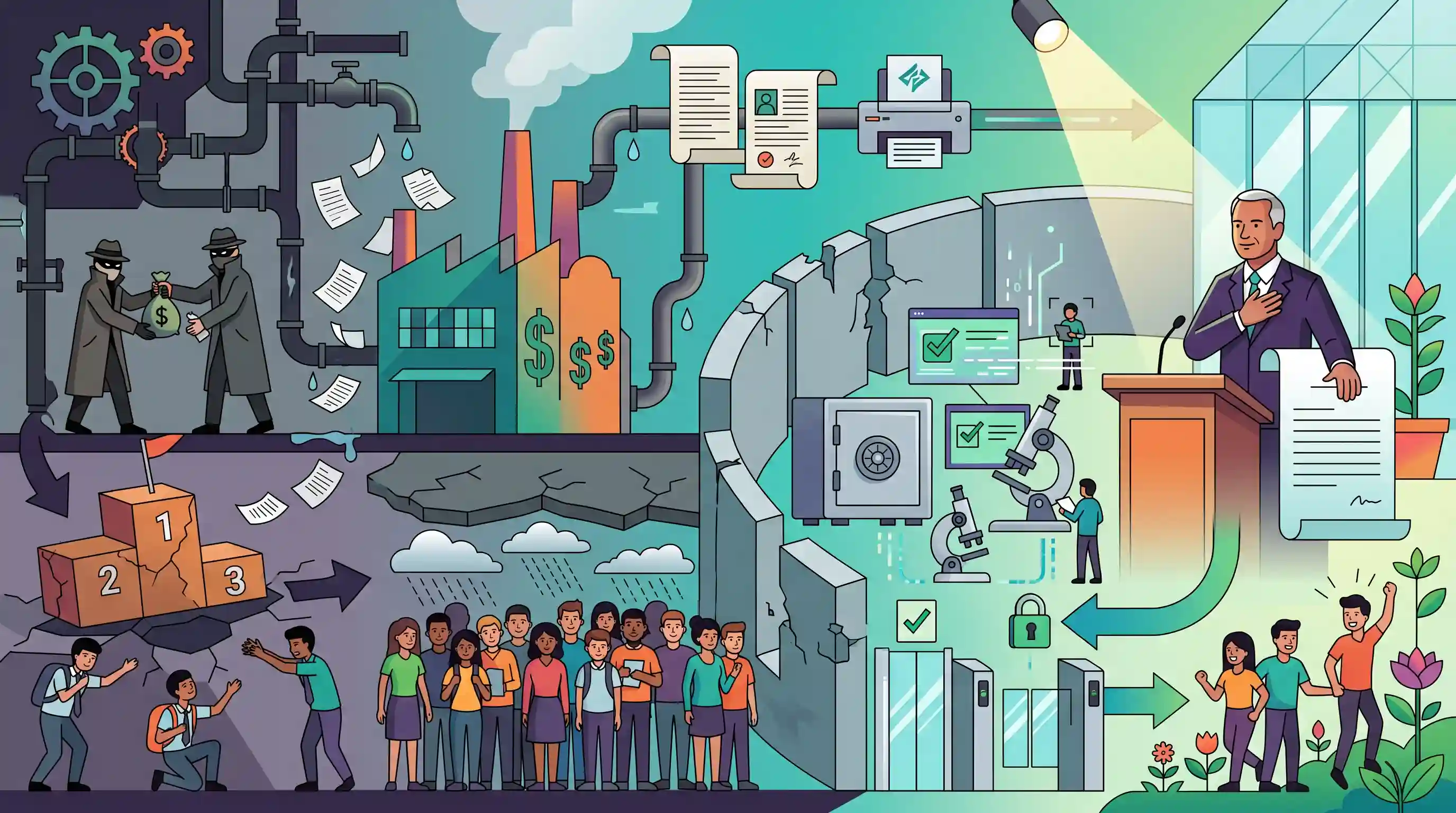
The article analyses the recurring systemic subversion of public examinations and teacher recruitment in India (including NEET and several state recruitment tests). It argues that paper-leak syndicates—utilising insider networks and printing-press collusions—exploit vulnerabilities to profit from the coaching ecosystem. It stresses that such leaks compromise meritocracy and damage India's demographic dividend. To fix the rot, the article advocates for structural reforms in question-paper setting (such as scrutinising examiners' backgrounds and conflicts of interest) coupled with strict political accountability, demanding that Education Ministers own up to administrative failures.
Key Points
- Corrosive Nature of Exam Leaks: Unlike isolated bribery, systematic subversion of public exams and recruitment is deeply corrosive because it erodes meritocracy and directly impedes India's capacity to leverage its demographic dividend.
- The Recurring Scam Template: Exam leak syndicates across states (e.g., Gujarat, Rajasthan, J&K, Maharashtra) operate similarly—leveraging insider networks (such as printing-press employees, security staff, or government teachers) to funnel exam papers into the lucrative coaching ecosystem.
- Structural Vulnerabilities in Exam Setting: Recruitment boards often rely on a closed pool of examiners. Systemic gaps remain as the antecedents, commercial connections, and potential conflicts of interest of these paper-setters are rarely scrutinised.
- Performative Investigations: Standard government responses are often performative—arresting local 'kingpins' and holding superficial investigations until public outrage dies down, without reforming the structural flaws in paper distribution and setting.
- Need for Political and Administrative Accountability: Remedying the crisis requires establishing strict accountability. Education Ministers at the State and Central levels must take moral and administrative ownership of routine failures rather than remaining insulated from consequences.
Important Terms
National Testing Agency (NTA)

An autonomous, premier testing organization under the Ministry of Education, established to conduct highly standardized, transparent entrance examinations for admissions and fellowships in Indian higher educational institutions.
UPSC context
GS Paper 2 (Governance & Education); tests institutional reforms, administrative transparency, and public exam management.
National Eligibility-cum-Entrance Test (NEET)
A standardized, centralized national-level entrance exam conducted by the NTA for candidates seeking admission to undergraduate medical and dental programs across all Indian medical colleges.
UPSC context
GS Paper 2 (Education & Social Sector); examines challenges in centralized testing and equity in professional education.
Public Examinations (Prevention of Unfair Means) Act, 2024
A central law enacted to curb malpractices, paper leaks, and organized cheating in exams conducted by public authorities, prescribing strict, non-bailable penalties and heavy fines.
UPSC context
GS Paper 2 (Governance & Accountability); tests statutory measures to secure examination integrity and deter public recruitment syndicates.
Teacher Eligibility Test (TET)
A mandatory qualifying test under the RTE Act, 2009, establishing minimum professional benchmarks for candidates aspiring to teach in primary and upper-primary schools in India.
UPSC context
GS Paper 2 (Social Sector/Education); tests execution of statutory standards and Right to Education mandates.
Demographic Dividend
The accelerated economic growth potential arising from shifts in a country's population age structure, particularly when the working-age population (15-64) exceeds the dependent population.
UPSC context
GS Paper 3 (Economy) & GS Paper 1; tests human capital development and macroeconomic challenges of youth employment.
Ministry of Education
The central ministry responsible for formulating educational policies, coordinating standards in higher education and research, and overseeing apex testing and administrative bodies like the NTA.
UPSC context
GS Paper 2 (Social Sector/Education); tests federal policy formulation, administrative accountability, and implementation of educational reforms.
Prelims Trap
The Public Examinations (Prevention of Unfair Means) Act, 2024 automatically applies to and governs state-level public service commission examinations.
The 2024 Central Act only applies to central authorities like UPSC, SSC, NTA, and railways. States must enact or adopt their own legislation for state exams.
Static Concepts Connected
What is the legal status and governance of the National Testing Agency (NTA)?
- Legal Identity: Registered as an autonomous, self-sustained premier testing society under the Societies Registration Act, 1860.
- RTI Applicability: Operates fully under the ambit of the Right to Information (RTI) Act, 2005, ensuring public accountability.
- Leadership Structure: Headed by a Director-General appointed by the Central Government, supported by a Governing Body of experts.
What did the Radhakrishnan Commission (1948-49) recommend regarding recruitment and exams?
- Decoupling Degrees: Recommended decoupling university degrees from eligibility for administrative services to reduce unnecessary degree-obsession among youth.
- Specialized Examinations: Advocated for separate, specialized public competitive examinations conducted by recruitment boards for public services.
- Evaluation Shift: Stressed shifting the evaluation focus toward continuous, classroom-based internal assessments over high-stakes external exams.
Cross-Topic Patterns
Demographic dividend and youth unemployment
Exam leaks exacerbate India's high graduate unemployment rate (29.1%), threatening to convert the country's demographic window of opportunity into a socio-economic crisis.
Nolan Principles and administrative ethics
Routine exam subversions and systemic denials of accountability violate the Nolan Principles of Integrity, Accountability, and Openness in public governance.

Radhakrishnan Committee's 2024 NTA reform proposals and the Public Examinations Act are high-probability areas for a 2026 GS2/GS4 question.
Linked PYQs · 3
Linked PYQs · 3
- 2024MainsGS2
What are the aims and objects of recently passed and enforced, The Public Examination (Prevention of Unfair Means) Act, 2024? Whether University/State Education Board examinations, too, are covered under the Act ?
- 2014MainsGS3
While we flaunt India's demographic dividend, we ignore the dropping rates of employability. What are we missing while doing so? Where will the jobs that India desperately needs come from? Explain.
- 2023MainsGS4
Corruption is the manifestation of the failure of core values in the society." In your opinion, what measures can be adopted to uplift the core values in the society ?
