Five-State Panel Formed for Yamuna Rejuvenation Plan
Source:hindustantimes ↗
Why It Matters
Inter-state river governance and Yamuna pollution management are critical recurring themes in environmental governance, directly impacting Uttar Pradesh and the National Capital Region.
Summary
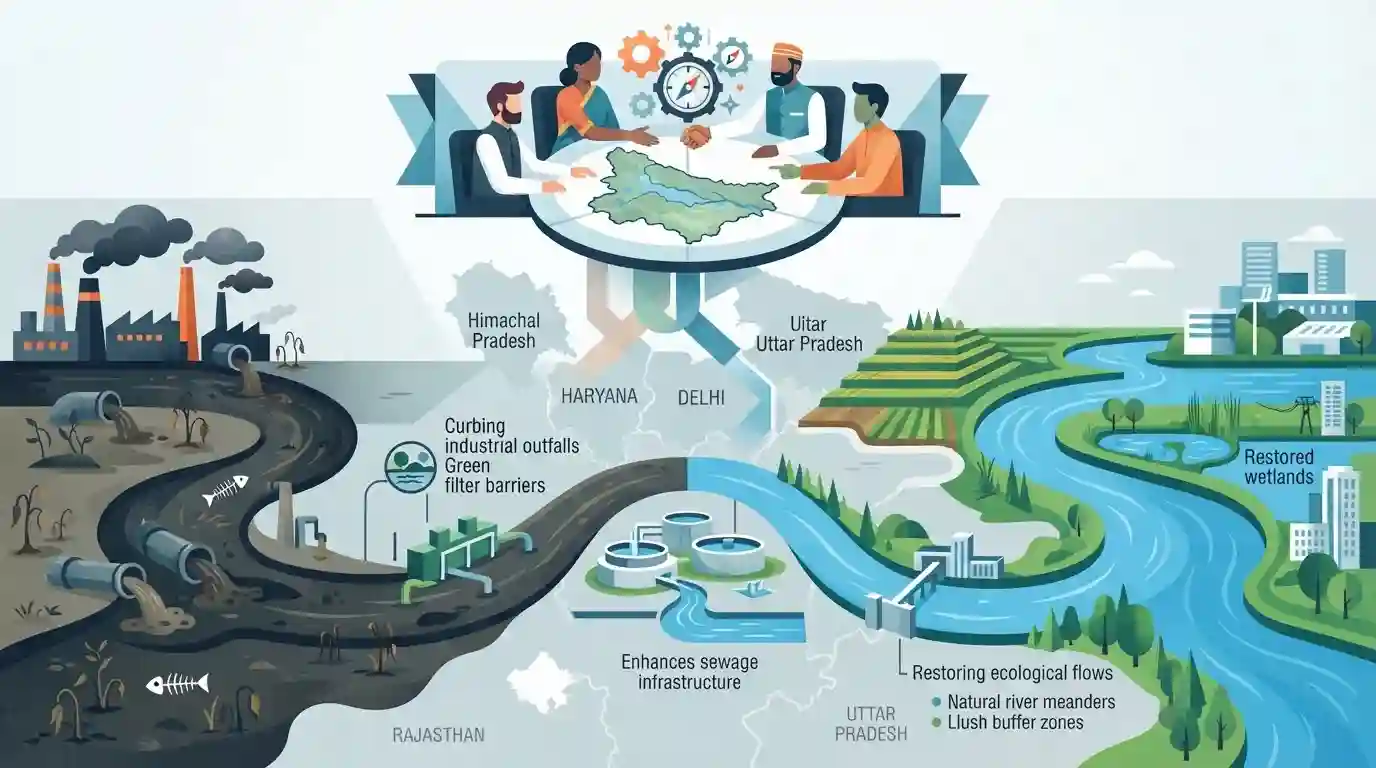
A five-state panel has been constituted to oversee and coordinate the implementation of the Yamuna rejuvenation plan, focusing on curbing pollution, enhancing sewage infrastructure, and restoring ecological flows across the river basin involving Delhi, UP, Haryana, Himachal Pradesh, and Rajasthan.
Key Points
- A new five-state panel has been established to oversee the comprehensive Yamuna rejuvenation plan, addressing multi-state coordination challenges.
- The initiative involves cooperation between states through which the Yamuna flows or impacts, including Delhi, Uttar Pradesh, Haryana, Himachal Pradesh, and Rajasthan.
- The committee will monitor pollution abatement, sewage treatment plant (STP) upgrades, and ecological flow (e-flow) maintenance in the Yamuna basin.
Important Terms
Yamuna Rejuvenation Plan

A central government-constituted interstate committee headed by the Union home secretary, designed to monitor and coordinate pollution control, sewage infrastructure, and ecological flow restoration across the Yamuna river basin.
UPSC context
GS Paper III (Environment & Ecology); tests knowledge of river basin management, interstate water governance, and pollution mitigation strategies in India.
National Green Tribunal
A specialized statutory body established under the National Green Tribunal Act, 2010, for effective and expeditious disposal of cases relating to environmental protection and conservation of forests and natural resources.
UPSC context
GS Paper II & III (Polity & Environment); tests statutory bodies, judicial interventions in environmental degradation, and pollution control enforcement in India.
Prelims Trap
Uttarakhand is a permanent member of the five-state Yamuna Rejuvenation Panel.
Aspirants often confuse Uttarakhand as a member of this specific 5-state Yamuna panel, whereas Himachal Pradesh is included alongside Delhi, UP, Haryana, and Rajasthan.
Static Concepts Connected
What are the constitutional and statutory provisions for Inter-state Water disputes and River Boards in India?
- Article 262: Article 262 empowers Parliament to provide for the adjudication of any dispute relating to the use, distribution or control of inter-state waters.
- River Boards Act: The River Boards Act, 1956 enables the Central government to establish river boards for advice on inter-state river basin development upon state request.
- NGT Act 2010: The National Green Tribunal (NGT) Act, 2010 provides effective and expeditious disposal of cases relating to environmental protection and conservation of forests and other natural resources.
Cross-Topic Patterns
Federalism and River Inter-State Water Disputes
Inter-state councils and river boards established under central acts highlight the interplay between federalism, Article 262, and environmental degradation under Schedule VII.

Expect a matching list question linking basin states to river rejuvenation panels or NGT mandates in UP.
Linked PYQs · 3
Linked PYQs · 3
- 2018UPPSC_PRELIMSGS1
Which of the following rivers of Uttar Pradesh has been declared a 'Biological Disaster' due to environmental pollution?
- 2020UPPSC_PRELIMSGS1
Consider the following tributaries of River Yamuna and arrange them from West to East : 1. Betwa 2. Ken 3. Sindh 4. Chambal Select the correct answer from the codes given below.
- 2022UPPSC_PRELIMSGS1
The main purpose of 'Ganga Action Plan' project, launched in 1985, was
