National Education Policy Implementation Assessment
Source:Indian Express ↗
Why It Matters
The National Education Policy (NEP) 2020 is the overarching framework guiding India's educational transformation. Taking stock of its five-year implementation is crucial for understanding shifts in human capital development, federal cooperation in education, and alignment with SDG 4, which frequently feature in Mains GS2 questions.
Summary
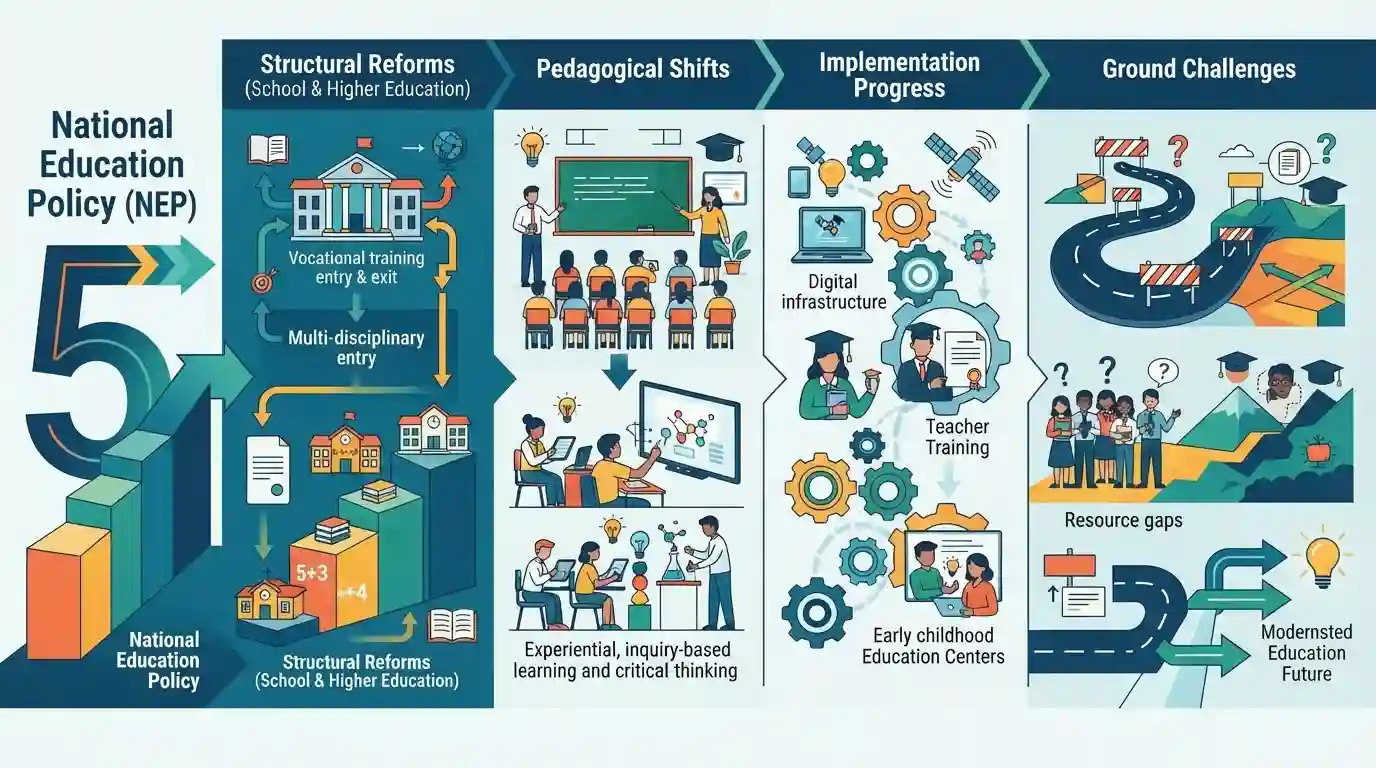
An assessment of the five-year journey of the National Education Policy (NEP), evaluating its implementation progress, structural reforms in school and higher education, pedagogical shifts, and the ground challenges faced in transitioning India's education ecosystem.
Key Points
- The National Education Policy (NEP) marks five years of transition, focusing on structural changes in school and higher education in India.
- Key elements include the shift to a 5+3+3+4 pedagogical structure, early childhood care and education (ECCE), multidisciplinary higher education, and the promotion of regional languages.
- Implementation challenges persist, including infrastructural gaps, teacher training, funding constraints, and coordination between central and state educational bodies.
- The policy aims to align India's educational outcomes with global standards and Sustainable Development Goal 4 (SDG 4).
Important Terms
National Education Policy 2020

India's comprehensive framework aiming to overhaul school and higher education by introducing a 5+3+3+4 pedagogical structure, flexible multidisciplinary learning, foundational literacy and numeracy, and increased vocational integration.
UPSC context
UPSC Mains GS Paper II: Social Sector, Education, Human Resource Development, and Government Policies.
Sustainable Development Goal 4
The global UN 2030 Agenda goal dedicated to ensuring inclusive and equitable quality education and promoting lifelong learning opportunities for all.
UPSC context
UPSC Mains GS Paper II: International Conventions, Global Goals, and Social Sector Development.
Ministry of Education
The central government department responsible for formulating, coordinating, and implementing national educational policies and programs across India.
UPSC context
UPSC Mains GS Paper II: Structure, Organization, and Functioning of Ministries and Departments of the Government.
Prelims Trap
mandates the complete replacement of English medium education with mother tongue across all schools by 2025
Aspirants often assume NEP 2020 made mother-tongue instruction legally mandatory for all schools, whereas it is recommended/advocated up to Grade 5 where possible, respecting education as a concurrent subject.
Static Concepts Connected
What are the key institutional and structural reforms introduced under the National Education Policy (NEP) 2020?
- Curricular Shift: Replaces 10+2 structure with a 5+3+3+4 design, integrating Early Childhood Care and Education (ECCE) for ages 3-6.
- Higher Ed Regulator: Establishes a single overarching umbrella regulator, the Higher Education Commission of India (HECI), replacing UGC and AICTE.
- Flexibility: Promotes multidisciplinary education with multiple entry and exit options, alongside the Academic Bank of Credits (ABC).
- Public Funding: Reiterates the long-standing national goal of public spending on education reaching 6% of GDP.
Cross-Topic Patterns
NEP 2020 vs Fiscal Responsibility Targets
The target of spending 6% of GDP on education, foundational under the Kothari Commission and NEP 2020, frequently intersects with fiscal deficit targets under the FRBM Act.
Multilingualism and Constitutional Federalism
The push for regional languages and mother-tongue instruction links educational equity directly to the Eighth Schedule of the Constitution and linguistic federalism debates.

NEP 2020 structural reforms (5+3+3+4, ECCE, multidisciplinary HEI) will be tested via analytical statements on federal implementation bottlenecks.
Linked PYQs · 2
Linked PYQs · 2
- 2020MainsGS2
National Education Policy 2020 is in conformity with the Sustainable Development Goal-4 (2030). It intends to restructure and reorient education system in India. Critically examine the statement.
- 2023MainsGS2
Skill development programmes have succeeded in increasing human resources supply to various sectors. In the context of the statement analyse the linkages between education, skill and employment.
