National Education Policy Implementation Status After Five Years
Source:Indian Express ↗
हे का महत्त्वाचे आहे
Evaluating the five-year progress of NEP 2020 is critical for UPSC aspirants tracking social sector reforms, human capital development, and policy implementation gaps in India's education ecosystem.
सारांश
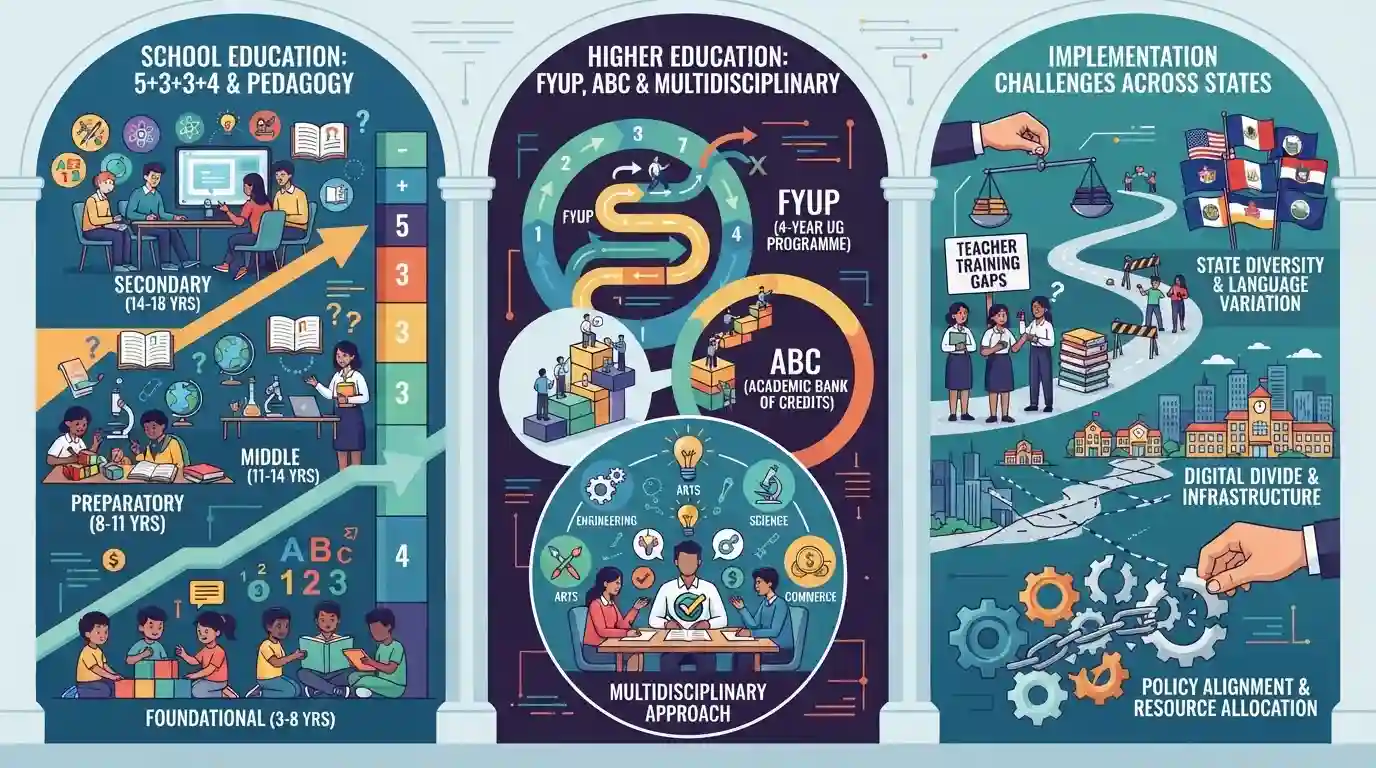
An analytical stock-take of the National Education Policy (NEP) 2020 after five years of its implementation, examining the shifts in school pedagogy (5+3+3+4, FLN, NCF), higher education changes (FYUP, ABC, multidisciplinary approach), and the ongoing implementation challenges across states.
मुख्य मुद्दे
- The National Education Policy (NEP) 2020 completes five years of transition, prompting a comprehensive stock-take of structural reforms in school and higher education.
- Key milestones include the restructuring of school education into the 5+3+3+4 design, development of new National Curriculum Frameworks (NCF), and emphasis on foundational literacy and numeracy (FLN).
- Higher education transitions involve the introduction of the Four-Year Undergraduate Programme (FYUP), multi-disciplinary learning, Academic Bank of Credits (ABC), and flexibility in exit and entry options.
- Challenges remain regarding implementation consistency across states, resource allocation, teacher training, infrastructural gaps, and bridging equity and access.
संबंधित स्थिर संकल्पना
What are the key structural components and targets of the National Education Policy (NEP) 2020?
- Curricular Design: 5+3+3+4 Design: Replaces the 10+2 structure, covering ages 3 to 18 across foundational, preparatory, middle, and secondary stages.
- Literacy Target: FLN Priority: Aims to achieve universal foundational literacy and numeracy in primary school through the NIPUN Bharat mission.
- Higher Education: Higher Ed Flexibility: Introduces Four-Year Undergraduate Programmes (FYUP), multiple entry/exit options, and the Academic Bank of Credits (ABC).
- Target GER: GER Target: Aims to increase Gross Enrolment Ratio in higher education including vocational education to 50% by 2035.
आंतर-विषय नमुने
NEP 2020 and Sustainable Development Goal 4
NEP 2020 structural reforms (5+3+3+4, FLN) intersect directly with SDG 4 targets, making social sector resource allocation a frequent mains evaluation theme.
Higher Education Reform meets Digital Public Infrastructure
The introduction of the Academic Bank of Credits and FYUP links higher education restructuring with digital public infrastructure (DPI) governance and skilling initiatives.

NEP 2020 governance shifts + Academic Bank of Credits operational mechanics likely to feature in mains or conceptual prelims.
संबंधित PYQ · 2
संबंधित PYQ · 2
- 2020MainsGS2
National Education Policy 2020 is in conformity with the Sustainable Development Goal-4 (2030). It intends to restructure and reorient education system in India. Critically examine the statement.
- 2023MainsGS2
Skill development programmes have succeeded in increasing human resources supply to various sectors. In the context of the statement analyse the linkages between education, skill and employment.
