Assessing Structural Reforms and Implementation Challenges of NEP 2020
Source:Indian Express ↗
આ શા માટે મહત્વનું છે
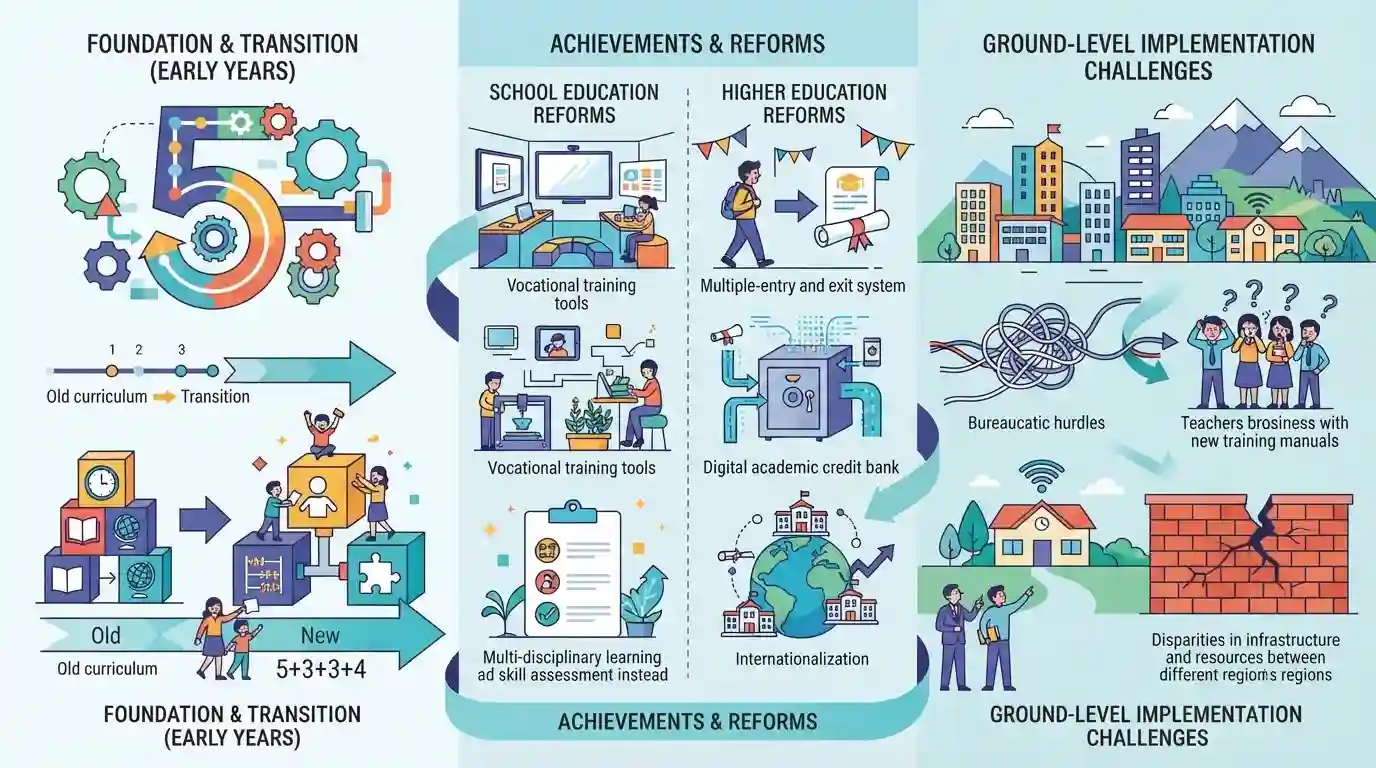
The National Education Policy 2020 is the overarching framework guiding India's educational transformation. Assessing its five-year transition is crucial for analyzing policy outcomes, structural reforms in school and higher education, and alignment with Sustainable Development Goal 4 (SDG 4).
સારાંશ
An evaluation of the implementation and transition of the National Education Policy (NEP) over its first five years, highlighting structural reforms in school and higher education, achievements, and persistent ground-level implementation challenges.
મુખ્ય મુદ્દા
- The National Education Policy (NEP) marks five years of transition, assessing changes across school and higher education systems in India.
- Key structural shifts include the 5+3+3+4 pedagogical design, foundational literacy and numeracy (FLN) missions, and the integration of early childhood care.
- Higher education reforms focus on multidisciplinary education, flexibility via the Academic Bank of Credits (ABC), internationalisation, and the restructuring of regulatory frameworks.
- Challenges remain regarding infrastructure, teacher training, uniform implementation across states, and resource allocation.
મહત્વપૂર્ણ શબ્દો
National Education Policy (NEP) 2020

India's comprehensive framework for education reform, replacing the 1986 policy. It introduces structural shifts like the 5+3+3+4 school model, multidisciplinary higher education, and an emphasis on foundational literacy and numeracy.
UPSC context
Crucial for GS Paper II (Social Sector, Human Resources, Education policies). Frequently tested regarding structural changes, federal implications, and implementation challenges.
Sustainable Development Goal 4 (SDG 4)
The United Nations Sustainable Development Goal dedicated to education, aiming to ensure inclusive and equitable quality education and promote lifelong learning opportunities for all by 2030.
UPSC context
Relevant for GS Paper II and Prelims. Tests India's international commitments to human capital development, universal access, and educational equity.
પ્રિલિમ્સ ટ્રેપ
The NEP 2020 replaces compulsory schooling age brackets or makes secondary education legally enforceable under Article 21A.
NEP 2020 replaces the 10+2 system with 5+3+3+4, but schooling is still compulsory under Article 21A for ages 6-14; the policy extends coverage downwards to age 3 via ECCE.
સંલગ્ન સ્થિર ખ્યાલો
What are the core structural pillars and targets of the National Education Policy 2020?
- Pedagogical Structure: Replaces the 10+2 structure with a 5+3+3+4 design covering ages 3 to 18, integrating Early Childhood Care and Education (ECCE).
- FLN Target: Aims to achieve universal foundational literacy and numeracy in primary school by 2025 through the NIPUN Bharat mission.
- GDP Target: Reiterates the long-standing national goal of public spending on education reaching 6 percent of the Gross Domestic Product.
- Higher Ed Flexibility: Introduces the Academic Bank of Credits (ABC) to facilitate multiple entry and exit points in higher education.
આંતર-વિષય પેટર્ન
Education Policy + SDG 4 Human Capital
NEP 2020 mandates foundational literacy and numeracy as a national mission, directly operationalising SDG 4 targets for inclusive human capital development.
Structural School Reform + Demographic Dividend
The 5+3+3+4 design and Academic Bank of Credits shift the focus from rote learning to federal skill-building and employability.

NEP 2020 structural pillars (5+3+3+4, ABC, ECCE) will feature in GS-II governance/social sector questions with federal implementation hurdles.
સંલગ્ન PYQ · 2
સંલગ્ન PYQ · 2
- 2020MainsGS2
National Education Policy 2020 is in conformity with the Sustainable Development Goal-4 (2030). It intends to restructure and reorient education system in India. Critically examine the statement.
- 2023MainsGS2
Skill development programmes have succeeded in increasing human resources supply to various sectors. In the context of the statement analyse the linkages between education, skill and employment.
