Pandemic Crisis Management and Public Health Vulnerabilities
Source:Indian Express ↗
Why It Matters
A critical evaluation of pandemic management directly tackles core UPSC themes in GS Paper II (Health, Governance, Federalism) and GS Paper III (Disaster Management). It trains aspirants to look beyond the immediate crisis and analyze long-term policy impacts, institutional capacity, and the State's role in safeguarding vulnerable populations.
Summary
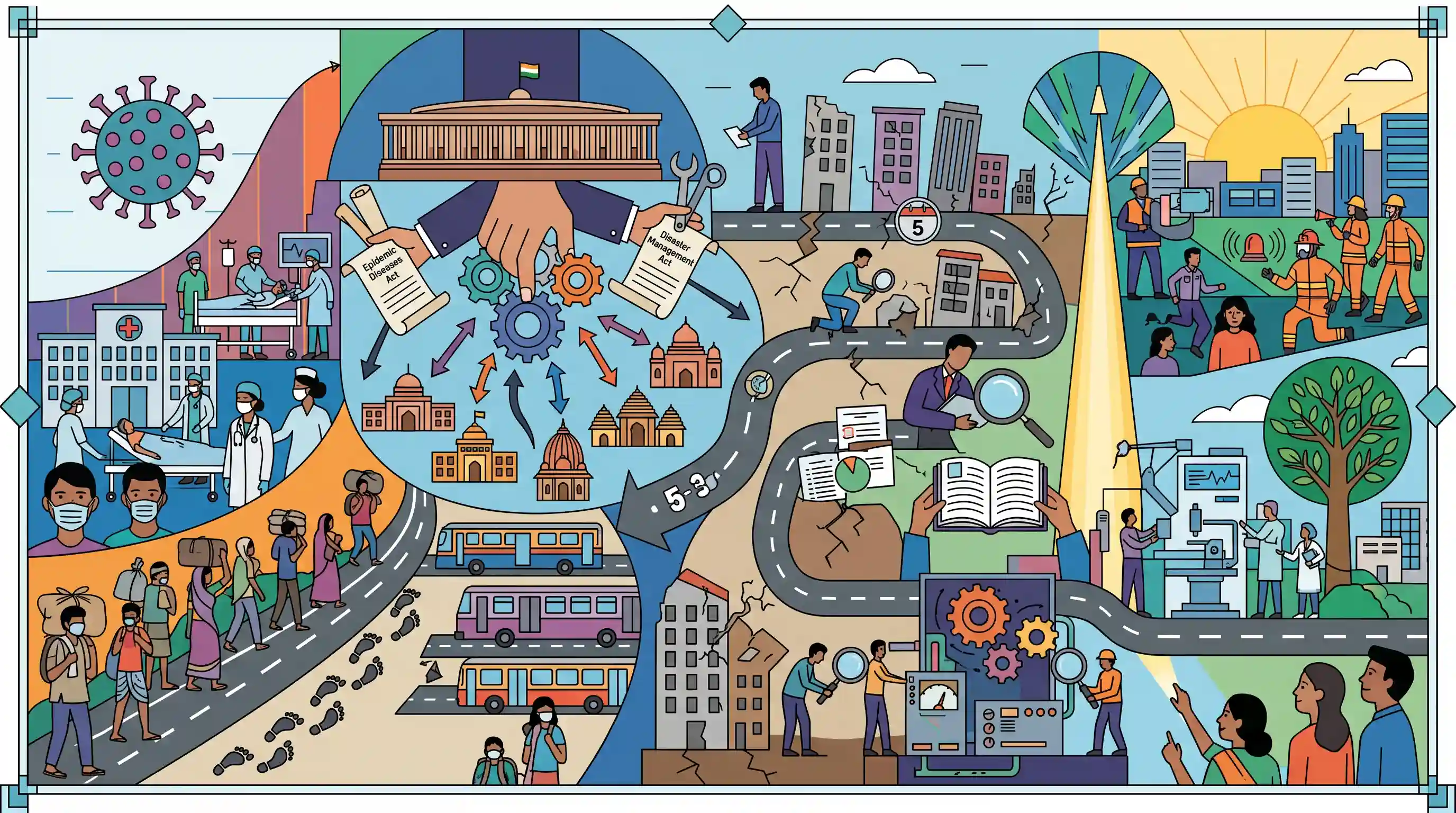
Five years post-COVID-19, this opinion piece serves as a critical retrospective evaluating India's management of the pandemic crisis. It raises fundamental questions about the systemic vulnerabilities exposed during the period, spanning from the inadequacies of the public health infrastructure to the socio-economic devastation faced by marginalized communities like migrant workers. The article emphasizes the necessity of scrutinizing governance frameworks—such as the centralizing application of the Epidemic Diseases Act and the Disaster Management Act—and underscores the importance of transparency, accountability, and strengthened state capacity in healthcare to better prepare for future emergencies.
Key Points
- The five-year retrospective of the COVID-19 pandemic requires an honest assessment of India's crisis response, public health infrastructure, and governance paradigms.
- The pandemic exposed deep structural flaws in public healthcare, underscoring the urgent need for robust State intervention rather than relying heavily on marketized health systems.
- The crisis highlighted centralizing tendencies in disaster management, utilizing colonial-era laws like the Epidemic Diseases Act of 1897 alongside the Disaster Management Act of 2005, which challenged federal cooperation.
- Socio-economic impacts disproportionately hit vulnerable populations, especially migrant workers and the unorganized sector, revealing glaring gaps in social safety nets.
- There remains an ongoing need for accountability, data transparency, and institutional reform to ensure preparedness for future public health emergencies.
Important Terms
Epidemic Diseases Act, 1897

A colonial-era law providing the government extraordinary powers to restrict movement and implement measures to prevent the spread of dangerous epidemic diseases.
UPSC context
GS-II (Governance). Tests understanding of legal frameworks for health and evolution of colonial laws in modern crises.
Disaster Management Act, 2005
Legislation providing the legal framework for managing disasters through institutional mechanisms like the National Disaster Management Authority (NDMA) and the National Executive Committee.
UPSC context
GS-III (Disaster Management). Analyzes administrative responses and center-state power dynamics during national emergencies.
Indian Council of Medical Research (ICMR)
India's apex body for formulating and promoting biomedical research, functioning under the Department of Health Research within the Ministry of Health and Family Welfare.
UPSC context
GS-II (Statutory Bodies/Health). Tests awareness of the institutional role in vaccine development and evidence-based policy.
Public Health Infrastructure
The network of facilities (PHCs, CHCs), medical personnel, and diagnostic systems required to deliver health services to the population.
UPSC context
GS-II (Issues relating to Health). Essential for evaluating structural gaps and the need for universal health coverage.
State Capacity
The professional, financial, and organizational ability of a government to effectively implement policies and provide essential public goods like healthcare.
UPSC context
GS-II (Governance). Fundamental for analyzing the gap between legislative intent and ground-level execution in social sectors.
Cooperative Federalism
A constitutional model where the center and states work together, often strained by centralizing mandates under the Disaster Management Act during crises.
UPSC context
GS-II (Federal Structure). Tests understanding of power-sharing and the friction between central authority and state-led health responses.
Prelims Trap
"Public health is listed under the Concurrent List of the Seventh Schedule to allow both Centre and States to manage pandemics."
Public health and sanitation is strictly a State List subject (Entry 6). The Centre intervened during COVID-19 by leveraging the Disaster Management Act, 2005, and the Epidemic Diseases Act.
Static Concepts Connected
What are the key differences between the Epidemic Diseases Act, 1897 and the DMA, 2005?
- Scope and Origin: EDA 1897 is a colonial-era law strictly for disease containment. DMA 2005 provides a comprehensive, modern framework for multi-hazard disaster mitigation and response.
- Institutional Setup: EDA lacks a structured hierarchy, merely delegating powers. DMA establishes a rigid, top-down institutional mechanism via NDMA, SDMA, and DDMA.
- Penalty Provisions: Both rely on Section 188 of the IPC for non-compliance, but DMA has specific extra clauses penalizing false warnings and misappropriation of funds.
How does the Seventh Schedule distribute legislative powers for public health and disaster management?
- State List: Entry 6 explicitly places "Public health and sanitation; hospitals and dispensaries" strictly under the jurisdiction of the state legislatures.
- Concurrent List: Entry 29 permits joint jurisdiction over preventing the inter-state spread of infectious diseases. Disaster Management itself is largely legislated via concurrent or residuary powers.
Cross-Topic Patterns
Centralization via Disaster Laws
The pandemic highlighted asymmetrical federalism. The Centre used the DMA 2005 to issue binding lockdown directives on a State subject (Public Health), sparking ongoing debates regarding executive overreach.
Pandemic catalyst for informal sector mapping
The mass exodus of migrant workers exposed deep social security gaps, directly accelerating structural welfare mapping like the e-Shram portal and the One Nation One Ration Card (ONORC) scheme.

Expect a Mains question evaluating the adequacy of the Disaster Management Act 2005 for biological disasters vs federal autonomy.
Linked PYQs · 4
Linked PYQs · 4
- 2024MainsGS2
In a crucial domain like the public healthcare system the Indian State should play a vital role to contain the adverse impact of marketisation of the system. Suggest some measures through which the State can enhance the reach of public healthcare at the grassroots level.
- 2020MainsGS2
Indian Constitution exhibits centralising tendencies to maintain unity and integrity of the nation. Elucidate in the perspective of the Epidemic Diseases Act, 1897; The Disaster Management Act, 2005 and recently passed Farm Acts.
- 2020MainsGS2
In order to enhance the prospects of social development, sound and adequate health care policies are needed particularly in the fields of geriatric and maternal health care. Discuss.
- 2020MainsGS3
Discuss the recent measures initiated in disaster management by the Government of India departing from the earlier reactive approach.
