Bangladesh Election Results and Strategic Implications for India
Source:The Hindu ↗
Why It Matters
Political transitions in neighboring countries directly impact India's regional security, border management, and foreign policy. Understanding the new political landscape in Bangladesh is crucial for analyzing India's 'Neighbourhood First' policy and tackling cross-border issues like immigration, security, and economic cooperation.
Summary
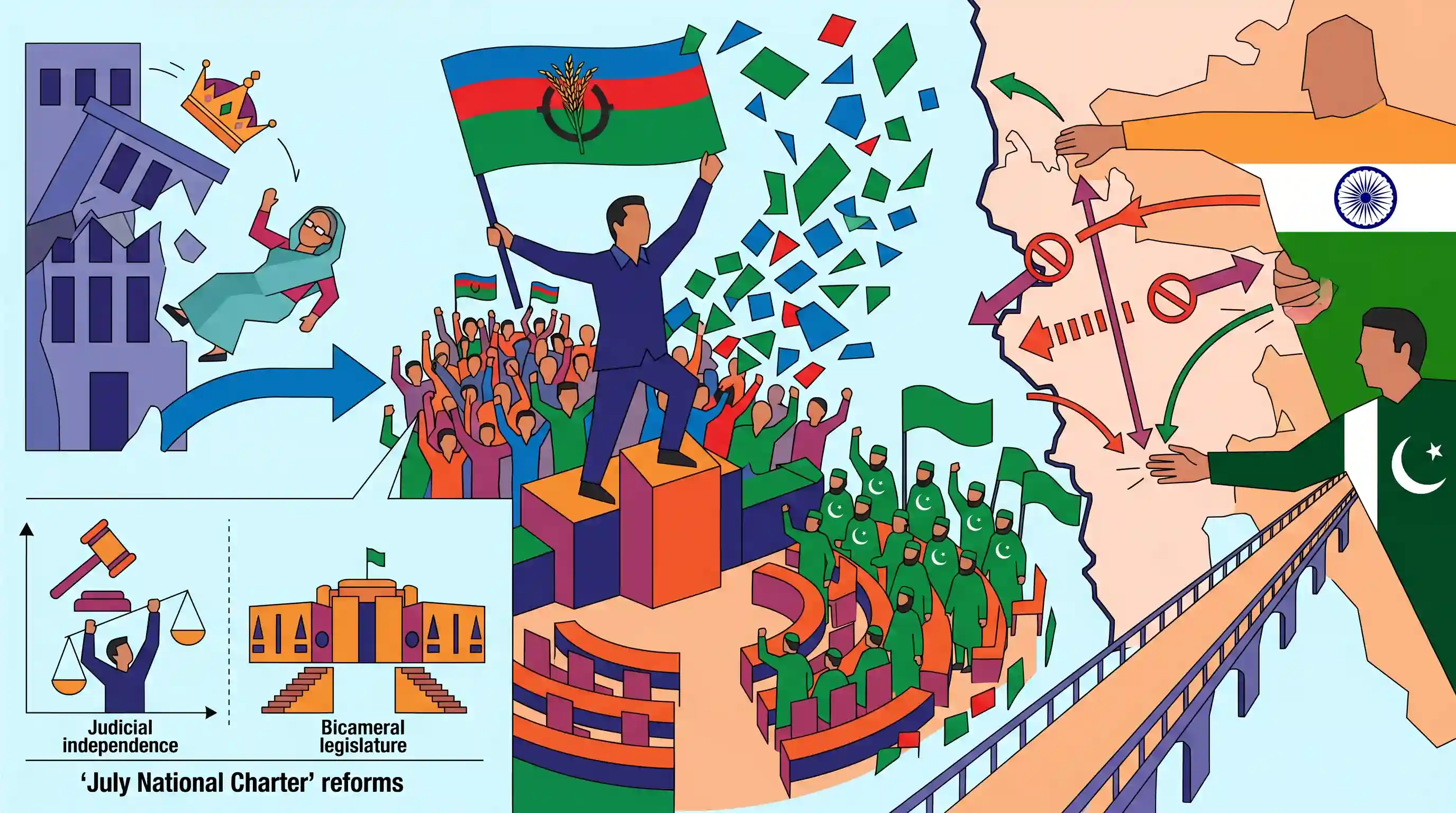
The recent Bangladesh national elections, the first since the fall of Sheikh Hasina in 2024, delivered a sweeping mandate for Tarique Rahman's Bangladesh Nationalist Party (BNP). The electorate largely endorsed the 'July National Charter' aiming for structural reforms like judicial independence and a bicameral legislature. A significant development was the political resurgence of Jamaat-e-Islami, which won 68 seats after allying with the newly formed National Citizen Party (NCP), though the NCP itself performed poorly. For India, the transition demands a strategic reset in bilateral relations to navigate the deep-seated anti-India sentiment in Bangladesh and growing regional competition from Pakistan.
Key Points
- The Bangladesh Nationalist Party (BNP) secured a decisive victory in the first national election since Sheikh Hasina's ouster, endorsing the July National Charter's structural reforms.
- Jamaat-e-Islami emerged as a powerful political force by securing 68 seats through an alliance with the National Citizen Party (NCP).
- The NCP, formed by leaders of the anti-Hasina student movement, underperformed due to internal contradictions and backlash over its alliance with Jamaat.
- The new government faces massive challenges, including economic recovery, checking the rise of radical elements, and overcoming the BNP's past reputation for political violence.
- India faces a critical need to reset bilateral ties with Dhaka to counter deepening anti-India sentiment and expanding Pakistani influence in Bangladesh.
Important Terms
July National Charter

A 2025 constitutional reform framework in Bangladesh, endorsed by a 2026 referendum, proposing structural changes like prime ministerial term limits, a bicameral legislature, and enhanced judicial independence to prevent authoritarianism.
UPSC context
GS Paper II (International Relations). Tests knowledge of constitutional transitions in the neighborhood and their impact on democratic stability and India’s interests.
Bangladesh Nationalist Party (BNP)
A major center-right political party in Bangladesh founded in 1978. Led by Tarique Rahman, it secured a landslide victory in the 2026 elections, ending over 15 years of Awami League dominance.
UPSC context
GS Paper II (India and its neighborhood). Important for analyzing shifts in bilateral diplomacy, security cooperation, and the "Neighbourhood First" policy.
Jamaat-e-Islami
A prominent Islamist political party in Bangladesh that emerged as the main opposition after winning 68 seats in the 2026 elections, following the lifting of a decade-long ban on its activities.
UPSC context
GS Paper II & III. Relevant for assessing the rise of religious-political groups in South Asia and their implications for regional security and secularism.
National Citizen Party (NCP)
Bangladesh’s first student-led political party, established in 2025 by leaders of the July 2024 uprising. It advocates for anti-fascism and "Second Republic" reforms but had a limited performance in the 2026 elections.
UPSC context
GS Paper II. Tests awareness of emerging political movements and youth-driven democratic shifts in India’s immediate neighborhood.
Prelims Trap
The 'July National Charter' is a bilateral border management framework between India and Bangladesh.
The 'July National Charter' is a domestic reform roadmap pushed by Bangladeshi citizens after the 2024 protests, not a bilateral agreement with India.
Static Concepts Connected
What are the key security paradigms of the India-Bangladesh border?
- Longest boundary: At 4,096 km, it is India's longest international land boundary, primarily guarded by the Border Security Force (BSF).
- Porous terrain: Riverine stretches, dense settlements, and shifting topography complicate fencing, facilitating illegal migration, cattle smuggling, and human trafficking.
- Insurgent havens: North-East insurgent groups have historically exploited the porous border for sanctuary, making Dhaka's political regime directly tied to India's internal security.
What are the core tenets of India's 'Neighbourhood First' Policy?
- Gujral Doctrine: Anchors the policy through non-reciprocal relations, offering unilateral economic, trade, and transit concessions to smaller neighbours.
- Connectivity focus: Prioritizes physical infrastructure, inland waterways, and power grid integration to deepen South Asian economic interdependence.
- Security synergy: Ensures neighbouring territories are not utilized for anti-India activities, demanding constant diplomatic recalibration during political transitions.
Cross-Topic Patterns
Regime change & internal security
The rise of Jamaat-e-Islami links GS2 foreign policy with GS3 internal security, focusing on border management, illegal migration, and potential safe-havens for northeast Indian insurgents.
Geoeconomics and transit diplomacy
Anti-India sentiment threatens crucial bilateral connectivity projects, potentially offering a strategic vacuum for China and Pakistan to expand their geoeconomic footprint in the Bay of Bengal region.

Expect a GS2 Mains question linking Bangladesh's regime change to India's 'Neighbourhood First' limitations and shifting border security.
Linked PYQs · 4
Linked PYQs · 4
- 2022MainsGS2
India is an age-old friend of Sri Lanka.’ Discuss India's role in the recent crisis in Sri Lanka in the light of the preceding statement.
- 2024MainsGS2
Discuss the geopolitical and geostrategic importance of Maldives for India with a focus on global trade and energy flows. Further also discuss how this relationship affects India's maritime security and regional stability amidst international competition ?
- 2020MainsGS3
Analyze internal security threats and transborder crimes along Myanmar, Bangladesh and Pakistan borders including Line of Control (LoC). Also discuss the role played by various security forces in this regard.
- 2020PrelimsGS1
Consider the following statements: 1. The value of Indo-Sri Lanka trade has consistently increased in the last decade. 2. "Textile and textile articles" constitute an important item of trade between India and Bangladesh. 3. In the last five years, Nepal has been the largest trading partner of India in South Asia. Which of the statements given above is/are correct?
