Bangladesh Elections Bring BNP Victory and Regional Shifts
Source:The Hindu ↗
Why It Matters
Regime changes in India's immediate neighbourhood significantly impact its 'Neighbourhood First' policy, cross-border security, and regional geostrategic stability. Understanding the new political dynamics in Bangladesh is crucial for analyzing India's foreign policy recalibration and broader geopolitical realignments in South Asia.
Summary
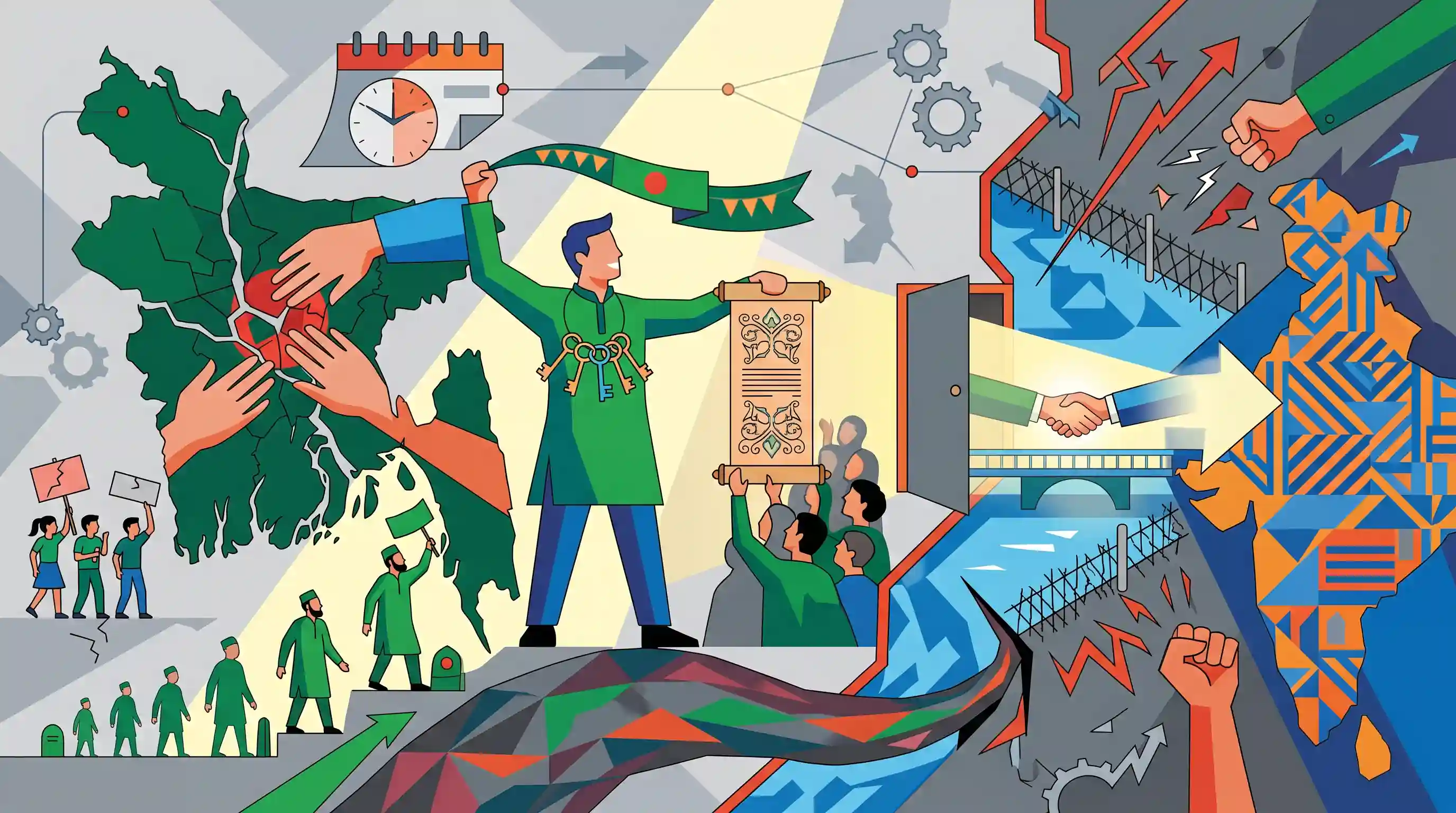
The article details five key takeaways from the February 2026 Bangladesh election, highlighting the decisive victory of Tarique Rahman's BNP and the endorsement of the July National Charter. It notes the political resurgence of Jamaat-e-Islami and the weak electoral performance of the student-led National Citizen Party. The analysis outlines the immediate domestic challenges for the BNP government in healing national divides and highlights the strategic implications for India. For New Delhi, the regime change offers a crucial opportunity to reset strained bilateral relations, provided it can successfully navigate challenges related to cross-border immigration rhetoric, regional anti-India sentiment, and Pakistan's growing influence in Dhaka.
Key Points
- The BNP-led alliance secured a decisive electoral mandate, while voters simultaneously endorsed the July National Charter in a referendum to enact constitutional changes.
- Jamaat-e-Islami emerged as the second-largest political party, successfully consolidating Islamist constituencies following the collapse of the Awami League government.
- The National Citizen Party (NCP), founded by student leaders of the anti-Hasina movement, performed poorly, winning only six seats and facing friction with its alliance partners.
- Tarique Rahman's new BNP government faces significant challenges, including the need to overcome its controversial past legacy of political violence and the creation of the RAB.
- The new government presents India with an opportunity to reset bilateral ties, though it must navigate headwinds like domestic Indian rhetoric on immigration, anti-India sentiment in Bangladesh, and expanding diplomatic ties between Dhaka and Pakistan.
Important Terms
July National Charter

A 2025 reform agreement between major political parties and the interim government, setting constitutional and administrative changes (e.g., PM term limits) to transition Bangladesh into a 'Second Republic.'
UPSC context
GS II (International Relations/Polity); tests understanding of constitutional transitions and regional stability in India's neighbourhood.
Bangladesh Nationalist Party (BNP)
A major center-right political party in Bangladesh, led by Tarique Rahman, which secured a landslide victory in the 2026 elections after a 20-year absence from power.
UPSC context
GS II (India and Neighbourhood); vital for assessing shifts in bilateral cooperation and strategic interests under a new Dhaka regime.
Jamaat-e-Islami
Bangladesh's largest Islamist party, which emerged as the main parliamentary opposition in 2026 after its legal status was reinstated following years of being banned.
UPSC context
GS II/III (Regional Security); relevant for analyzing the influence of religious-political groups on South Asian security and India's interests.
National Citizen Party (NCP)
Bangladesh's first student-led party, founded in 2025 by leaders of the 2024 'July Uprising' to champion anti-fascist reforms and youth-centric governance.
UPSC context
GS II (International Relations); examines the impact of youth-led civil society movements on democratic transitions in the neighbourhood.
Awami League
The long-dominant secular party of ousted PM Sheikh Hasina, which was barred from participating in the 2026 elections following the 2024 mass uprising.
UPSC context
GS II (India and Neighbourhood); critical for historical context of India-Bangladesh ties and the challenges of regional regime change.
Rapid Action Battalion (RAB)
An elite paramilitary unit of the Bangladesh Police that faced international scrutiny for human rights abuses during the Awami League's administration.
UPSC context
GS III (Security Challenges); tests knowledge of human rights, internal security, and law enforcement agencies in cross-border contexts.
Prelims Trap
The student-led National Citizen Party won a decisive mandate to form the new Bangladesh government.
While the student movement spearheaded the ouster of Sheikh Hasina, the traditional opposition party (BNP) actually won the decisive mandate in the 2026 elections.
Static Concepts Connected
What are the key unresolved issues in India-Bangladesh relations?
- Teesta River Water: Stalled agreement on sharing waters of the Teesta, crucial for northern Bangladesh and West Bengal.
- Border Management: Persistent friction over illegal immigration, cattle smuggling, and BSF shootings at the porous border.
- China's Footprint: Growing Chinese investments in Bangladesh's infrastructure and defense systems through the Belt and Road Initiative.
Does the Indian Constitution allow for amendments via a national referendum?
- No Referendum Provision: Unlike Bangladesh's "July National Charter" vote, Article 368 of the Indian Constitution does not provide for a direct citizen referendum.
- Parliamentary Majority: Amendments strictly require special majorities in Parliament, and ratification by half the states for federal provisions.
Cross-Topic Patterns
Border Security + Internal Security
Regime changes in neighboring countries directly impact India's border management, necessitating policy shifts by the BSF and MHA regarding illegal immigration, border fencing, and cross-border river water sharing.
Pakistan's influence + Neighborhood First
Pakistan's growing diplomatic footprint in Dhaka under the BNP challenges India's "Neighborhood First" policy and requires a strategic recalibration of sub-regional groupings like BIMSTEC.

Expect a GS-2 Mains question linking regime changes in South Asia (Bangladesh, Maldives) to the challenges of India's Neighborhood First.
Linked PYQs · 3
Linked PYQs · 3
- 2022MainsGS2
Do you think that BIMSTEC is a parallel organisation like the SAARC ? What are the similarities and dissimilarities between the two ? How are Indian foreign policy objectives realized by forming this new organisation?
- 2015MainsGS2
Project 'Mausam' is considered a unique foreign policy initiative of the Indian Government to improve relationship with its neighbours. Does the project have a strategic dimension? Discuss.
- 2016MainsGS3
Border management is a complex task due to difficult terrain and hostile relations with some countries. Elucidate the challenges and strategies for effective border management.
