Centres of Excellence for Five Classical Languages
Source:The Hindu ↗
આ શા માટે મહત્વનું છે
Important for UPSC Prelims regarding criteria, lists, and institutional setups associated with Classical Languages in India.
સારાંશ
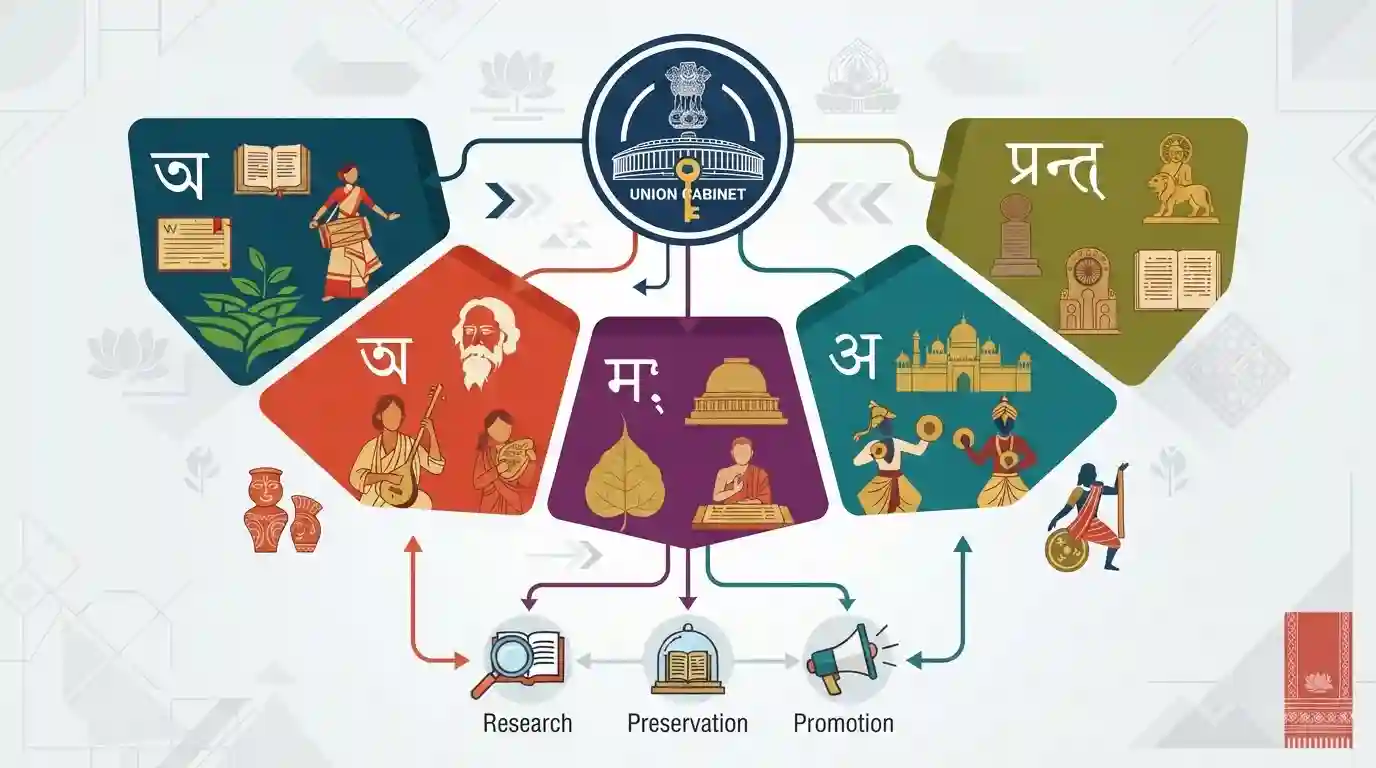
The Union Cabinet has approved the setting up of Centres of Excellence for five classical languages — Assamese, Bengali, Pali, Marathi, and Prakrit — to foster research, preservation, and promotion of their ancient literature and linguistic history.
મુખ્ય મુદ્દા
- The Union Cabinet approved the establishment of Centres of Excellence for five classical languages: Assamese, Bengali, Pali, Marathi, and Prakrit.
- This expands the government's initiative to preserve, promote, and research India's rich linguistic heritage and ancient literary traditions.
- Classical languages receive special funding and institutional support for research, digitization of manuscripts, and promotion of academic study.
મહત્વપૂર્ણ શબ્દો
Union Cabinet

The supreme executive body of the Indian government, headed by the Prime Minister, responsible for executive decisions, policy formulation, and administrative governance.
UPSC context
UPSC Polity: Tests knowledge of executive governance, decision-making procedures, and the constitutional role of the Union Cabinet.
Ministry of Education
The central government ministry responsible for formulating national education policy, regulating higher education, and promoting educational infrastructure and linguistic research across India.
UPSC context
UPSC Governance / Social Justice: Tests understanding of institutional mechanisms for education policy implementation and cultural preservation.
Classical Languages of India
Languages recognized by the Government of India for their antiquity, distinct literary tradition, and ancient texts, currently totaling 11 languages after recent additions.
UPSC context
UPSC Art and Culture: Crucial for questions on Indian heritage, linguistic history, and criteria for classical status.
પ્રિલિમ્સ ટ્રેપ
All classical languages in India are automatically included in the Eighth Schedule of the Constitution.
Aspirants often confuse classical language status with Eighth Schedule constitutional recognition or ministry-driven linguistic formulas (like the Three-Language Formula).
સંલગ્ન સ્થિર ખ્યાલો
What are the criteria and constitutional provisions regarding classical languages and the Eighth Schedule in India?
- Antiquity Criteria: High antiquity of early texts/recorded history over a period of 1,500-2,000 years.
- Valuable Heritage: A body of ancient literature/texts considered a heritage by generations of speakers.
- Original Tradition: The literary tradition must be original and not borrowed from another speech community.
- Constitutional Distinction: Eighth Schedule inclusion is distinct; currently, 22 languages are in the Eighth Schedule, while 11 languages hold Classical status.
આંતર-વિષય પેટર્ન
Classical Languages vs. Eighth Schedule Politics
Classical language recognition intersects with Eighth Schedule inclusion demands, creating political and administrative friction between constitutional official languages and heritage designations.
Pali/Prakrit Preservation & Buddhist Diplomacy
Preservation of ancient literary repositories like Pali and Prakrit directly connects with Buddhist circuit tourism and soft-power diplomacy across South and Southeast Asia.

Expect a matching list or multi-statement question on criteria for Classical Language status and the full list of 11 recognized languages.
સંલગ્ન PYQ · 2
સંલગ્ન PYQ · 2
- 2014PrelimsGS1
Consider the following languages: 1. Gujarati 2. Kannada 3. Telugu Which of the above has/have been declared as 'Classical Language/Languages' by the Government?
- 2015PrelimsGS1
Which one of the following was given classical language status recently?
