Bankura Political Violence Triggers Demands for Judicial Inquiry
Source:The Hindu ↗
Why It Matters
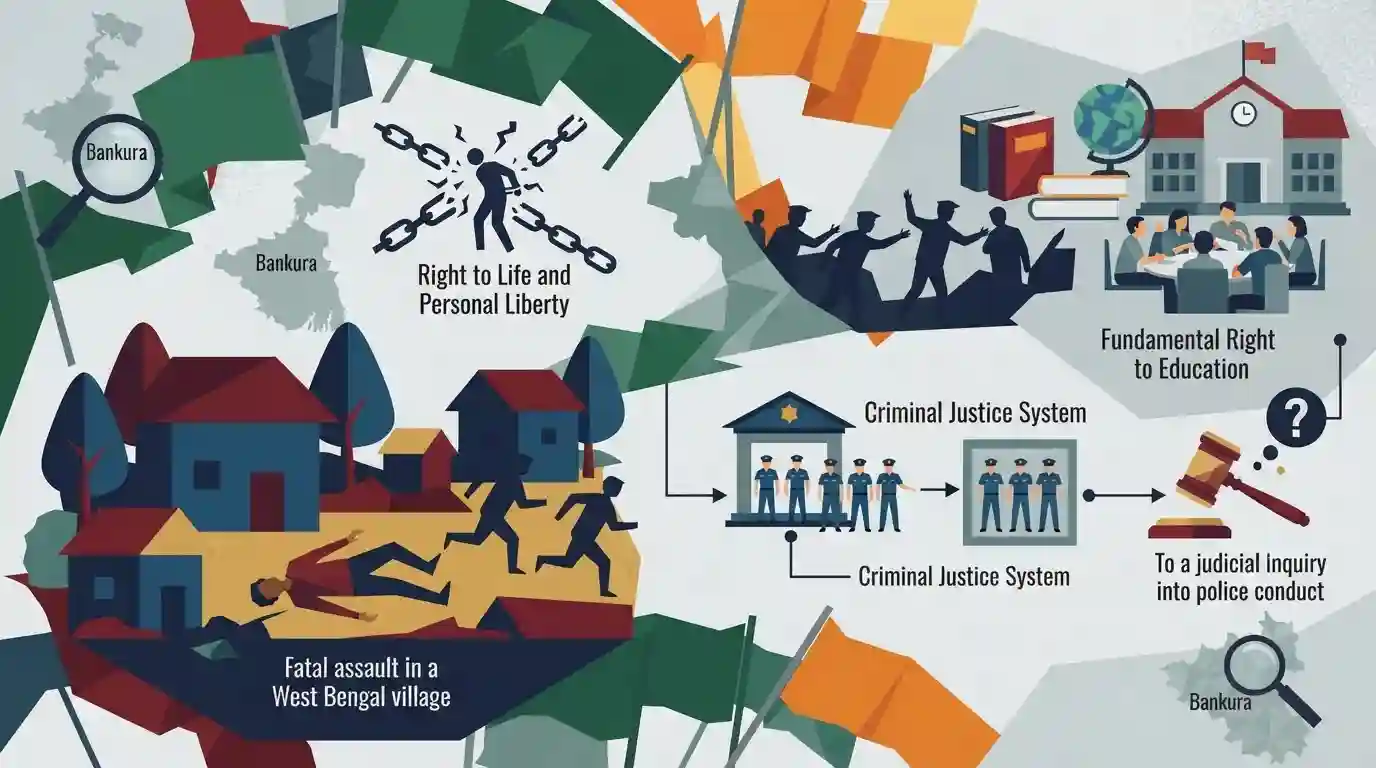
Highlights persistent issues of political violence and law enforcement lapses in West Bengal. It emphasizes constitutional themes surrounding the Right to Life (Article 21), Right to Education, and the role of the judiciary in ensuring police accountability.
Summary
Five more individuals have been arrested in connection with the fatal assault on the father of a Cockroach Janata Party (CJP) activist in West Bengal's Bankura district, bringing the total arrests to eight. The activist was targeted following a local government school inspection as part of an education reform campaign. The incident underscores ongoing political violence in the state, with CJP leadership demanding a judicial inquiry into police conduct and attributing the attack to the ruling BJP, an allegation denied by the Chief Minister.
Key Points
- Eight people have been arrested regarding the fatal assault of Janab Mafik, father of a CJP activist, in Bankura's Indus area.
- The attack occurred after CJP activist Abdul Hafiz inspected a local government school under the party's 'School Thik Karo' campaign.
- CJP delegates demanded an independent judicial investigation into the local police's conduct during the episode and the construction of a world-class school in the deceased's name.
- CJP leadership alleges the involvement of BJP workers, while West Bengal CM Suvendu Adhikari dismissed the allegations, labeling the accused as mere criminals.
Important Terms
School Thik Karo campaign

Launched by the CJP on August 15, 2026, this grassroots campaign empowers citizens to conduct social audits of rural government schools by documenting deficient infrastructure and demanding accountability in public education.
UPSC context
Tests GS Paper II (Social Sector/Education) regarding civil society interventions, public accountability, and social auditing mechanisms.
Cockroach Janata Party (CJP)
A youth-driven satirical political movement established in May 2026. It functions as a powerful pressure group mobilizing young citizens on critical issues like unemployment, educational irregularities, and systemic transparency.
UPSC context
Relevant for GS Paper II (Polity) under the emergence of modern pressure groups, civil society, and digital democracy movements.
Bharatiya Janata Party (BJP)
A major national political party in India that currently forms the central government and serves as the principal opposition force within the political landscape of West Bengal.
UPSC context
Vital for GS Paper II questions on India's party system, political violence, and national vs. state political dynamics.
Trinamool Congress
Founded by Mamata Banerjee in 1998, the All India Trinamool Congress is the dominant regional political party and the current ruling government in West Bengal.
UPSC context
Crucial for WBCS GS Paper II (State Polity) exploring regional parties, state-level governance, and local political developments.
Prelims Trap
The Centre can unilaterally initiate a judicial or CBI inquiry into political violence in a state.
Police and Public Order are strictly State subjects under the 7th Schedule. Central agencies like CBI require state consent or a High Court/Supreme Court directive to investigate state political violence.
Static Concepts Connected
How is the Right to Education structured in the Indian Constitution?
- 86th Amendment Act: Inserted Article 21A, making education a Fundamental Right for children aged 6 to 14 years.
- DPSP Shift: Amended Article 45 to direct the state to provide early childhood care and education for children until they complete six years of age.
- Fundamental Duty: Added Article 51A(k) requiring parents/guardians to provide educational opportunities to their children.
What is the mandate of the State Human Rights Commission (SHRC)?
- Statutory Body: Established under the Protection of Human Rights Act, 1993, to probe rights violations related to subjects in the State and Concurrent lists.
- Appointment: Chairperson and members are appointed by the Governor on the recommendation of a committee headed by the Chief Minister.
- Recommendatory Nature: It has the powers of a civil court, but its recommendations are not binding on the state government.
Cross-Topic Patterns
Political Violence & 7th Schedule
Persistent political violence in West Bengal consistently brings the 7th Schedule into focus, highlighting 'Police' and 'Public Order' as exclusive responsibilities of the State government.
Grassroots Education Audits & RTE
Activism around school infrastructure connects directly to the statutory guarantees under the RTE Act, 2009, making state inaction a justiciable violation of Article 21A.

Expect MCQs blending Article 21 rights with 7th Schedule jurisdiction (Police as a State subject) and the recommendatory nature of SHRCs.
Linked PYQs · 3
Linked PYQs · 3
- 2021WBCS_PRELIMSGS1
Article 21 of the Indian Constitution ensues
- 2022WBCS_PRELIMSGS1
Who is the protector of the Fundamental Rights of a citizen?
- 2024WBCS_PRELIMSGS1
Which Fundamental Rights cannot be suspended during a National Emergency under Article 359?
