Judicial Appointments and Sanctioned Strength of Supreme Court
Source:The Hindu ↗
Why It Matters
The appointment of Supreme Court judges and the methodology of determining court strength are recurring themes in UPSC Polity. The usage of an Ordinance to increase the sanctioned strength highlights a specific constitutional mechanism (Article 123) intersecting with the judiciary framework, which is crucial for GS2 and Prelims questions on the Collegium system and Constitutional articles.
Summary
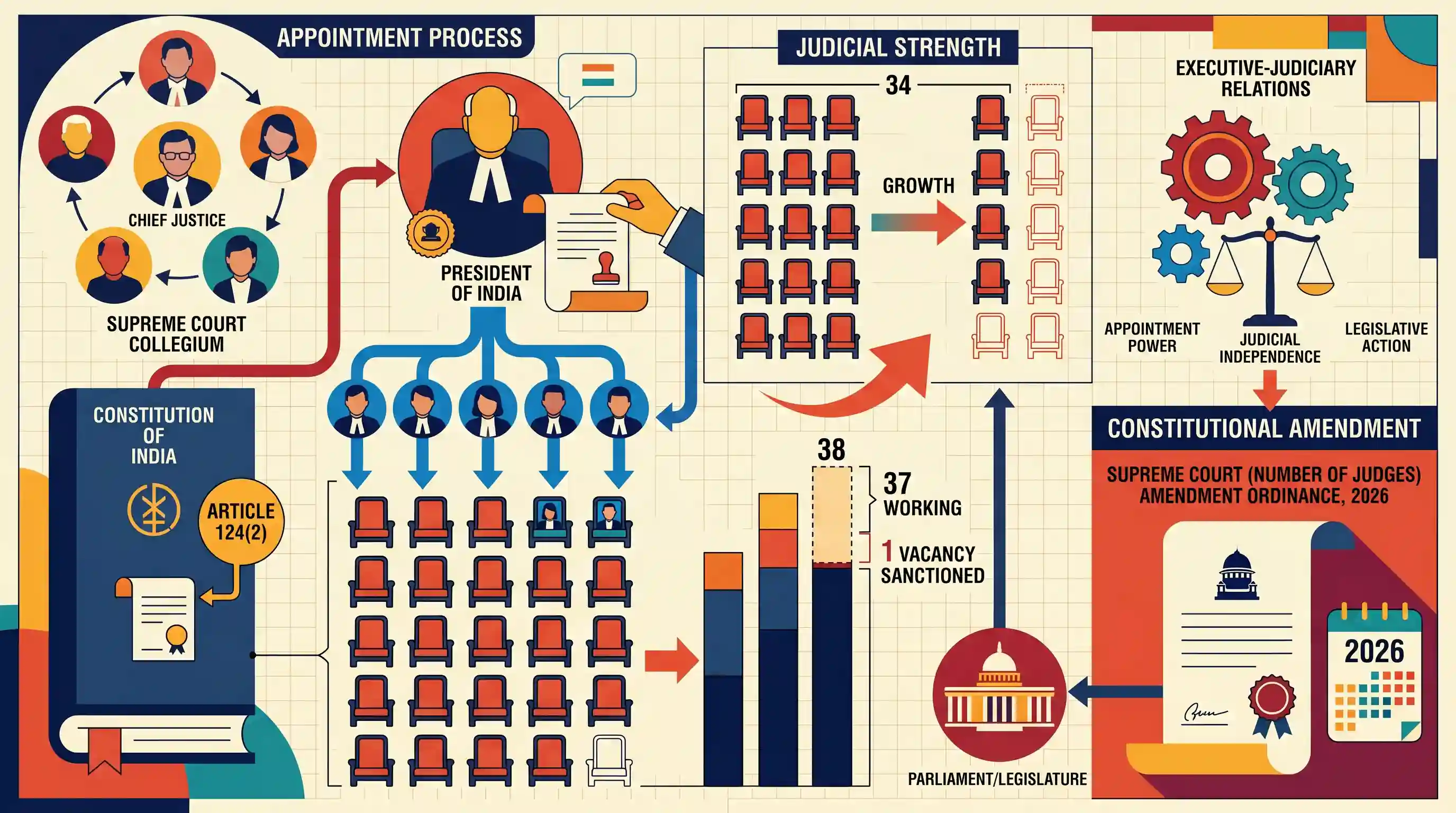
Five new judges have been appointed to the Supreme Court of India by the President under Article 124(2) of the Constitution, acting on the recommendations of the Supreme Court Collegium. This development brings the working strength of the apex court to 37, closely aligning with its newly revised sanctioned strength of 38 judges. The increase in the sanctioned strength from 34 to 38 was recently implemented via the Supreme Court (Number of Judges) Amendment Ordinance, 2026.
Key Points
- The President of India appointed five new judges to the Supreme Court, elevating its working strength to 37 judges.
- The sanctioned strength of the Supreme Court was recently increased from 34 to 38 through the Supreme Court (Number of Judges) Amendment Ordinance, 2026.
- Supreme Court judges are appointed by the President under Article 124(2) of the Constitution following recommendations by the Collegium.
Important Terms
Supreme Court Collegium

A judicial mechanism where the Chief Justice of India and four senior-most judges recommend appointments to the higher judiciary. It evolved through the 'Three Judges Cases' to ensure judicial independence.
UPSC context
GS-II: Separation of Powers; tests understanding of the judicial appointment process versus executive primacy.
Article 124(2) of the Constitution
The constitutional provision mandating that every Supreme Court judge be appointed by the President. Interpretation of its 'consultation' clause established the Collegium system's binding nature.
UPSC context
GS-II: Constitutional Provisions; fundamental for questions regarding the structure and independence of the judiciary.
Supreme Court (Number of Judges) Amendment Ordinance, 2026
A 2026 legislative measure (amending the 1956 Act) that raised the Supreme Court's maximum judge capacity from 34 to 38 to tackle mounting case pendency.
UPSC context
GS-II: Parliament; tests knowledge of legislative tools used to manage judicial capacity and workload.
Supreme Court of India
The highest judicial forum and final court of appeal under the Constitution of India, acting as the ultimate interpreter and guardian of constitutional values.
UPSC context
GS-II: Judiciary; tests knowledge of the apex court's jurisdiction, powers, and constitutional role.
Law Ministry
The Union ministry (specifically the Department of Justice) responsible for the administrative processing of judicial appointments, legislative drafting, and legal advisory to the government.
UPSC context
GS-II: Government Policies and Interventions; focuses on the executive's administrative role in judicial functioning.
Prelims Trap
"The President of India determines the sanctioned maximum strength of the Supreme Court."
Article 124(1) vests the power to alter the number of SC judges in Parliament by law. The President only fixes the strength of High Courts.
Static Concepts Connected
How did the Supreme Court Collegium system evolve through judicial pronouncements?
- First Judges (1981): Ruled that "consultation" does not mean "concurrence," giving the executive primacy in judicial appointments.
- Second Judges (1993): Overruled the 1981 verdict, establishing that the CJI's advice (consulting two senior-most judges) is binding.
- Third Judges (1998): Expanded the Supreme Court Collegium to a five-member body comprising the CJI and four senior-most judges.
Who dictates the sanctioned strength of the Supreme Court versus High Courts?
- Supreme Court: Under Article 124(1), only Parliament can increase the number of Supreme Court judges by enacting a law.
- High Courts: The Constitution does not specify a maximum strength for High Courts; it is determined by the President based on workload.
Cross-Topic Patterns
Ordinance route for judicial structure
Promulgating an ordinance to increase SC strength emphasizes that Presidential ordinance power (Article 123) is exactly co-extensive with Parliament's legislative competence, even for structural judicial changes.
MoP and Collegium friction
Timely appointments highlight the ongoing Executive-Judiciary tension regarding the finalized Memorandum of Procedure (MoP) for judge elevations, a frequent Mains theme since the NJAC ruling.

Expect a multi-statement question contrasting who fixes the sanctioned strength of the SC (Parliament) versus High Courts (President).
Linked PYQs · 4
Linked PYQs · 4
- 2019PrelimsGS1
Consider the following statements: 1. The 44th Amendment to the Constitution of India introduced an Article placing the election of the Prime Minister beyond judicial review. 2. The Supreme Court of India struck down the 99th Amendment to the Constitution of India as being violative of the independence of judiciary. Which of the statements given above is/are correct?
- 2019PrelimsGS1
Consider the following statements: 1. The motion to impeach a Judge of the Supreme Court of India cannot be rejected by the Speaker of the Lok Sabha as per the Judges (Inquiry) Act, 1968. 2. The Constitution of India defines and gives details of what constitutes 'incapacity and proved misbehaviour' of the Judges of the Supreme Court of India. 3. The details of the process of impeachment of the Judges of the Supreme Court of India are given in the Judges (Inquiry) Act, 1968. 4. If the motion for the impeachment of a Judge is taken up for voting, the law requires the motion to be backed by each House of the Parliament and supported by a majority of total membership of that House and by not less than two-thirds of total members of that House present and voting. Which of the statements given above is/are correct?
- 2021PrelimsGS1
With reference to Indian judiciary, consider the following statements : 1. Any retired judge of the Supreme Court of India can be called back to sit and act as a Supreme Court judge by the Chief Justice of India with prior permission of the President of India. 2. A High Court in India has the power to review its own judgement as the Supreme Court does. Which of the statements given above is/are correct?
- 2019MainsGS2
Do you think that Constitution of India does not accept principle of strict separation of powers rather it is based on the principle of 'checks and balance'? Explain.
