Subordinate Judiciary Career Stagnation and Promotion Bench
Source:The Hindu ↗
Why It Matters
The subordinate judiciary is the backbone of India's legal system. Stagnation in the career progression of lower court judges negatively impacts judicial morale, efficiency, and overall independence. It is highly relevant for GS2 Polity questions on judicial reforms and the functioning of the lower judiciary.
Summary
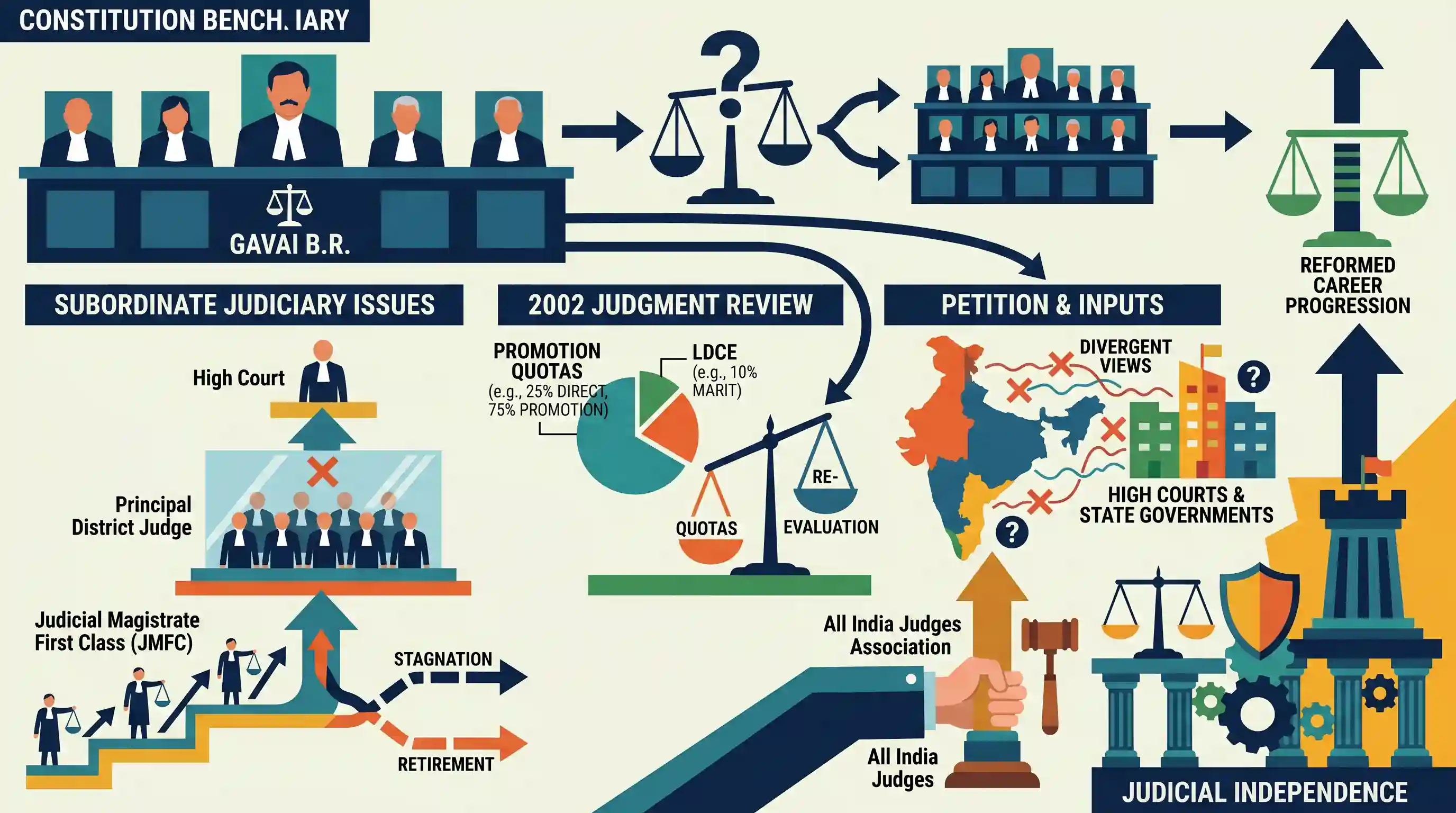
A five-judge Constitution Bench led by CJI B.R. Gavai is considering if the issue of limited promotional avenues for entry-level judicial officers (subordinate judiciary) needs to be referred to a larger bench. The petition by the All India Judges Association highlights the career stagnation of Judicial Magistrates First Class (JMFC), many of whom retire without becoming Principal District Judges. The Court is re-evaluating the promotion quotas established in its 2002 judgment to ensure better career progression amidst divergent views from various High Courts and State governments.
Key Points
- A five-judge Constitution Bench of the Supreme Court is examining whether the issue of stagnant career progression for entry-level judicial officers should be referred to a larger bench.
- Entry-level Judicial Magistrates First Class (JMFC) often retire without reaching the post of Principal District Judge (PDJ) due to systemic bottlenecks.
- The 2002 All India Judges Association judgment had set quotas for filling District Judge vacancies (50% promotion by merit-cum-seniority, 25% limited competitive exams, 25% direct recruitment), which is now being scrutinized for causing stagnation.
- High Courts and State governments hold divergent views on how to reform the promotional avenues and criteria for the subordinate judiciary.
Important Terms
All India Judges Association (AIJA)

A national body representing the interests of judicial officers in the subordinate judiciary, instrumental in filing landmark petitions for uniform service conditions, pay scales, and retirement benefits across India.
UPSC context
GS Paper 2: Judiciary; critical for understanding judicial independence and reforms in service conditions of the lower judiciary.
Subordinate Judiciary
The judicial tier below High Courts (District and Subordinate Courts), primarily governed by Articles 233 to 237, dealing with the majority of grassroots-level litigation in India.
UPSC context
GS Paper 2: Structure, organization and functioning of the Judiciary; tests knowledge of local judicial administration and pendency issues.
Judicial Magistrate First Class (JMFC)
An entry-level judicial officer in the criminal justice system who presides over trials for offenses punishable with up to three years of imprisonment; also known as Civil Judge (Junior Division) on the civil side.
UPSC context
GS Paper 2: Separation of powers; relevant for discussions on career stagnation and recruitment within the judicial hierarchy.
Constitution Bench
A Supreme Court bench comprising at least five judges, convened under Article 145(3) to resolve "substantial questions of law" regarding the interpretation of the Constitution.
UPSC context
GS Paper 2: Constitutional Provisions; tests understanding of the Supreme Court's role in interpreting the Constitution and settling legal conflicts.
Article 233
Constitutional provision governing the appointment of District Judges by the Governor in consultation with the High Court, including quotas for direct recruitment from the Bar and promotion from the service.
UPSC context
GS Paper 2: Indian Constitution; central to debates on judicial appointments, the "Bar quota," and the role of High Courts.
All India Judicial Service (AIJS)
A proposed centralized recruitment system for the lower judiciary on the lines of the IAS/IPS, empowered by Article 312 to ensure merit-based, uniform appointments across states.
UPSC context
GS Paper 2: Judicial Reforms; a recurring theme in mains regarding systemic fixes for vacancy and quality issues in courts.
Prelims Trap
"District Judges are appointed by the Governor on the aid and advice of the State Cabinet."
Article 233 explicitly mandates the Governor to consult the respective High Court for appointing District Judges, making it a judicial rather than purely executive decision.
Static Concepts Connected
How is the district judiciary appointed and controlled constitutionally?
- Article 233 (Appointment): Under Article 233, the Governor appoints District Judges, but must do so in consultation with the respective High Court. Direct recruits require 7 years of legal practice.
- Article 235 (Control): Article 235 vests complete administrative and disciplinary control over district and subordinate courts, including postings and promotions, in the High Court, not the state government.
What mandates the formation of a Constitution Bench?
- Article 145(3): Article 145(3) requires a minimum of five judges to decide cases involving a substantial question of law regarding the interpretation of the Constitution.
- Presidential Reference: A Constitution Bench of at least five judges must also be constituted to hear advisory opinions sought by the President under Article 143.
- Overruling Precedent: A larger bench (e.g., 7 or 9 judges) is convened to review or overrule a prior judgment delivered by a bench of a smaller or equal size.
Cross-Topic Patterns
Stagnation vs All India Judicial Service (AIJS)
Career bottlenecks in the lower judiciary routinely revive GS-2 debates on creating an All India Judicial Service (AIJS) under Article 312 to centralize recruitment and standardize career progression.
Continuing Mandamus beyond environmental law
The SC uses "continuing mandamus" here to systematically reform judicial services over decades, mirroring its long-term monitoring strategy used in environmental governance (e.g., T.N. Godavarman case).

Prelims 2026 will likely test the exact constitutional distinction between Art 233 (appointment) and Art 235 (administrative control).
Linked PYQs · 2
Linked PYQs · 2
- 2021PrelimsGS1
We adopted parliamentary democracy based on the British model, but how does our model differ from that model? 1. As regards legislation, the British Parliament is supreme or sovereign but in India, the power of the Parliament to legislate is limited. 2. In India, matters related to the constitutionality of the Amendment of an Act of the Parliament are referred to the Constitution Bench by the Supreme Court. Select the correct answer using the code given below.
- 2023MainsGS2
“Constitutionally guaranteed judicial independence is a prerequisite of democracy.” Comment.
