Manipur Crisis: Arrests Over Student Assault and Arms Recovery
Source:The Hindu ↗
Why It Matters
The situation in Manipur presents a multidimensional case study for UPSC aspirants covering internal security challenges (GS3), the sociological dynamics of ethnic conflicts in North-East India (GS1), and the constitutional application of President's Rule under Article 356 during internal disturbances (GS2).
Summary
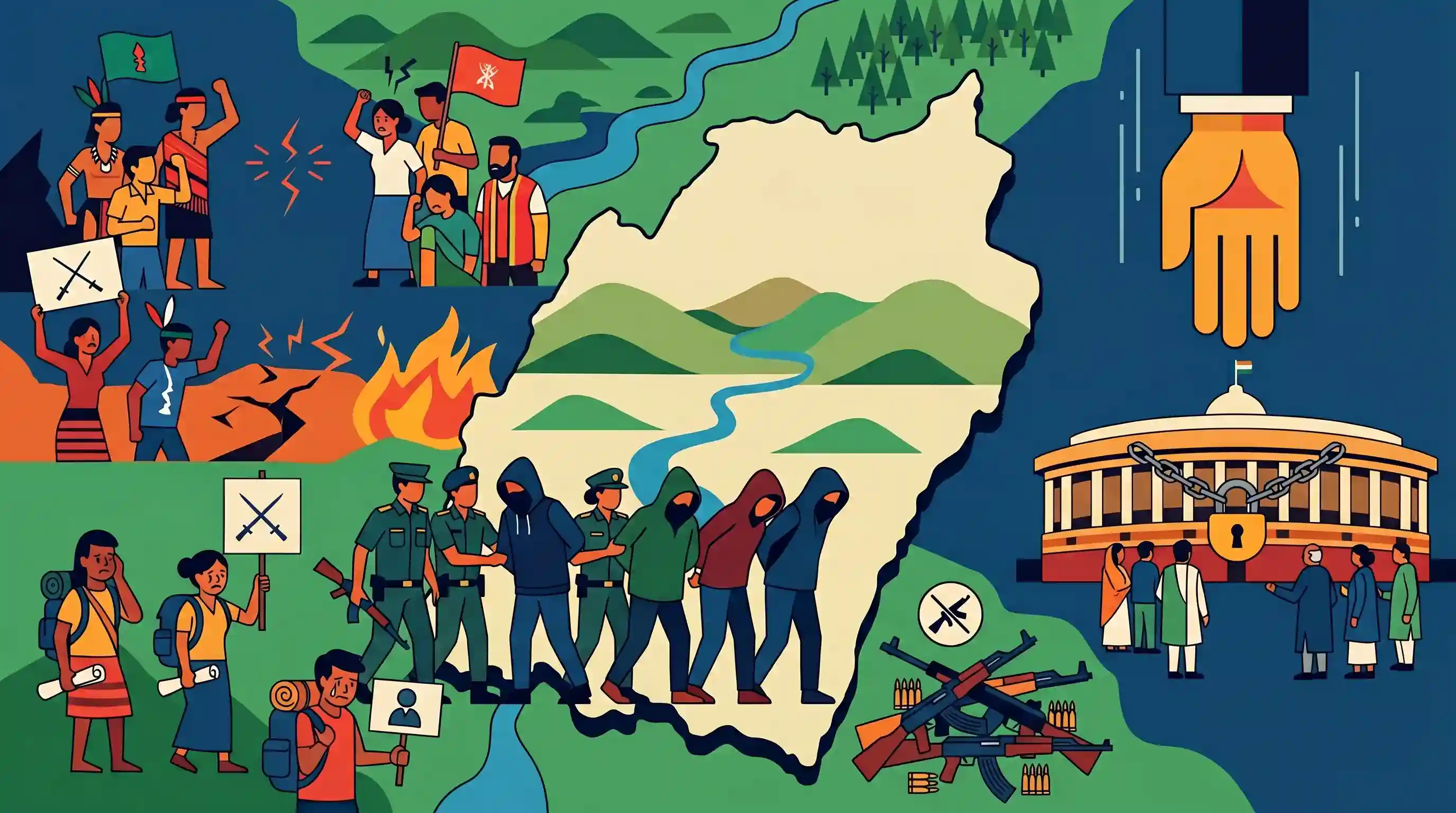
Five individuals affiliated with a militant group were arrested in Manipur for assaulting student leaders of the Monsang Naga tribe, leading to the recovery of illegal automatic weapons. The incident highlights the persistent internal security challenges and ethnic tensions in Manipur, which has been grappling with violence between the Meitei and Kuki-Zo communities since May 2023. Amid the crisis, the state has been placed under President's Rule under Article 356, with the legislative assembly in suspended animation.
Key Points
- Five alleged cadres of a militant outfit were arrested in Kakching district, Manipur, for assaulting four student leaders belonging to the Monsang tribe.
- The police recovered multiple automatic rifles, local weapons, and ammunition from the suspects, underscoring the ongoing proliferation of arms in the region.
- The Monsang tribe is part of the broader Naga community, which has largely stayed out of the ongoing ethnic violence between the valley-based Meitei and hill-based Kuki-Zo groups.
- Manipur has been under President's Rule since September 15, following the resignation of Chief Minister N. Biren Singh, with the State Assembly kept under suspended animation.
Important Terms
Article 356 (President's Rule)

A constitutional provision allowing the President to assume control of a state's administration if the Governor reports that the state government cannot function according to the Constitution.
UPSC context
GS Paper II (Polity); tests understanding of emergency provisions, federalism, and the breakdown of constitutional machinery.
Suspended Animation
A legal status where a State Legislative Assembly is neither dissolved nor functional; it remains 'alive' but loses law-making powers until the proclamation is revoked or approved.
UPSC context
GS Paper II (Polity); tests knowledge of executive-legislative relations during a Constitutional Emergency.
Monsang Naga
A minority Tibeto-Burman Scheduled Tribe primarily inhabiting the Chandel district of Manipur; they have a distinct culture and are traditionally part of the Naga ethnic fold.
UPSC context
GS Paper I (Social Issues) and GS Paper III (Internal Security); relevant for tribal diversity and conflict impact on minorities.
Ethnic Conflict
Violent struggle between distinct groups over identity, political representation, or resources; in Manipur, it primarily involves the Meitei, Kuki-Zo, and Naga communities.
UPSC context
GS Paper III (Internal Security); tests analysis of communal violence and its threat to national integration.
North-East Insurgency
Protracted armed rebellions in India’s Northeast by groups seeking autonomy or secession, often fueled by ethnic grievances, porous borders, and illegal arms trafficking.
UPSC context
GS Paper III (Internal Security); tests understanding of border management and the role of non-state actors in regional instability.
Prelims Trap
"The President can dissolve the State Assembly immediately upon imposing President's Rule under Article 356."
Post S.R. Bommai (1994), the President can only place the Assembly in 'suspended animation'. Dissolution can only occur after Parliament approves the Article 356 proclamation.
Static Concepts Connected
What does 'suspended animation' of a State Assembly mean under Article 356?
- Assembly Status: The State Assembly is not dissolved; MLAs retain their membership, but the assembly cannot meet or hold sessions.
- Legislative Power: The Parliament assumes the power to legislate on state subjects and pass the state budget.
- S.R. Bommai (1994): The Supreme Court ruled that dissolution before parliamentary approval is unconstitutional, mandating suspended animation initially.
How is Manipur's demography geographically distributed among its major ethnic groups?
- Imphal Valley: Occupies roughly 10% of Manipur's landmass but holds the majority of the population, predominantly inhabited by the Meitei community.
- Hill Districts: Comprise roughly 90% of the landmass, predominantly inhabited by recognized Scheduled Tribes, notably the Kuki-Zo and Naga groups.
- Inner Line Permit: Manipur is protected under the ILP regime, which regulates the entry and stay of non-indigenous 'outsiders'.
Cross-Topic Patterns
Internal Security + Border Management
Arms proliferation in Manipur connects directly to porous Myanmar borders, which recently prompted the Union government to suspend the Free Movement Regime (FMR) to curb insurgent logistics.
Article 356 + Tribal Geography
The constitutional breakdown in Manipur ties Article 356 dynamics directly to demands for separate administration by hill tribes, merging static polity with human geography.

Expect a mixed-statement question linking Article 356 'suspended animation' (S.R. Bommai) with Manipur's hill-valley demographics.
Linked PYQs · 2
Linked PYQs · 2
- 2023MainsGS2
Account for the legal and political factors responsible for the reduced frequency of using Article 356 by the Union Governments since mid 1990s.
- 2017MainsGS3
The North-East region of India has been infested with insurgency for a very long time. Analyze the major reasons for the survival of armed insurgency in this region.
