Project Cheetah achieves new milestone with five cubs born at Kuno
Source:Indian Express ↗
Why It Matters
Project Cheetah represents the world's first intercontinental large wild carnivore translocation project. Its progress is a direct indicator of India's capability in ecological restoration and wildlife conservation, making it a highly probable topic for UPSC Prelims and GS3 Environment sections.
Summary
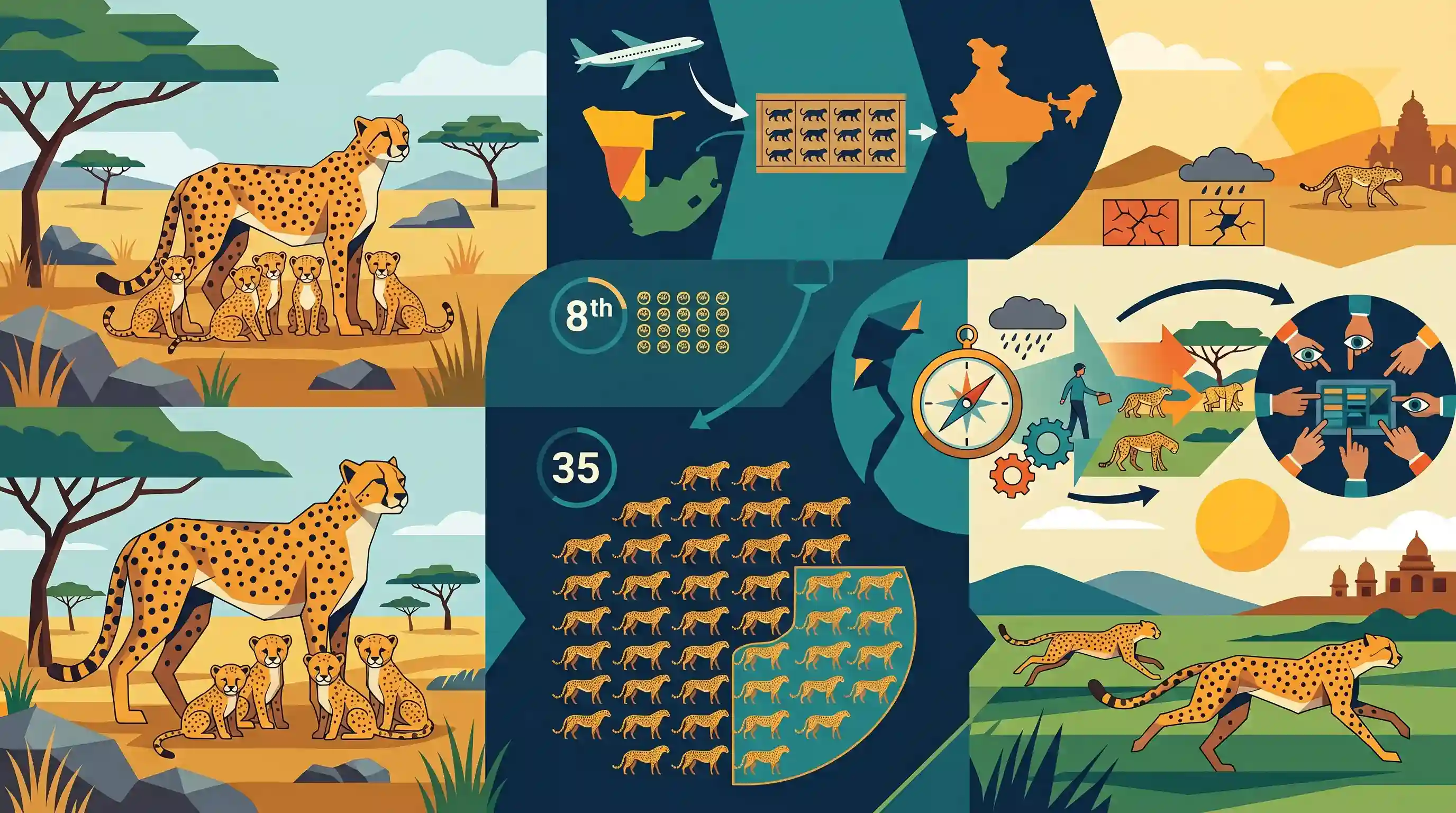
Five cheetah cubs were born to the Namibian cheetah 'Aasha' at Kuno National Park in Madhya Pradesh, bringing India's total cheetah population to 35. This marks the eighth successful litter on Indian soil, elevating the count of Indian-born surviving cubs to 24. Project Cheetah, initiated in 2022 with the translocation of 20 felines from Namibia and South Africa, aims to reintroduce the species after its local extinction. Despite initial setbacks, including adult fatalities from infections, the project is advancing through a phased release strategy guided by the Cheetah Project Steering Committee to ensure the long-term survival of the species in the wild.
Key Points
- Five cubs were born to the Namibian cheetah Aasha at Kuno National Park, increasing the total cheetah population in India to 35.
- The tally of Indian-born surviving cubs has reached 24, marking the eighth successful litter on Indian soil under Project Cheetah.
- Project Cheetah began in 2022 with the intercontinental translocation of 20 cheetahs from Namibia and South Africa to restore the species in India.
- The project faced early challenges such as fatal septicaemia cases in some adults, prompting the Cheetah Project Steering Committee to recommend a phased and monitored release of the animals into the wild.
Important Terms
Project Cheetah

India's 2022 initiative to reintroduce cheetahs—the only large carnivore to go extinct in the country (1952)—using intercontinental translocation from Africa to restore grassland and savannah ecosystems.
UPSC context
GS Paper 3 (Environment); tests species reintroduction, biodiversity conservation, and international wildlife cooperation.
Kuno National Park
A 748 sq. km protected area in Sheopur, Madhya Pradesh, selected as the primary reintroduction site for African cheetahs due to its suitable grasslands and dry deciduous forests.
UPSC context
GS Paper 3/Prelims; tests geographical locations, ecosystem types, and specific sites for flagship conservation projects.
Cheetah Project Steering Committee
An 11-member panel formed by the NTCA to supervise progress, provide expert guidance, and manage community interfaces for India's cheetah reintroduction program.
UPSC context
GS Paper 3 (Environment/Governance); tests the institutional framework and monitoring of high-stakes conservation initiatives.
National Tiger Conservation Authority (NTCA)
A statutory body under the Ministry of Environment, Forest and Climate Change (per Wildlife Protection Act, 1972) that oversees Project Tiger and now Project Cheetah.
UPSC context
GS Paper 3/Prelims; tests knowledge of statutory bodies, wildlife laws, and umbrella species management.
Asiatic Cheetah
A critically endangered subspecies (Acinonyx jubatus venaticus) found only in Iran; its 1952 extinction in India prompted the current reintroduction of the "Vulnerable" African subspecies.
UPSC context
GS Paper 3/Prelims; tests comparative biology, IUCN red list statuses, and historical causes of species extinction.
Prelims Trap
Project Cheetah aims to reintroduce the critically endangered Asiatic Cheetah to the Indian wilderness.
India imported the African Cheetah (Vulnerable status), not the Asiatic Cheetah. The Asiatic Cheetah is indeed Critically Endangered but currently survives only in Iran.
Static Concepts Connected
What are the key differences between African and Asiatic Cheetahs?
- IUCN Status: African cheetahs are listed as Vulnerable, whereas the Asiatic cheetah is classified as Critically Endangered.
- Native Range: African cheetahs are widely distributed across Southern and Eastern Africa. The Asiatic cheetah's range is severely restricted to arid regions of Iran.
- Physical Traits: Asiatic cheetahs typically have a smaller head, shorter legs, and a thicker coat compared to their African counterparts.
Why was Kuno National Park selected for species reintroduction?
- Habitat Match: Its dry deciduous forest and savanna-type grasslands closely resemble the cheetah's natural African habitat.
- Prey Base: It hosts a robust prey base of chital, sambar, nilgai, and wild pigs, which is essential for sustaining apex carnivores.
- Prior Preparation: Villages were already relocated to prepare Kuno for a proposed Asiatic lion translocation, offering a largely undisturbed core area.
Cross-Topic Patterns
Ecological Naivety & Pathogens
Cheetah deaths from tick-borne septicaemia highlight 'ecological naivety'—where translocated species lack immunity to localized Indian pathogens, a critical concept in species relocation and disease ecology.
NTCA's expanding statutory mandate
Originally established under the Wildlife (Protection) Act specifically for tigers, the NTCA now serves as the nodal agency for cheetahs, indicating an administrative shift towards broader apex predator management.

A 2026 Prelims multi-statement question will likely contrast African vs Asiatic cheetahs, alongside Kuno's savanna ecosystem characteristics.
Linked PYQs · 1
Linked PYQs · 1
- 2017PrelimsGS1
Recently there was a proposal to translocate some of the lions from their natural habitat in Gujarat to which one of the following sites?
