UN Report on School Sanitation Deficits for Indian Children
Source:The Hindu ↗
આ શા માટે મહત્વનું છે
The report highlights critical gaps in public infrastructure and social sector development, directly affecting child health, retention rates in schools (especially for adolescent girls), and progress toward Sustainable Development Goals (SDGs).
સારાંશ
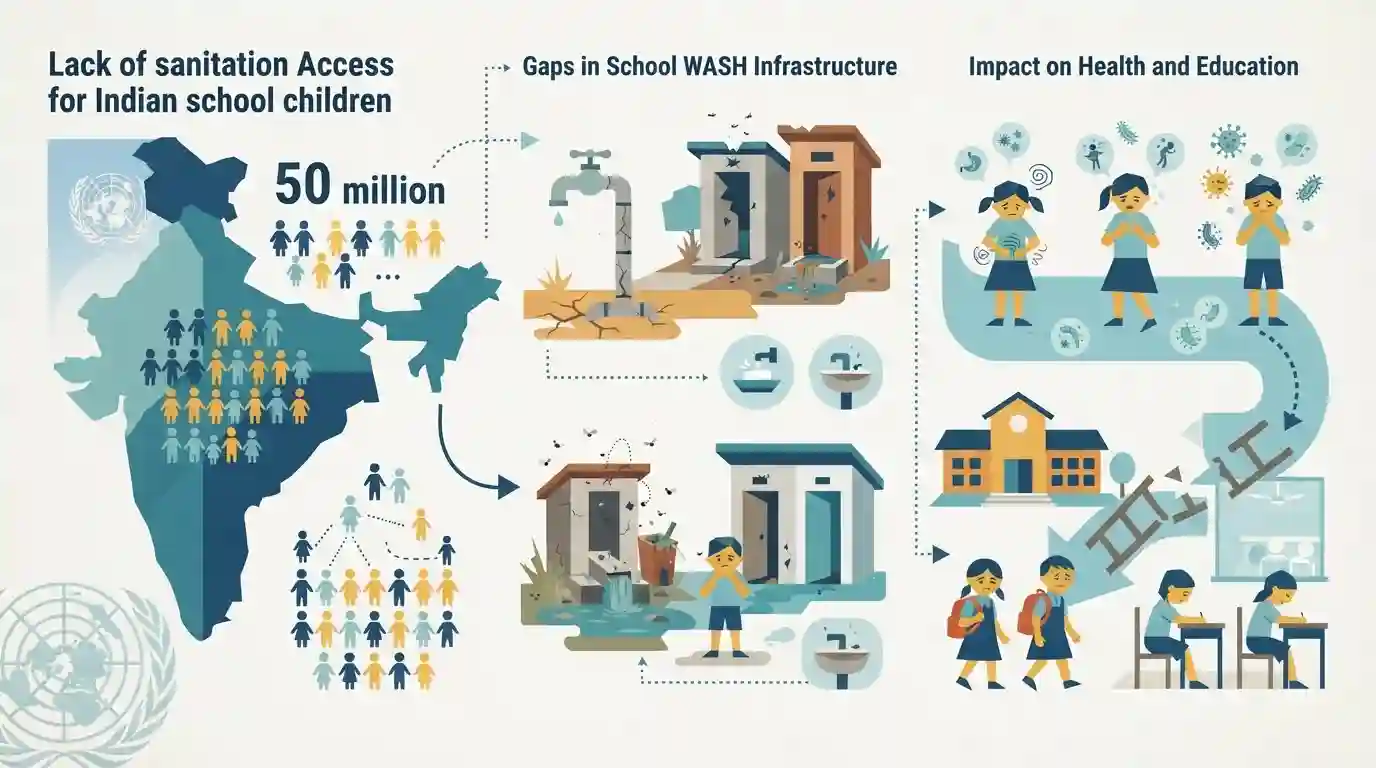
A UN report reveals that approximately 5 crore Indian children still lack access to proper sanitation services in schools, drawing attention to ongoing gaps in school WASH (Water, Sanitation, and Hygiene) infrastructure and its impact on children's health and education.
મુખ્ય મુદ્દા
- A UN report highlights that five crore Indian children still lack access to basic sanitation services in their schools.
- School sanitation and hygiene are crucial components of child health, gender equality, and educational outcomes, particularly for adolescent girls.
- Despite major national initiatives like Swachh Bharat Mission, gaps remain in achieving universal coverage of WASH (Water, Sanitation, and Hygiene) facilities in educational institutions.
મહત્વપૂર્ણ શબ્દો
Sustainable Development Goals

A collection of 17 global goals adopted by the United Nations in 2015 to address universal social, economic, and environmental challenges by 2030.
UPSC context
UPSC GS Paper II & III: Evaluates global commitments to human development, sustainability, poverty eradication, and inclusive growth.
SDG 6
The sixth Sustainable Development Goal dedicated to ensuring universal, sustainable access to safe drinking water, sanitation, and hygiene for all by 2030.
UPSC context
UPSC GS Paper II (Social Sector/WASH): Essential for questions on public health, sanitation policies, and international development targets.
United Nations
An international organization founded in 1945, committed to maintaining international peace and security, promoting human rights, and fostering global socio-economic development.
UPSC context
UPSC GS Paper II: Core international organization whose reports and conventions form the bedrock of global governance and multilateral diplomacy questions.
પ્રિલિમ્સ ટ્રેપ
India has achieved universal basic sanitation coverage across all schools due to the Swachh Bharat Mission.
While India is on track for universal basic drinking water in schools by 2030, basic sanitation infrastructure still leaves 5 crore children uncovered, making absolute coverage claims incorrect.
સંલગ્ન સ્થિર ખ્યાલો
What are the core monitoring indicators and targets under Sustainable Development Goal 6 (SDG 6)?
- Safe Drinking Water: Target 6.1 focuses on achieving universal and equitable access to safe and affordable drinking water for all by 2030.
- Sanitation & Hygiene: Target 6.2 aims to achieve access to adequate and equitable sanitation and hygiene for all, ending open defecation.
- Custodianship: The WHO-UNICEF Joint Monitoring Programme (JMP) is the official custodian agency tasked with tracking global progress on SDG 6 indicators.
આંતર-વિષય પેટર્ન
WASH Gaps + Female Labour Force Participation
Inadequate school toilets directly cause adolescent girls to drop out after menarche, linking sanitation infrastructure failure to female labour force participation and human capital metrics.
SDG Indicators + Inter-Ministerial Policy Convergence
UNICEF-WHO Joint Monitoring Programme data feeds directly into SDG 6 and SDG 4 reviews, testing policy coordination between health and education ministries.

Expect a statement-based question pairing Swachh Bharat Mission (Grameen/Urban) coverage milestones with WHO-UNICEF JMP school WASH data.
સંલગ્ન PYQ · 2
સંલગ્ન PYQ · 2
- 2017MainsGS2
To ensure effective implementation of policies addressing water, sanitation and hygiene needs the identification of the beneficiary segments is to be synchronized with the anticipated outcomes." Examine the statement in the context of the WASH scheme.
- 2020MainsGS2
National Education Policy 2020 is in conformity with the Sustainable Development Goal-4 (2030). It intends to restructure and reorient education system in India. Critically examine the statement.
