Fitch Ratings India Sovereign Credit Rating and Fiscal Risks
Source:The Hindu ↗
ఇది ఎందుకు ముఖ్యం
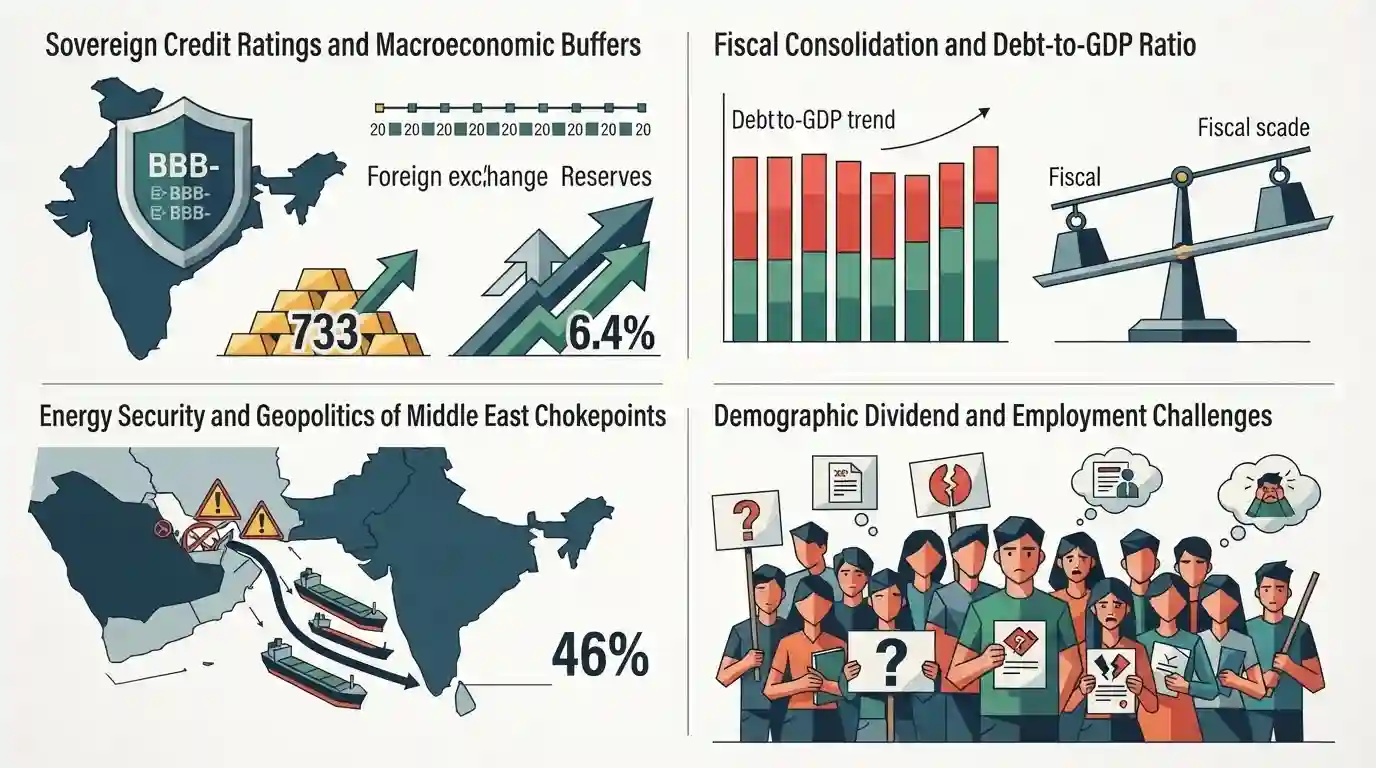
This article offers a crucial multidisciplinary case study. It connects macroeconomic indicators (like sovereign ratings, debt-to-GDP, and CAD) with international geopolitical vulnerabilities (the Strait of Hormuz energy transit chokepoint) and domestic socio-economic challenges (public protests over unemployment and NEET paper leaks). It exemplifies how socio-political pressures can influence global fiscal risk assessments and national economic planning.
సారాంశం
Fitch Ratings has affirmed India's sovereign credit rating at 'BBB-' with a stable outlook for the 20th year in a row. While praising India's robust economic growth (projected at 6.4% in the current fiscal) and strong foreign exchange reserves ($733 billion), Fitch flagged fiscal consolidation risks stemming from domestic youth protests over employment opportunities and competitive exam leaks (NEET). It also noted external vulnerabilities arising from West Asian geopolitical tensions, as 46% of India's crude imports transit through or near the blocked Strait of Hormuz.
ముఖ్య అంశాలు
- Fitch Ratings affirmed India's sovereign credit rating at 'BBB-' (the lowest investment grade) with a 'stable' outlook for the 20th consecutive year, citing robust growth and solid external finances.
- The rating agency highlighted fiscal risks arising from recent youth protests over unemployment and competitive examination paper leaks (NEET), which could pressure the government to hike spending on job creation, skill development, and education.
- Fitch projected India's GDP growth at 6.4% for the current fiscal year (FY27), noting resilience against external headwinds like the energy shock from the U.S.-Iran conflict and the subsequent blockade of the Strait of Hormuz.
- India's heavy reliance on oil imports (87% of total crude requirement) was emphasized, with 46% of these imports transiting through or near the strategic Strait of Hormuz.
- Macroeconomic indicators remain robust with foreign exchange reserves projected to touch $733 billion by FY27-end, and the Current Account Deficit (CAD) expected to widen moderately to 1.4% of GDP due to the energy shock.
- The government's debt-to-GDP ratio is projected at 55.6% for FY27, trending down toward the government's target of 50% of GDP by March 2031.
ముఖ్యమైన పదాలు
Fitch Ratings

A major global credit rating agency that evaluates the creditworthiness of countries and corporations. It assigns ratings (e.g., 'BBB-') that indicate the level of risk associated with investing in a specific entity's debt.
UPSC context
Important for GS Paper 3 (Economy). Its ratings affect sovereign borrowing costs, foreign investment flows, and macroeconomic stability assessments.
Strait of Hormuz
A narrow, strategically vital waterway connecting the Persian Gulf to the Gulf of Oman and the Arabian Sea. It is a critical chokepoint handling around 20% of global petroleum consumption and LNG trade.
UPSC context
Crucial for GS Paper 2 (IR) and GS Paper 1 (Geography). It tests knowledge of maritime chokepoints and India's energy security.
Fiscal Consolidation
A process aimed at improving government fiscal health by reducing fiscal deficits and stabilizing debt accumulation. In India, it involves higher revenue realization, rationalizing revenue expenditure, and is guided by the FRBM Act.
UPSC context
Highly relevant for GS Paper 3 (Economy). Tests understanding of budget management, deficit targeting, and the balance between capital expenditure and debt control.
National Eligibility cum Entrance Test
A nationwide entrance examination in India conducted by the National Testing Agency (NTA) for admission to undergraduate medical and dental programs. Recent paper leaks have caused widespread controversy and protests.
UPSC context
Relevant for GS Paper 2 (Governance and Social Justice). Highlights issues of institutional credibility, public trust, and examination reforms.
ప్రిలిమ్స్ ఉచ్చు
"A BBB- rating by Fitch classifies India's sovereign debt as speculative or junk status."
BBB- is actually the lowest *investment* grade rating. Only ratings below BBB- (such as BB+ or lower) are classified as non-investment, speculative, or "junk" status.
అనుసంధానమైన స్థిర భావనలు
What is the N.K. Singh FRBM Committee's recommendation on Debt-to-GDP ratio?
- Central Debt: Recommended a 40% debt-to-GDP ratio ceiling for the Central government.
- State Debt: Recommended a 20% debt-to-GDP ratio ceiling for the States, bringing the combined total to 60%.
- Escape Clause: Permitted a deviation of up to 0.5% of GDP in the fiscal deficit target during extraordinary circumstances.
What is the geographical significance of the Strait of Hormuz?
- Water Bodies: It is the strategic maritime chokepoint connecting the Persian Gulf to the Gulf of Oman and the Arabian Sea.
- Bordering Nations: It is flanked by Iran to the north and the Musandam Peninsula (Oman) and UAE to the south.
- Strategic Value: Handles roughly 20% of global oil transit, making it highly sensitive to Middle East geopolitical conflicts.
అంతర-అంశ నమూనాలు
Demographic Dividend to Fiscal Risk
Structural unemployment (youth protests) forces increased populist government spending on jobs/welfare, threatening fiscal consolidation paths and sovereign credit ratings.
Geopolitics to Macro-Stability
Middle East chokepoint blockades directly widen India's Current Account Deficit (CAD) by spiking imported crude costs, testing forex resilience.

Expect a multi-statement prelims question linking maritime chokepoints (Hormuz) with macroeconomic impacts on CAD and imported inflation.
అనుసంధాన PYQలు · 3
అనుసంధాన PYQలు · 3
- 2026PrelimsGS1
Ships from which of the following countries have to cross the Strait of Hormuz to reach out to the Indian Ocean ? 1. Bahrain 2. Syria 3. Qatar 4. Egypt Select the answer using the code given below :
- 2025MainsGS2
"Energy security constitutes the dominant kingpin of India's foreign policy, and is linked with India's overarching influence in Middle Eastern countries.” How would you integrate energy security with India's foreign policy trajectories in the coming years?
- 2014MainsGS3
While we flaunt India's demographic dividend, we ignore the dropping rates of employability. What are we missing while doing so? Where will the jobs that India desperately needs come from? Explain.
