Fitch Lowers India Growth Forecast Amid Global Trade Wars
Source:The Hindu ↗
Why It Matters
Provides crucial data points and real-world context on how protectionism, tariff wars, and global policy uncertainty impact India's macroeconomic stability and GDP growth prospects, directly addressing frequent Mains questions on the shift away from free trade.
Summary
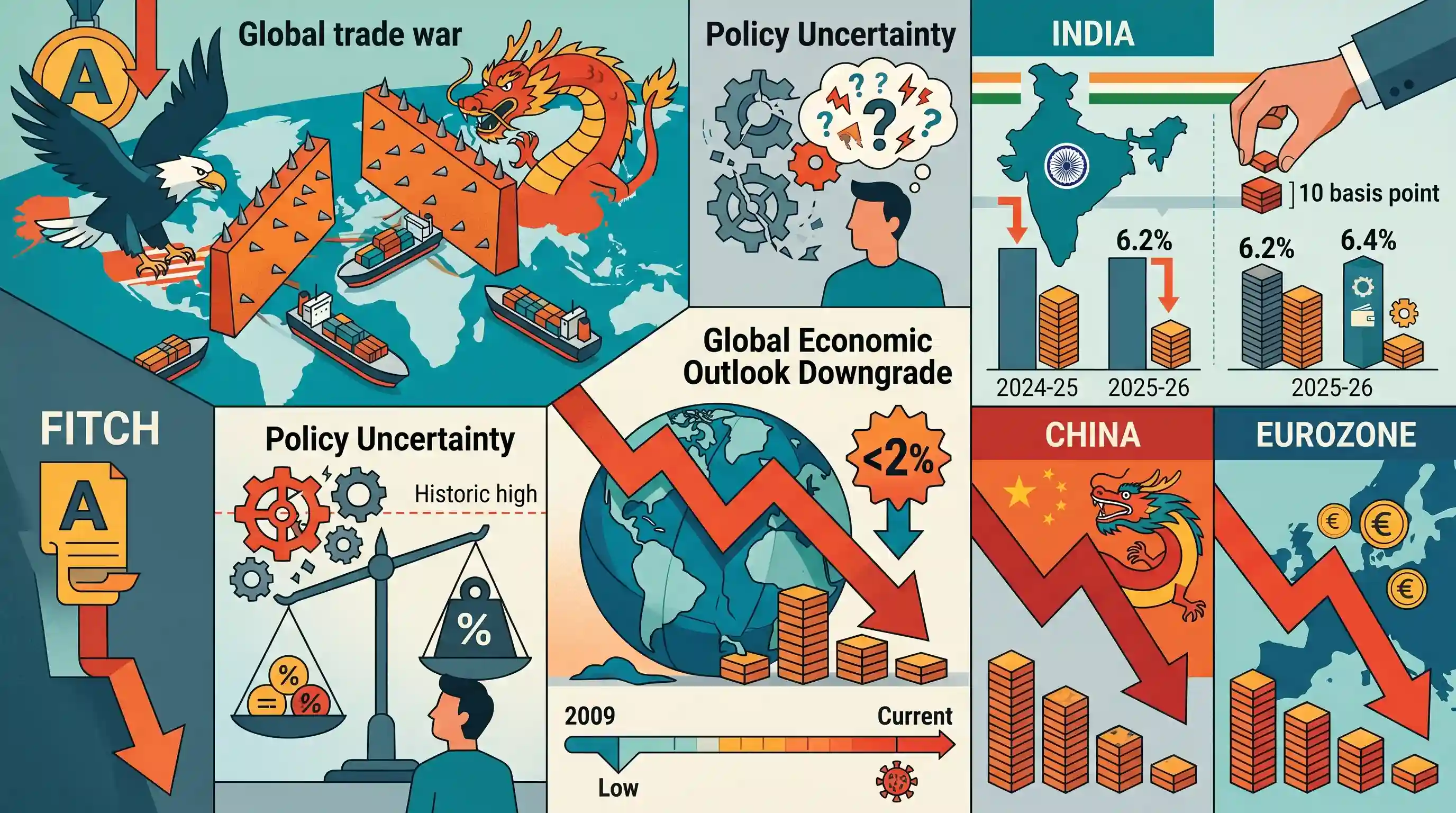
Fitch Ratings has cut India's GDP growth estimate by 10 basis points to 6.4% for the 2025-26 fiscal year and 6.2% for 2024-25, citing severe escalations in the global trade war. An intense exchange of retaliatory tariffs between the U.S. and China has pushed the U.S. average effective tariff rate to historic highs, causing widespread policy uncertainty. As a result, Fitch has significantly downgraded its world economic outlook, forecasting global GDP growth to plummet below 2%—the weakest expansion since the 2009 financial crisis, aside from the pandemic. While India experiences minor downward revisions, other major economies like China and the eurozone face sharper growth slowdowns.
Key Points
- Fitch Ratings marginally downgraded India's GDP growth estimates by 10 basis points to 6.2% for FY25 and 6.4% for FY26.
- The downgrade is driven by severe escalations in the global trade war, particularly retaliatory tariff hikes between the U.S. and China.
- Global GDP growth is projected to fall below 2% in 2025, which would be the weakest global growth rate since 2009 (excluding the pandemic).
- The U.S. average effective tariff rate (ETR) has risen to 23%, its highest level since 1909, creating massive policy uncertainty that hurts business investment prospects.
Important Terms
Liberation Day tariff hikes

A specific package of sweeping "reciprocal" import duties announced by the U.S. on April 2, 2025, aimed at reducing trade deficits; it triggered a significant escalation in global trade wars.
UPSC context
GS-2: Effect of policies of developed countries on India's interests; GS-3: Issues relating to intellectual property and global trade.
Credit Rating Agencies (Fitch Ratings)
Global firms that evaluate the creditworthiness of debt issuers (sovereigns/corporates). India frequently criticizes their "opaque methodologies" and governance indicators for potentially disadvantaging developing economies.
UPSC context
GS-3: Indian Economy (mobilization of resources, growth); tests understanding of external benchmarks affecting FDI and borrowing costs.
Effective Tariff Rate (ETR)
The actual tax burden on imports calculated by dividing total tariff revenue collected by the total value of imports; it reflects the true level of trade protectionism.
UPSC context
GS-3: Indian Economy and trade issues. Tests technical understanding of protectionist barriers beyond nominal tariff rates.
Reciprocal Tariffs
A trade policy where a country imposes import duties on another nation at the exact same level that the latter charges on its own exports, seeking "tit-for-tat" parity.
UPSC context
GS-3: International trade and its impact on the domestic economy; relates to "Trade Wars" and neo-mercantilist policies.
Basis Points (bps)
A standard unit of measure for interest rates and financial percentages, equal to one-hundredth of one percent (0.01%). Used to denote small changes in GDP or interest rates.
UPSC context
Prelims/GS-3: Basic economic terminology essential for interpreting monetary policy changes and growth revisions.
Prelims Trap
Fitch and other 'Big Three' credit rating agencies are recognized as specialized agencies of the World Bank Group.
The 'Big Three' (Fitch, S&P, Moody's) are entirely private, commercial financial corporations. They are not multilateral or UN-affiliated institutions, despite their global influence.
Static Concepts Connected
How are Credit Rating Agencies (CRAs) regulated and what is their economic impact?
- Primary Regulator: The Securities and Exchange Board of India (SEBI) regulates domestic credit rating agencies under the SEBI (Credit Rating Agencies) Regulations, 1999.
- Sovereign Impact: Sovereign rating downgrades by global CRAs increase the risk premium, leading to higher external commercial borrowing (ECB) costs for domestic companies.
- Domestic Operations: Global entities (like Fitch) issue sovereign ratings, while their domestic subsidiaries (like India Ratings) rate local corporate debt instruments.
What are the primary forms of trade protectionism under international trade norms?
- Tariff Barriers: Customs duties applied to imports, like the U.S. effective tariff rate hikes. These generally must abide by Most Favoured Nation (MFN) rules unless specific exceptions apply.
- Non-Tariff Barriers: Includes quotas, embargoes, strict licensing requirements, and arbitrary Sanitary and Phytosanitary (SPS) measures designed to restrict import volumes.
- Trade Remedies: WTO-allowed defensive measures such as Anti-dumping duties, Countervailing Duties (CVD) against subsidized imports, and Safeguard measures to protect domestic industries from sudden surges.
Cross-Topic Patterns
Export Dependency vs. Domestic Consumption
India's domestic consumption base buffers it from global trade shocks much better than highly export-dependent manufacturing hubs like China, Germany, or ASEAN nations, explaining the minor growth downgrade.
Macroeconomic Outlook and FPI Flows
Downgrades in growth projections can pressure a country's sovereign credit rating, which directly impacts the borrowing costs (ECBs) for domestic corporates and influences Foreign Portfolio Investment (FPI) trends.

U.S.-China trade war impacts + India's domestic demand resilience could form an analytical Mains GS3 question on macroeconomic stability.
Linked PYQs · 5
Linked PYQs · 5
- 2021MainsGS3
Explain the difference between computing methodology of India's Gross Domestic Product (GDP) before the year 2015 and after the year 2015.
- 2020MainsGS3
Define potential GDP and explain its determinants. What are the factors that have been inhibiting India from realizing its potential GDP?
- 2018MainsGS3
How would the recent phenomena of protectionism and currency manipulations in world trade affect macroeconomic stability of India?
- 2025MainsGS3
What are the challenges before the Indian economy when the world is moving away from free trade and multilateralism to protectionism and bilateralism? How can these challenges be met?
- 2018MainsGS2
What are the key areas of reform if the WTO has to survive in the present context of "Trade War', especially keeping in mind the interest of India?
