Fitch growth forecast reduction amid Middle East conflict
Source:The Hindu ↗
Why It Matters
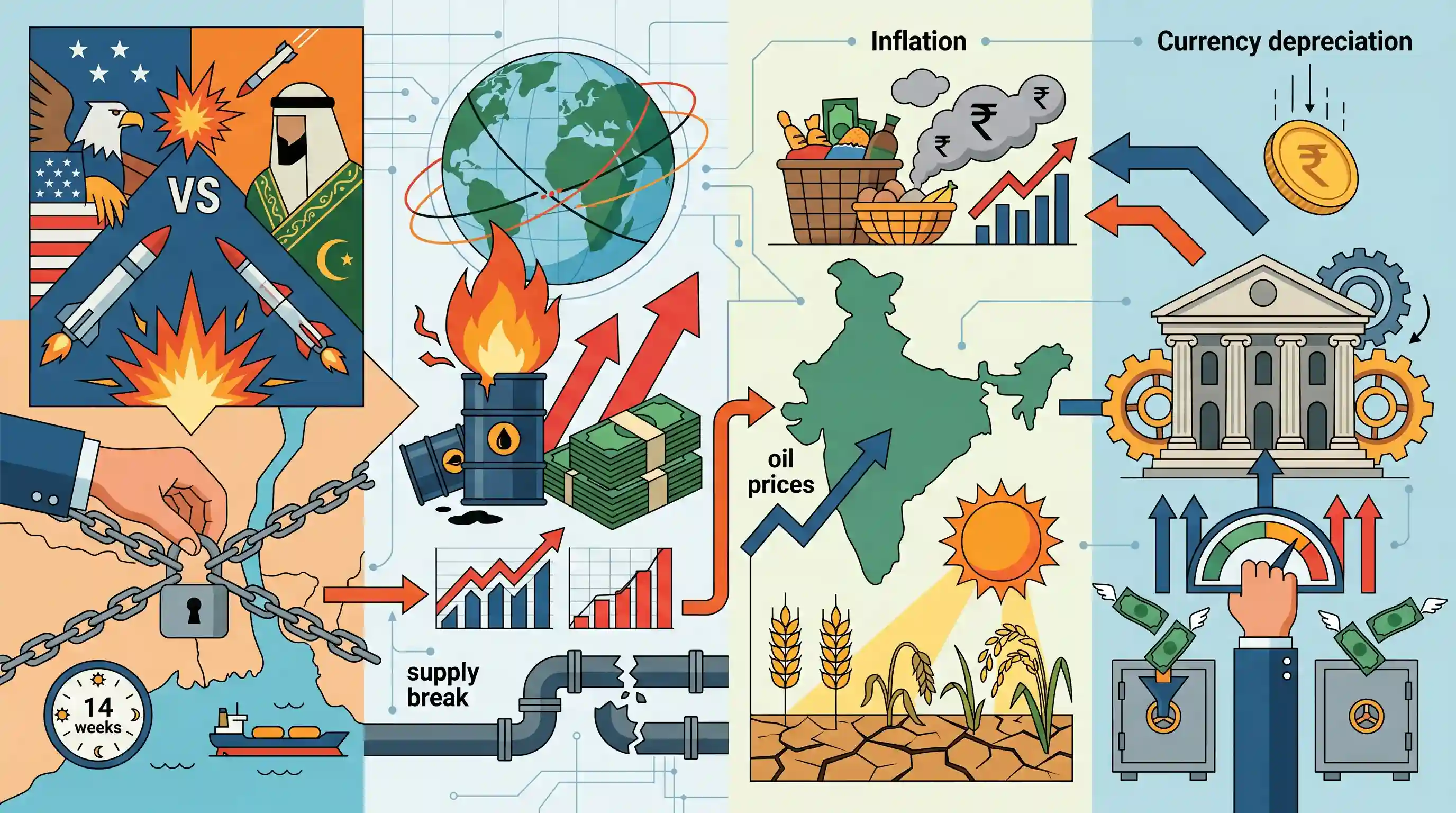
It serves as a prime case study of how geopolitical conflicts (US-Iran war) disrupt critical choke points (Strait of Hormuz), leading to imported inflation, currency depreciation, and tighter monetary policy in India. This interlinks GS2 (IR) and GS3 (Economy/Energy).
Summary
The ongoing U.S.-Iran war and the resulting 14-week closure of the Strait of Hormuz have triggered a significant global energy shock, prompting Fitch Ratings to cut India's FY27 GDP growth projection to 6.4%. Elevated crude oil prices, coupled with domestic agricultural setbacks from extreme heat and below-par monsoons, are exacerbating inflationary pressures in India. To counter rising inflation and a depreciating rupee, the Reserve Bank of India (RBI) is expected to hike policy rates. This development underscores India's macroeconomic vulnerability to geopolitical conflicts in the Middle East and highlights the critical importance of energy security.
Key Points
- Fitch Ratings downgraded India's FY27 GDP growth forecast from 6.7% to 6.4% due to the economic fallout of the U.S.-Iran war.
- The prolonged closure of the Strait of Hormuz has triggered a global energy shock, leading Fitch to revise its Brent crude oil price assumption upward to $87/bbl.
- Surging oil prices, combined with domestic issues like heatwaves and a below-average monsoon, are expected to push retail inflation in India up to 5.3%.
- In response to inflationary pressures and a depreciating rupee, the Reserve Bank of India (RBI) is anticipated to tighten monetary policy and raise interest rates.
Important Terms
Strait of Hormuz

World's most critical oil chokepoint, located between Oman and Iran. It connects the Persian Gulf with the Gulf of Oman, carrying approximately 20% of global oil trade.
UPSC context
GS Paper 2 (Geography/IR); tests knowledge of strategic maritime bottlenecks and India’s energy trade vulnerabilities.
Energy Security
Reliable, affordable, and uninterrupted access to energy sources. For India, it involves diversifying imports and expanding strategic reserves to mitigate external supply shocks and fuel growth.
UPSC context
GS Paper 3 (Infrastructure/Security); vital for assessing India’s high dependence on imported crude oil and economic stability.
Fitch Ratings
One of the 'Big Three' global credit rating agencies that assess the creditworthiness of sovereign nations. Its ratings influence India’s foreign investment attractiveness and borrowing costs.
UPSC context
GS Paper 3 (Economy); relevant for understanding external influences on India's investment climate and fiscal reputation.
Reserve Bank of India (RBI)
India's central bank and primary monetary authority. It regulates the banking system, manages foreign exchange, and implements policies to ensure price and financial stability.
UPSC context
GS Paper 3 (Economy); core institution for monetary management, banking regulation, and inflation control.
Monetary Policy
The framework used by the RBI to regulate money supply and interest rates. Its primary objective is maintaining price stability (inflation targeting) while supporting economic growth.
UPSC context
GS Paper 3 (Economy); tests knowledge of tools like the Repo Rate and the Monetary Policy Committee.
GDP Growth Projection
An estimate of a country's future economic performance. It measures the expected percentage change in the total value of all final goods and services produced within a nation.
UPSC context
GS Paper 3 (Growth/Development); key for tracking national economic health and the impact of global shocks on output.
Prelims Trap
The RBI cuts policy rates to counter the GDP growth slowdown caused by an energy shock.
Aspirants assume a growth downgrade prompts rate cuts. However, with surging inflation and a depreciating rupee, the RBI typically hikes rates (tightens policy) to stabilize the economy.
Static Concepts Connected
How does a crude oil price shock impact India's macroeconomic stability?
- CAD Widening: The Current Account Deficit increases sharply due to a higher import bill, as India imports over 80% of its crude oil requirements.
- Imported Inflation: Higher fuel costs cascade into transport and production, causing cost-push imported inflation across the economy.
- Rupee Depreciation: Increased demand for dollars to pay for expensive oil imports puts downward pressure on the Indian Rupee.
What is the geographical significance of the Strait of Hormuz?
- Maritime Chokepoint: It connects the Persian Gulf to the Gulf of Oman and the Arabian Sea.
- Bordering Nations: It is flanked by Iran to the north and Oman (the Musandam Peninsula exclave) to the south.
- Energy Transit: It facilitates roughly 20% of global petroleum transit, making it the world's most critical oil chokepoint.
Cross-Topic Patterns
Stagflation risks + Monetary Policy
Geopolitical supply shocks create a stagflation dilemma for the RBI: hiking rates to tame cost-push inflation while growth forecasts simultaneously drop.
Maritime Chokepoints + Energy Security
The Strait of Hormuz highlights how India's heavy reliance on West Asian oil directly ties domestic macroeconomic stability to maritime chokepoint security.

Expect a multi-statement question linking West Asian maritime chokepoints to macroeconomic impacts like imported inflation and CAD widening.
Linked PYQs · 3
Linked PYQs · 3
- 2022PrelimsGS1
With reference to the Indian economy, consider the following statements: 1. If the inflation is too high, Reserve Bank of India (RBI) is likely to buy government securities. 2. If the rupee is rapidly depreciating, RBI is likely to sell dollars in the market. 3. If interest rates in the USA or European Union were to fall, that is likely to induce RBI to buy dollars. Which of the statements given above are correct?
- 2018MainsGS3
How would the recent phenomena of protectionism and currency manipulations in world trade affect macroeconomic stability of India?
- 2025MainsGS2
"Energy security constitutes the dominant kingpin of India's foreign policy, and is linked with India's overarching influence in Middle Eastern countries.” How would you integrate energy security with India's foreign policy trajectories in the coming years?
