Discarded Fishing Gear Drives Coastal Microplastic Contamination
Source:The Hindu ↗
Why It Matters
Plastic and microplastic pollution is a recurring theme in UPSC exams. This article connects the sources of marine pollution (fishing gear) to broader environmental and public health concerns, highlighting the roles of key institutions like NCCR and FSSAI. It provides vital examples for Mains answers on environmental degradation and facts for Prelims regarding microplastic characteristics and associated agencies.
Summary
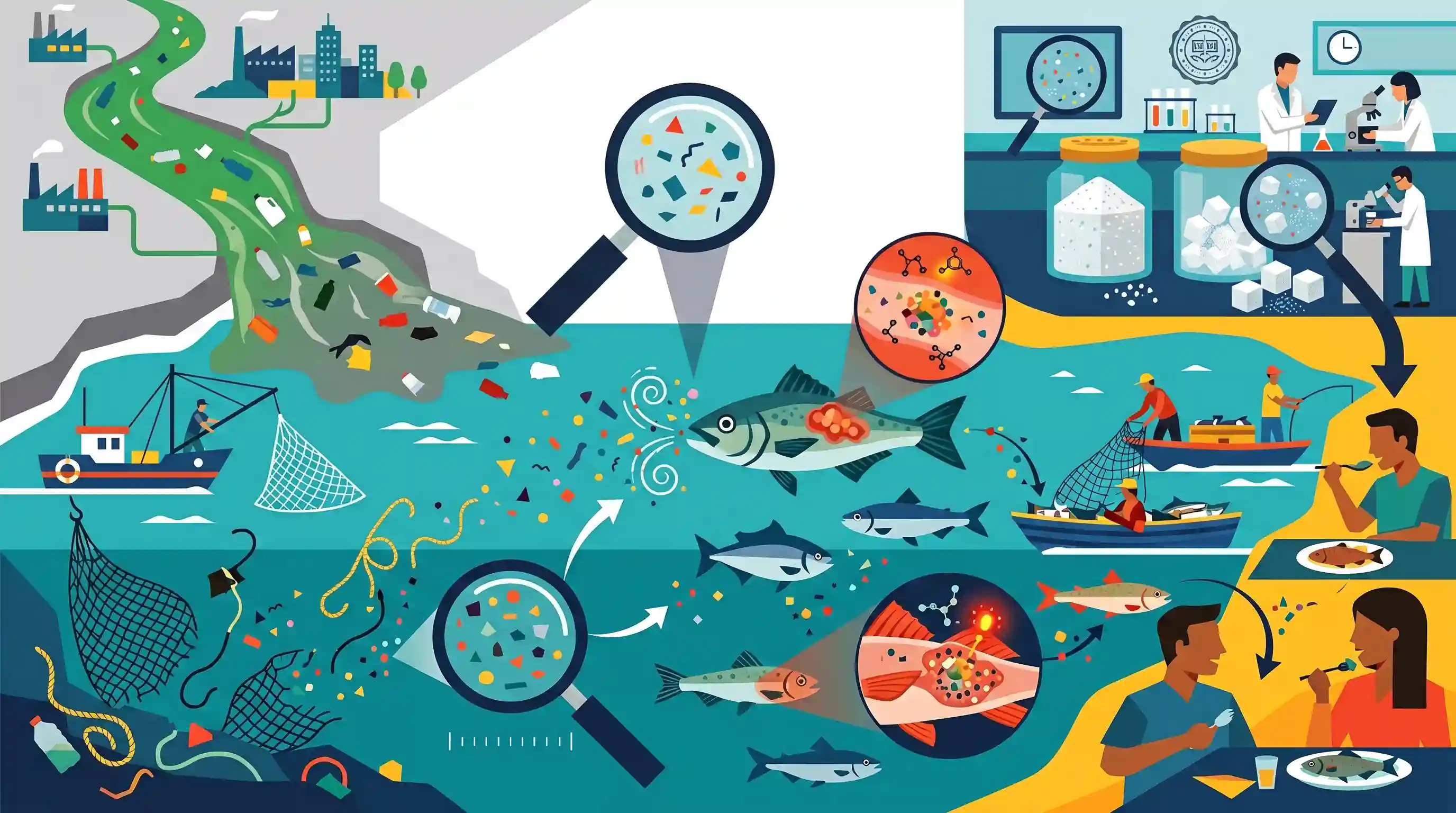
Recent assessments by the National Centre for Coastal Research (NCCR) reveal that abandoned, lost, and discarded fishing gear (ALDFG), alongside riverine inputs, are the primary contributors to microplastic contamination along Indian coasts. These microplastics—defined as plastic particles ranging from 1 µm to 5 mm—pose severe threats to marine ecosystems, leading to health issues like tumours in aquatic life and bioaccumulating toxic chemicals such as BPA and phthalates. The problem extends to human health as microplastics enter the food chain, prompting the Food Safety and Standards Authority of India (FSSAI) to initiate testing in food products like salt and sugar. Resolving this environmental challenge requires strict mitigation of marine debris, particularly from the fisheries sector.
Key Points
- Microplastic contamination along Indian coasts is primarily driven by abandoned, lost, and discarded fishing gear (ALDFG) and riverine inputs.
- The National Centre for Coastal Research (NCCR), under the Ministry of Earth Sciences, is actively assessing the abundance and distribution of microplastics in coastal waters.
- Microplastics (particles less than 5 mm) enter the food chain, carrying toxic chemicals like BPA and phthalates, causing tumours in marine life, and posing health risks to humans.
- FSSAI has launched a project to assess microplastic prevalence in food products, following studies confirming their presence in daily consumables like salt and sugar.
Important Terms
National Centre for Coastal Research (NCCR)

An attached office of the Ministry of Earth Sciences that monitors coastal water quality and marine pollution. It recently formulated the roadmap for India's National Marine Litter Policy.
UPSC context
GS Paper III (Environment & Ecology); tests knowledge of coastal management and institutional frameworks for marine pollution.
Ministry of Earth Sciences (MoES)
The nodal ministry responsible for oceanography, coastal research, and environmental monitoring in India. It oversees various institutes focused on mitigating marine debris and microplastic contamination.
UPSC context
GS Paper III (Science & Technology); relevant for government policies on environmental conservation and oceanic research.
Food Safety and Standards Authority of India (FSSAI)
India’s statutory food regulator under the Ministry of Health. It recently launched a project to establish protocols for detecting micro- and nano-plastics in common food items like salt and sugar.
UPSC context
GS Paper II (Regulatory Bodies); tests understanding of food safety standards and emerging public health challenges.
Toxics Link
An Indian environmental NGO (est. 1996) specializing in toxic pollution research. Its 2024 study on microplastics in salt and sugar catalyzed recent national regulatory investigations.
UPSC context
GS Paper III (Environment); highlights the role of civil society and NGOs in environmental advocacy and research.
ICAR-Central Institute of Fisheries Technology (CIFT)
A premier research institute under the Indian Council of Agricultural Research (ICAR) that addresses fishing gear technology and the environmental impact of abandoned, lost, and discarded fishing gear (ALDFG).
UPSC context
GS Paper III (Agriculture & Fisheries); relevant for sustainable fishing practices and marine ecosystem protection.
Prelims Trap
"Abandoned fishing nets breaking down in the ocean are a major source of primary microplastics."
False. Degraded nets form 'secondary' microplastics. Primary microplastics are those intentionally manufactured at a micro-scale, such as microbeads in facial scrubs or industrial abrasives.
Static Concepts Connected
What is the difference between Bioaccumulation and Biomagnification?
- Bioaccumulation: The gradual buildup of substances, such as microplastics or BPA, in a single organism over its lifetime.
- Biomagnification: The increasing concentration of toxic substances at successive trophic levels in a food chain, affecting apex predators the most.
What are BPA and Phthalates, and why are they harmful?
- Bisphenol A (BPA): An industrial chemical primarily used to produce polycarbonate plastics and epoxy resins.
- Phthalates: Chemical additives used as plasticizers to make plastics more flexible and durable.
- Health Impact: Both act as endocrine-disrupting chemicals (EDCs), interfering with hormonal systems, causing reproductive issues and developmental abnormalities in marine life and humans.
Cross-Topic Patterns
Microplastics & Ocean Gyres
Abandoned fishing gear and microplastics are swept by ocean currents into massive convergence zones within oceanic gyres, forming 'garbage patches' that disrupt marine ecology across international waters.
Ghost Gear vs. India's Blue Economy
ALDFG directly threatens the sustainable use of ocean resources (SDG 14), reducing commercial fishery yields and creating costly compliance hurdles for India's Deep Ocean Mission and Blue Economy policy.

Expect a multi-statement Prelims question linking specific microplastic sources (ghost gear, cosmetics) to their toxic additives (BPA).
Linked PYQs · 4
Linked PYQs · 4
- 2019PrelimsGS1
Why is there a great concern about the 'microbeads' that are released into environment?
- 2018PrelimsGS1
Consider the following statements: 1. The Food Safety and Standards Act, 2006 replaced the Prevention of Food Adulteration Act, 1954. 2. The Food Safety and Standards Authority of India (FSSAI) is under the charge of Director General of Health Services in the Union Ministry of Health and Family Welfare. Which of the statements given above is/are correct?
- 2025PrelimsGS1
Consider the following: I. Cigarette butts II. Eyeglass lenses III. Car tyres How many of them contain plastic?
- 2024PrelimsGS1
With reference to perfluoroalkyl and polyfluoroalkyl substances (PFAS) that are used in making many consumer products, consider the following statements : 1. PFAS are found to be widespread in drinking water, food and food packaging materials. 2. PFAS are not easily degraded in the environment. 3. Persistent exposure to PFAS can lead to bioaccumulation in animal bodies. Which of the statements given above are correct?
