NITI Aayog Fiscal Health Index for States
Source:Indian Express ↗
Why It Matters
State finances are a core component of GS3 macroeconomics and GS2 federalism. Understanding the parameters of the Fiscal Health Index is crucial for evaluating state-level public financial management, debt sustainability, and resource mobilization—areas frequently tested in both Prelims and Mains.
Summary
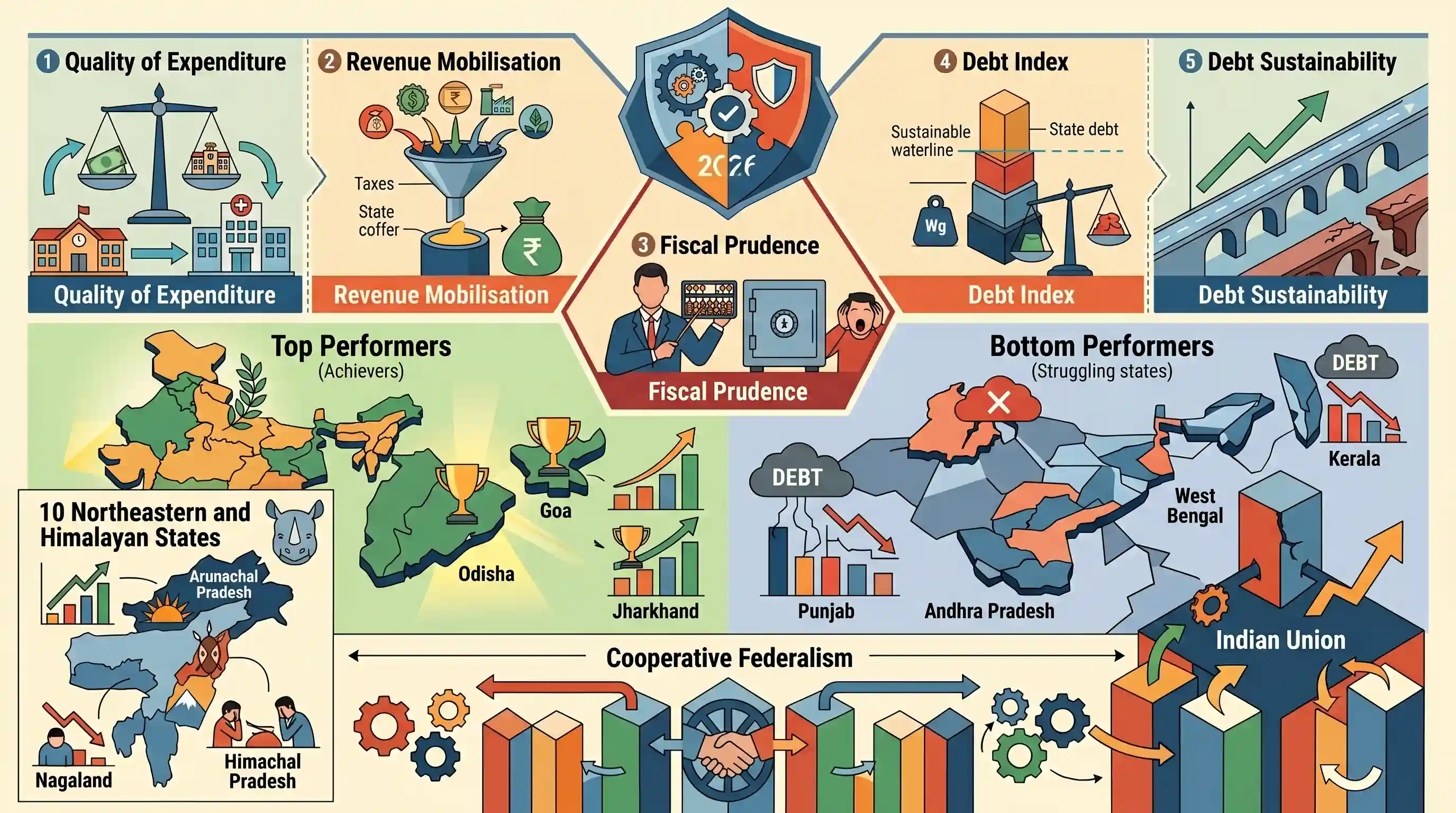
NITI Aayog has released the Fiscal Health Index (FHI) 2026, a comprehensive framework evaluating the fiscal performance of 18 major Indian states and 10 northeastern/Himalayan states for FY 2023-24. The index assesses states across five pillars: quality of expenditure, revenue mobilisation, fiscal prudence, debt index, and debt sustainability. Odisha emerged as the top-performing 'Achiever' state, driven by stable revenues and effective deficit control, followed by Goa and Jharkhand. In contrast, Punjab, Andhra Pradesh, West Bengal, and Kerala ranked at the bottom, facing significant financial strain from sustained deficits. Among northeastern and Himalayan states, Arunachal Pradesh secured the top spot, while states like Nagaland and Himachal Pradesh struggled due to limited administrative capacity. The findings underscore the critical importance of prudent debt management, qualitative public expenditure, and robust revenue mobilization strategies for states within India's federal structure.
Key Points
- NITI Aayog released the Fiscal Health Index (FHI) 2026 to evaluate the fiscal performance of Indian states for FY 2023-24 across five key pillars.
- The five pillars of FHI are quality of expenditure, revenue mobilisation, fiscal prudence, debt index, and debt sustainability.
- Odisha ranked first among major states as an 'Achiever' due to prudent fiscal management, followed by Goa and Jharkhand.
- Punjab, Andhra Pradesh, West Bengal, and Kerala ranked at the bottom ('Aspirational' status) facing ongoing financial strains and widening deficits.
- Arunachal Pradesh led among northeastern and Himalayan states, while states like Nagaland and Himachal Pradesh lagged due to fragmented public financial management.
Important Terms
Fiscal Health Index (FHI)

A data-driven framework by NITI Aayog that evaluates Indian states' fiscal performance across five pillars: quality of expenditure, revenue mobilisation, fiscal prudence, debt index, and debt sustainability.
UPSC context
General Studies III (Indian Economy); tests understanding of state-level fiscal indicators and comparative federal performance.
Quality of Expenditure
A metric assessing the allocation of government funds towards productive developmental and capital assets versus "committed" outlays like salaries, pensions, and interest payments.
UPSC context
General Studies III (Public Finance); tests knowledge of capital vs. revenue expenditure and productive resource allocation.
Revenue Mobilisation
The process of a government increasing its income through internal tax and non-tax sources to fund public services and infrastructure without over-reliance on borrowing.
UPSC context
General Studies III (Resource Mobilization); examines a state's capacity to generate self-sustaining income for development.
Fiscal Prudence
Disciplined financial management characterized by controlled budget deficits, effective spending, and strict adherence to fiscal targets like those set by FRBM Acts.
UPSC context
General Studies III (Fiscal Policy); relevant for questions on deficit control and macroeconomic stability.
Debt Sustainability
A state's long-term capacity to service its debt obligations (interest and principal) without compromising essential developmental spending or resorting to excessive future borrowing.
UPSC context
General Studies III (Indian Economy); critical for analyzing state-level debt-to-GSDP ratios and financial resilience.
NITI Aayog
The policy think tank of the Government of India that replaced the Planning Commission to provide strategic and technical advice on national and regional issues.
UPSC context
General Studies II (Statutory/Non-Constitutional Bodies); tests knowledge of its role in fostering cooperative federalism and competitive benchmarking.
Cooperative Federalism
The constitutional and administrative framework where the Central and State governments work together to solve national problems and share fiscal responsibilities.
UPSC context
General Studies II (Polity & Governance); essential for understanding Union-State relations and decentralized governance in India.
Prelims Trap
"The Fiscal Health Index is released by the Finance Commission to guide vertical tax devolution."
The FHI is released by NITI Aayog to foster competitive federalism, not by the Finance Commission or RBI for statutory fund devolution.
Static Concepts Connected
How is 'Quality of Expenditure' assessed in state budgeting?
- Capital vs Revenue: Higher ratios of capital expenditure to revenue expenditure indicate better quality, as it creates productive long-term physical or social assets.
- Committed Expenditure: A high burden of salaries, pensions, and interest payments limits fiscal space, lowering the quality of expenditure by crowding out developmental spending.
How does the Centre control State borrowings?
- Article 293(3): Under Article 293(3), a state cannot raise any loan without Centre's consent if it still owes outstanding debt to the Government of India.
- Net Borrowing Ceiling: The Centre, based on Finance Commission recommendations, sets a Net Borrowing Ceiling (typically a percentage of GSDP) for states each financial year.
Cross-Topic Patterns
FHI and Off-Budget Borrowings
Bottom-ranked states often use off-budget borrowings (e.g., Kerala's KIIFB). The Centre now includes these within the Net Borrowing Ceiling under Article 293, causing major Centre-State friction.
Fiscal Prudence vs Freebies Debate
Punjab and AP's low rankings provide empirical grounding for the ongoing Supreme Court and ECI debate on whether uncosted electoral promises ('revdi') threaten macroeconomic stability.

Expect a 2026 prelims question linking NITI Aayog's FHI pillars with Article 293 borrowing constraints and state off-budget debt.
Linked PYQs · 3
Linked PYQs · 3
- 2025MainsGS3
Explain how the Fiscal Health Index (FHI) can be used as a tool for assessing the fiscal performance of states in India. In what way would it encourage the states to adopt prudent and sustainable fiscal policies?
- 2019MainsGS3
The public expenditure management is a challenge to the Government of India in the context of budget making during the post-liberalization period. Clarify it.
- 2020MainsGS2
How far do you think cooperation, competition and confrontation have shaped the nature of federation in India? Cite some recent examples to validate your answer.
