Fiscal Federalism Balances Revenue Efficiency with Regional Equity
Source:The Hindu ↗
આ શા માટે મહત્વનું છે
Fiscal federalism, vertical/horizontal devolution formulas, and the friction over cesses/surcharges are critical themes in the UPSC syllabus. These issues sit at the intersection of GS Paper 2 (federal structures and constitutional bodies) and GS Paper 3 (mobilization of resources and government budgeting), making this analysis vital for both conceptual Prelims questions and analytical Mains essays.
સારાંશ
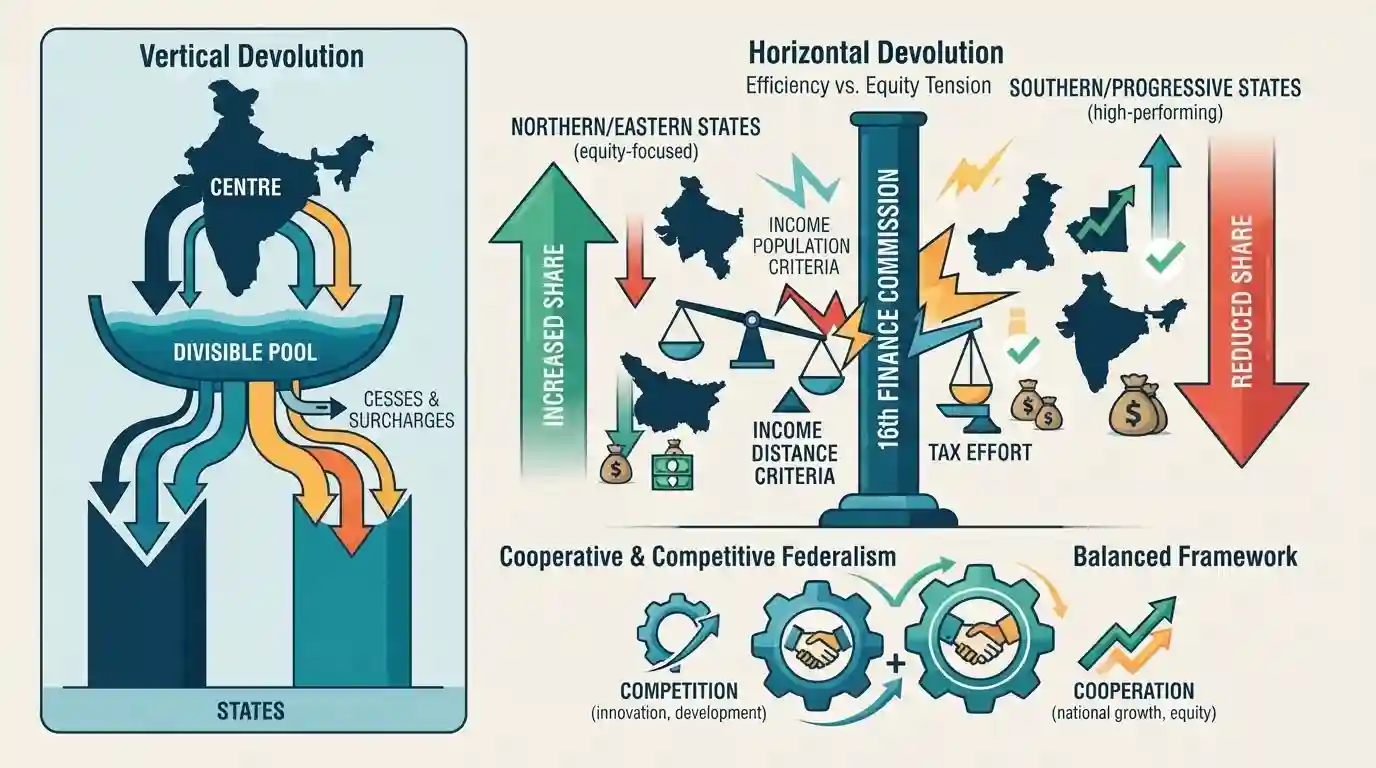
This article analyzes the structural tension between efficiency and equity in India's fiscal federalism. It highlights the growing friction between high-performing (mostly southern) states and the Centre regarding horizontal tax devolution formulas. While equity-driven criteria like 'income distance' and 'population' favor poorer northern and eastern states, they penalize progressive states for their success in population control and economic development. The piece explores these challenges in the context of the 16th Finance Commission's mandate, discussing the squeeze on the divisible tax pool due to cesses and surcharges and proposing a balanced framework that rewards efficiency without undermining cooperative federalism.
મુખ્ય મુદ્દા
- The structural conflict in India's fiscal federalism centers on the tension between 'efficiency' (rewarding fiscal discipline, tax collection, and demographic control) and 'equity' (redistributing resources to poorer states with low fiscal capacity).
- Advanced southern and western states face a dual penalty under the current devolution formula: their success in demographic transition reduces their population weight, while their economic growth increases their 'income distance' from the benchmark state, drastically shrinking their share in the divisible pool.
- Although the 15th Finance Commission mandated a 41% vertical devolution to states, the effective transfer is closer to 31-32% because the Centre increasingly relies on cesses and surcharges, which do not form part of the shareable divisible pool.
- Advanced states demand that the 16th Finance Commission (FC-XVI) reduce the weightage of 'income distance' (historically 45%), increase the weights for 'tax and fiscal effort' and 'demographic performance', and address the non-shareable nature of central cesses.
- FC-XVI, chaired by Arvind Panagariya, faces the massive task of balancing cooperative federalism (ensuring minimum standards of public services nationwide) with competitive federalism (incentivizing high-performing states that drive GDP growth).
મહત્વપૂર્ણ શબ્દો
Article 280 of the Constitution of India

A constitutional provision empowering the President of India to constitute a Finance Commission every five years to recommend the distribution of tax revenues between the Union and the States.
UPSC context
GS Paper II (Polity/Federal structures) and GS III (Economy); tests knowledge of constitutional bodies and Centre-State financial relations.
16th Finance Commission (FC-XVI)
A constitutional body chaired by Dr. Arvind Panagariya, tasked with recommending the tax devolution formula and fiscal roadmap between the Centre and States for the 2026–2031 period.
UPSC context
GS Paper II and III; tests latest developments in fiscal federalism, resource sharing, and cooperative federalism in India.
15th Finance Commission (FC-XV)
The constitutional body chaired by N.K. Singh that recommended a 41% vertical tax devolution to states and established specific horizontal devolution criteria for the 2021–2026 period.
UPSC context
GS Paper III (Indian Economy); tests historical benchmarks of tax sharing, demographic performance, and resource allocation formulas.
Goods and Services Tax (GST)
A comprehensive, destination-based indirect tax levied on the supply of goods and services across India, introduced via the 101st Constitutional Amendment Act, 2016.
UPSC context
GS Paper III (Taxation); tests comprehension of indirect tax structures, federal fiscal relations, and cooperative institutions like the GST Council.
પ્રિલિમ્સ ટ્રેપ
Article 271 empowers Parliament to levy surcharges on any tax, including the GST, to exclusively fund Union requirements.
Article 271 explicitly excludes GST from taxes on which Parliament can levy surcharges. Surcharges are restricted to taxes other than GST.
સંલગ્ન સ્થિર ખ્યાલો
What is the Constitutional basis of the Single Divisible Pool of Central Taxes?
- 80th Amendment Impact: Under Article 270 (amended by the 80th Amendment in 2000), almost all central taxes are pooled and shared with states.
- Exclusions: Cesses levied for specific purposes and surcharges under Article 271 are constitutionally excluded from this shareable pool.
- CAG Certification: Net proceeds are calculated under Article 279, certified by the Comptroller and Auditor General (CAG) of India.
What is the difference between Vertical and Horizontal Devolution?
- Vertical Devolution: The division of the shareable tax pool between the Centre and States as a collective unit (currently set at 41%).
- Horizontal Devolution: The distribution of the states' share among individual states based on formulaic criteria (e.g., income distance, population, forest cover).
- Primary Objective: Vertical addresses vertical fiscal imbalance (Centre collects more but states spend more), while horizontal addresses interstate developmental disparities.
આંતર-વિષય પેટર્ન
Demographic transition vs Fiscal rewards
Southern states' success in family planning (GS1 Population) directly reduces their tax share (GS3 Federalism), showing how success in social development can trigger fiscal penalties.
Off-budget levies and cooperative federalism
Increased reliance on non-shareable cesses (GS3 Budgeting) bypasses Article 280, eroding trust in cooperative federalism and altering the balance of power (GS2 Federalism).

Expect multi-statement questions comparing FC-XV and FC-XVI devolution criteria, especially the newly introduced GDP Contribution metric.
સંલગ્ન PYQ · 4
સંલગ્ન PYQ · 4
- 2023PrelimsGS1
Consider the following: 1. Demographic performance 2. Forest and ecology 3. Governance reforms 4. Stable government 5. Tax and fiscal efforts For the horizontal tax devolution, the Fifteenth Finance Commission used how many of the above as criteria other than population area and income distance?
- 2025PrelimsGS1
Which of the following statements with regard to recommendations of the 15th Finance Commission of India are correct? I. It has recommended grants of ₹ 4,800 crores from the year 2022-23 to the year 2025-26 for incentivizing States to enhance educational outcomes. II. 45% of the net proceeds of Union taxes are to be shared with States. III. ₹ 45,000 crores are to be kept as performance-based incentive for all States for carrying out agricultural reforms. IV. It reintroduced tax effort criteria to reward fiscal performance. Select the correct answer using the code given below.
- 2025MainsGS2
Examine the evolving pattern of Centre-State financial relations in the context of planned development in India. How far have the recent reforms impacted the fiscal federalism in India?
- 2025MainsGS3
Explain how the Fiscal Health Index (FHI) can be used as a tool for assessing the fiscal performance of states in India. In what way would it encourage the states to adopt prudent and sustainable fiscal policies?
