Women cadets passing out from National Defence Academy
Source:Indian Express ↗
Why It Matters
This development is a prime example of women breaking the glass ceiling in traditionally male-dominated sectors. It serves as a crucial case study for GS-1 (Role of Women) and GS-2 (Social Justice, Supreme Court Judgements) demonstrating how judicial intervention can drive institutional gender parity.
Summary
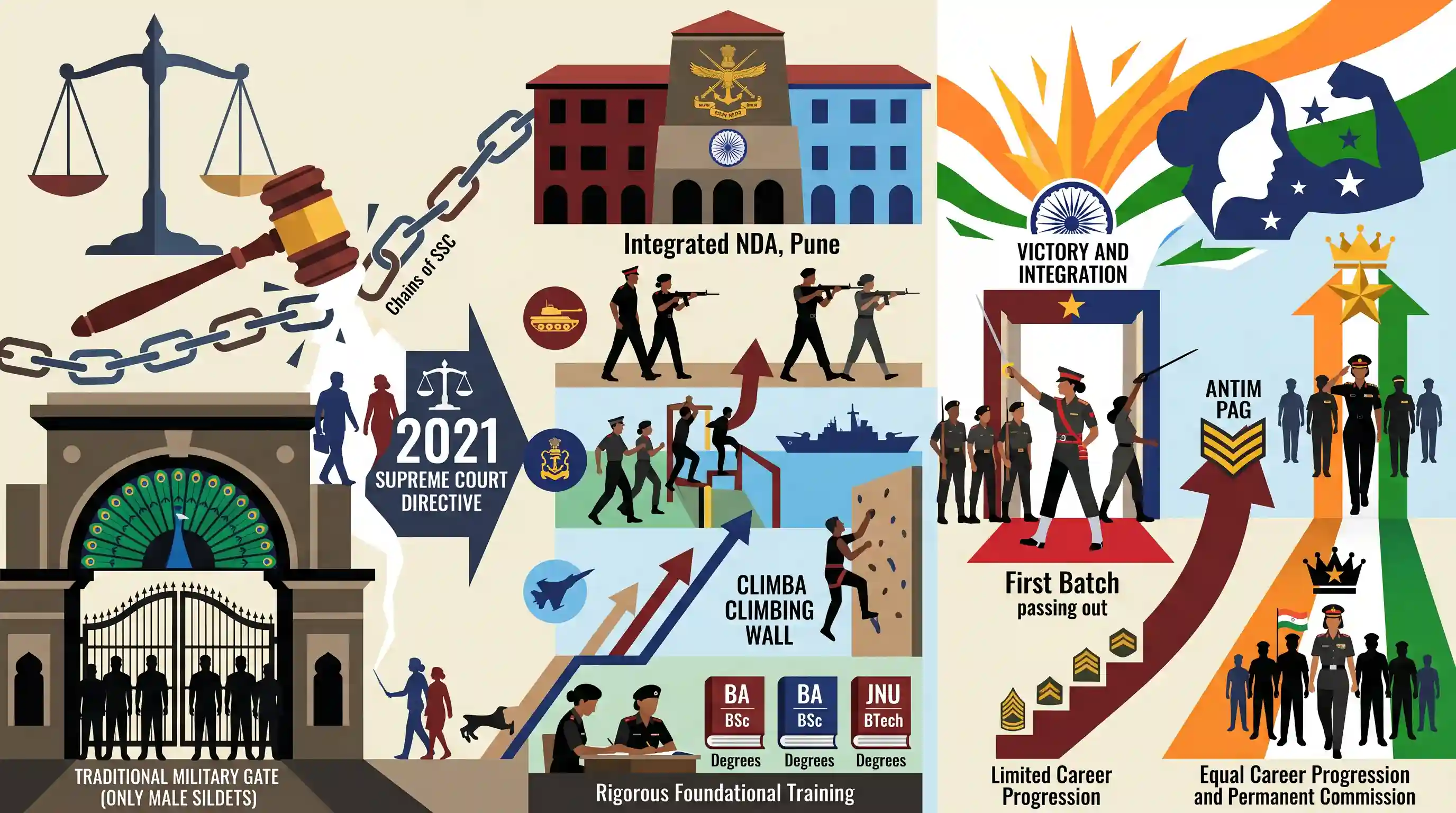
The National Defence Academy (NDA) in Pune recently witnessed its first batch of women cadets passing out, marking a watershed moment in the gender integration of the Indian Armed Forces. This structural change follows a landmark 2021 Supreme Court directive that broke the long-standing male bastion by allowing women to take the NDA exam. By receiving the same rigorous foundational training as male cadets, women are now better positioned to secure Permanent Commissions and attain leadership roles within the military. This evolution highlights a significant shift from restricting women to non-combat short service commissions toward ensuring gender equity, operational jointness, and equal career progression in the defense sector.
Key Points
- The passing out of the first batch of women cadets from the NDA is a historic milestone for gender integration in India's armed forces.
- This development stems from a 2021 Supreme Court ruling that mandated the government and military to allow women to sit for the NDA entrance exams.
- Training women at the NDA ensures they receive the same foundational tri-services training as their male counterparts, promoting institutional parity.
- The move supports the broader integration of women into leadership roles, permanent commissions, and progressively expands their footprint across combat and non-combat branches.
Important Terms
Permanent Commission (PC)

A career track in the Indian Armed Forces allowing officers to serve until retirement age. It provides pension benefits and pathways to senior command ranks, recently opened to women.
UPSC context
GS Paper 2 & 3: Tests understanding of gender parity in the military and constitutional mandates under Articles 14 and 16.
Short Service Commission (SSC)
A 10-to-14-year service tenure in the military. Historically the only entry path for women, it lacked pension benefits and restricted progression to top leadership roles before judicial reforms.
UPSC context
GS Paper 2: Highlights structural inequalities in service conditions and the evolution of career opportunities for women.
National Defence Academy (NDA)
The world's first tri-service academy, located in Pune, providing foundational training for Army, Navy, and Air Force cadets. It began admitting women in 2022 following judicial intervention.
UPSC context
GS Paper 3: Relevant for Internal Security and Defense. Tests knowledge of tri-service synergy and recent gender-inclusive milestones.
Kush Kalra v. Union of India (2021)
The 2021 Supreme Court ruling that mandated the induction of women into the National Defence Academy, citing that their exclusion was a violation of fundamental rights.
UPSC context
GS Paper 2: Landmark case for judicial activism and the enforcement of gender equality within the Indian Armed Forces.
Secretary, Ministry of Defence v. Babita Puniya (2020)
The 2020 Supreme Court judgment that granted Permanent Commission and command roles to women in the Indian Army, rejecting "physiological" arguments as gender stereotypes.
UPSC context
GS Paper 1 & 2: Essential for Social Justice and Constitutional Law topics regarding non-discrimination and women's empowerment.
Tri-services Integration
A military framework where the Army, Navy, and Air Force train or operate together to ensure synergy, common foundational values, and unified command structures.
UPSC context
GS Paper 3: Tests knowledge of military reforms, 'jointness', and the role of the Chief of Defence Staff (CDS).
Prelims Trap
Women officers are now eligible for all combat roles across the Indian Army, Navy, and Air Force.
While the SC mandated Permanent Commission and NDA entry, combat roles in the Army (like Infantry) remain restricted. Only the IAF has opened all combat roles to women.
Static Concepts Connected
How do Fundamental Rights apply to women in the Armed Forces?
- Article 14: Guarantees equality before the law; the Supreme Court ruled that a blanket ban on command roles for women violates this right (Babita Puniya case).
- Article 16: Forbids discrimination in public employment based on sex, ensuring women have equal opportunity to secure Permanent Commissions.
- Article 33 Exception: Allows Parliament to restrict fundamental rights of armed forces for discipline, but courts clarified this cannot justify arbitrary gender discrimination.
What distinguishes a Permanent Commission (PC) from a Short Service Commission (SSC)?
- Service Tenure: SSC officers typically serve a tenure of 10-14 years, whereas PC officers serve until the official retirement age for their achieved rank.
- Pension Entitlement: PC officers are entitled to full pension benefits post-retirement. SSC officers traditionally do not receive a pension unless they complete 20 years of service.
- Command Roles: PC enables officers to ascend to top leadership and command battalions, a pathway that was previously denied to women serving only under SSC.
Cross-Topic Patterns
Judicial intervention in military policy
The opening of NDA was driven by Supreme Court directives (Kush Kalra case) rather than executive policy, showcasing judicial activism enforcing Article 14 within traditionally insulated military domains.
Women in UN Peacekeeping forces
India's domestic integration of women officers aligns with its global soft power posture, having historically deployed the UN's first all-women peacekeeping contingent to Liberia in 2007.

Expect a 2026 Prelims question mixing the Babita Puniya ruling, NDA entry facts, and the ongoing combat-role restrictions in the Army.
Linked PYQs · 3
Linked PYQs · 3
- 2024MainsGS1
Distinguish between gender equality, gender equity and women's empowerment. Why is it important to take gender concerns into account in programme design and implementation?
- 2023MainsGS2
Explain the constitutional perspectives of Gender Justice with the help of relevant Constitutional Provisions and case laws.
- 2024PrelimsGS1
Which of the following is/are correctly matched in terms of equivalent rank in the three services of Indian Defence forces? (Army — Airforce — Navy) 1. Brigadier — Air Commodore — Commodore 2. Major General — Air Vice Marshal — Vice Admiral 3. Major — Squadron Leader — Lieutenant Commander 4. Lieutenant Colonel — Group Captain — Captain Select the correct answer using the code given below:
