Research Development and Innovation Scheme Funding Mechanisms
Source:The Hindu ↗
Why It Matters
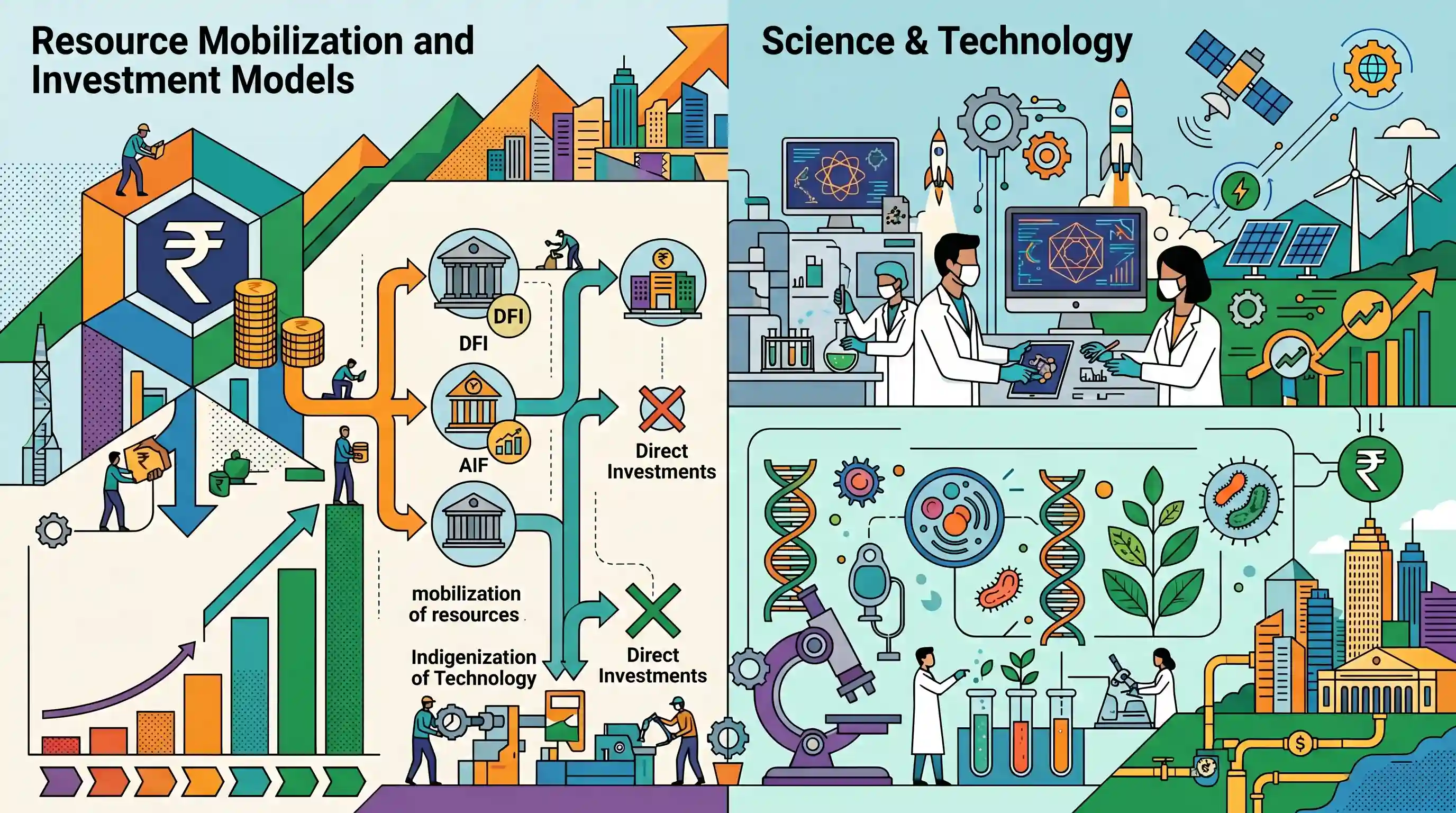
Understanding the structural mechanisms of how the government plans to fund high-risk scientific research is critical for both the economy (via Alternative Investment Funds) and S&T domains. It highlights India's push towards making its R&D funding ecosystem more institutionalized and robust.
Summary
The Indian government is preparing to disburse the first ₹3,000 crore from the ₹1 lakh crore Research Development and Innovation scheme by March 2026. Unveiled in 2025, the scheme experienced initial spending delays due to the time taken to establish its unique funding mechanism. Rather than direct investments, the corpus will be deployed over seven years through second-level fund managers, including alternate investment funds and development finance institutions. Currently, only two statutory bodies serve as fund managers. Concurrently, a ₹10,000 crore Biopharma Shakti mission was announced to spur biological research and innovation across multiple sectors.
Key Points
- The Department of Science and Technology will spend the first ₹3,000 crore tranche of the ₹1 lakh crore Research Development and Innovation scheme by March 2026.
- The scheme aims to fund high-risk, high-impact research over seven years, but no funds from its ₹20,000 crore FY 2025-26 allocation were spent until January 2026.
- Investments will not be made directly in startups or corporations; instead, the fund will channel money through second-level fund managers such as alternate investment funds (AIFs) and development finance institutions.
- Delays in spending occurred because only two statutory bodies have been appointed as fund managers so far, though 193 applicants are being shortlisted.
- The Budget also announced a ₹10,000 crore Biopharma Shakti mission over five years to develop biological materials, creating jobs and advancing fields like drug development and carbon capture.
Important Terms
Research Development and Innovation (RDI) Scheme

A ₹1 lakh crore corpus fund providing long-term, low-interest financing to incentivize private sector-led research and innovation in strategic and emerging technology sectors.
UPSC context
GS Paper III: Science & Technology and Economy; tests knowledge of investment models and indigenous technology development.
Biopharma SHAKTI Mission
A ₹10,000 crore flagship mission designed to transform India into a global hub for biologics and biosimilars, focusing on advanced biomanufacturing and non-animal methodologies.
UPSC context
GS Paper III: Biotechnology and Health; relevant for indigenization of high-value therapies and pharmaceutical sector reforms.
Anusandhan National Research Foundation (ANRF)
A statutory body established in 2023 to provide strategic direction for scientific research and manage major R&D funds like the RDI corpus through a two-tier mechanism.
UPSC context
GS Paper II & III: Governance and S&T; tests understanding of institutional frameworks for fostering a research culture.
Technology Development Board (TDB)
A statutory body under the Department of Science and Technology that promotes commercialization of indigenous technologies and acts as a key fund manager for the RDI scheme.
UPSC context
GS Paper III: S&T and Economy; tests knowledge of government bodies supporting industrial R&D and resource mobilization.
Department of Science and Technology (DST)
A nodal department within the Ministry of Science and Technology responsible for formulating S&T policies and overseeing the implementation of the RDI fund.
UPSC context
GS Paper II & III: Science policy and institutional governance.
Biotechnology Research and Innovation Council (BRIC)
An autonomous body created by subsuming 13 institutions under the Department of Biotechnology to integrate multi-disciplinary biotech research, training, and innovation.
UPSC context
GS Paper III: Biotechnology; tests knowledge of structural reforms in India’s biotechnology research landscape.
Prelims Trap
The RDI Scheme provides direct grants and equity to startups for high-impact research.
The scheme does not invest directly in startups. It uses a two-tiered mechanism, channeling funds via Second-Level Fund Managers (like AIFs) to disburse long-term, low-interest loans.
Static Concepts Connected
What are Alternative Investment Funds (AIFs) as per SEBI?
- Definition: Privately pooled investment vehicles collected from Indian or foreign investors, not covered by standard mutual fund regulations.
- Category I: Invests in start-ups, early-stage ventures, social ventures, SMEs, and infrastructure (e.g., Venture Capital Funds).
- Category II & III: Category II includes private equity/debt funds; Category III includes hedge funds employing complex trading strategies.
How do Biologics differ from traditional chemical drugs?
- Source: Manufactured in a living system (microorganisms, plant, or animal cells) rather than being chemically synthesized.
- Complexity: They are large, complex molecules (e.g., vaccines, monoclonal antibodies, cell therapies) compared to small-molecule chemical drugs.
- Biosimilars: Highly similar, cost-effective clinical alternatives to original biologics, requiring rigorous testing once the original patent expires.
Cross-Topic Patterns
Financialization of R&D funding
Integrating SEBI-regulated AIFs as Second-Level Fund Managers for S&T funding links capital market instruments directly with basic science research, marking a shift from traditional grant-based R&D to debt/investment-driven models.
NAMs + Clinical trial ethics
The push for New Approach Methodologies (NAMs) like organ-on-a-chip bridges advanced biotechnology with biomedical ethics, offering alternatives to traditional animal testing in clinical trials.

The two-tiered funding mechanism of the RDI scheme via AIFs and the distinction between biologics and biosimilars are prime targets for 2026 prelims.
Linked PYQs · 3
Linked PYQs · 3
- 2021MainsGS3
What are the research and developmental achievements in applied biotechnology? How will these achievements help to uplift the poorer sections of the society?
- 2025PrelimsGS1
With reference to investments, consider the following: I. Bonds II. Hedge Funds III. Stocks IV. Venture Capital How many of the above are treated as Alternative Investment Funds?
- 2019MainsGS3
How can biotechnology help to improve the living standards of farmers?
