Manipur Government Resumes Talks With Kuki-Zo Insurgent Groups
Source:The Hindu ↗
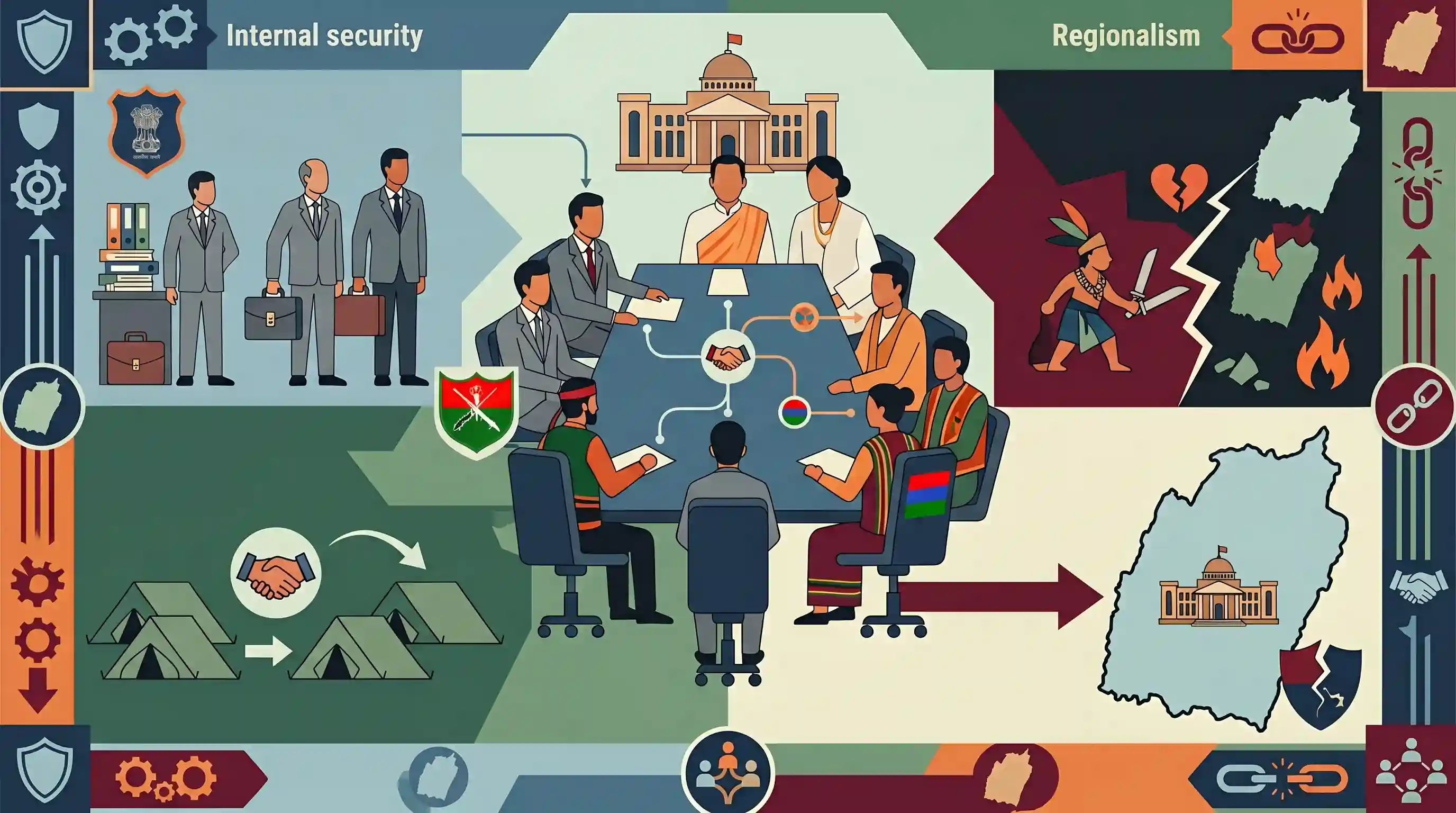
Why It Matters
The article highlights the ongoing internal security crisis in Manipur, showcasing the complexities of negotiating peace treaties like the Suspension of Operations (SoO) pact amid multi-ethnic conflicts. It touches on core UPSC themes such as North-East insurgency, the root causes of ethnic clashes, and administrative demands for autonomy (like creating a new Union Territory), which are critical for understanding India's internal security and governance challenges.
Summary
The Union Ministry of Home Affairs and the newly elected Manipur government, led by Chief Minister Y. Khemchand Singh, have resumed tripartite talks with Kuki-Zo insurgent groups under the Suspension of Operations (SoO) pact. During the meeting in Delhi, the insurgent groups (KNO and UPF) agreed to consolidate their camps to ease local friction. However, they expressed severe concerns over recent violence in Ukhrul district involving Tangkhul Nagas and reiterated their demand for a separate Union Territory with a legislature. They cited the State government's failure to protect Kuki-Zo civilians and leaders since the ethnic violence broke out in May 2023 as the primary reason a return to the status quo is untenable.
Key Points
- The Union Ministry of Home Affairs (MHA) and the newly restored Manipur government held their first talks with Kuki-Zo insurgent groups under the Suspension of Operations (SoO) pact.
- The Kuki-Zo groups, represented by the KNO and UPF, agreed to consolidate their designated camps to reduce friction with local populations.
- The insurgent groups highlighted fresh ethnic violence between Tangkhul Nagas and Kukis in the Naga-dominated Ukhrul district.
- The Kuki-Zo groups reiterated their demand for a separate Union Territory with a legislature for the hill areas, citing a complete lack of accountability from the State government regarding violence against Kuki-Zo communities.
Important Terms
Suspension of Operations (SoO) pact

A tripartite ceasefire agreement signed in 2008 between the Centre, Manipur government, and Kuki-Zo insurgent groups to initiate political dialogue and end hostilities.
UPSC context
GS Paper III: Internal Security; tests knowledge of peace accords and conflict resolution frameworks in Northeast India.
Kuki National Organisation (KNO)
An umbrella organization representing 17 Kuki-Zo insurgent groups in Manipur that are signatories to the Suspension of Operations pact.
UPSC context
GS Paper III: Internal Security; focuses on non-state actors and insurgency dynamics in sensitive border regions.
United Peoples’ Front (UPF)
A conglomerate of 8 Kuki-Zo militant groups in Manipur participating in the tripartite peace process and the SoO agreement.
UPSC context
GS Paper III: Internal Security; relevant for understanding the organizational structure of Northeast ethnic movements.
Ministry of Home Affairs (MHA)
The nodal central ministry responsible for internal security, border management, and coordinating tripartite peace negotiations with insurgent groups.
UPSC context
GS Paper II: Governance; tests understanding of the executive’s role in maintaining national integrity and law and order.
Intelligence Bureau (IB)
India's premier internal intelligence agency tasked with domestic counter-insurgency, counter-terrorism, and facilitating peace talks through expert interlocutors.
UPSC context
GS Paper III: Internal Security; involves the role of central agencies in intelligence-led operations and conflict mediation.
Prelims Trap
"The Suspension of Operations (SoO) pact is a bilateral agreement between the Centre and Kuki insurgent groups."
The SoO pact in Manipur is inherently tripartite. It mandates the agreement and participation of the Government of India, the State Government of Manipur, and the insurgent groups.
Static Concepts Connected
What is the constitutional basis for a Union Territory with a legislature?
- Article 239A: Empowers Parliament to create local legislatures or councils of ministers for certain UTs, originally used for Puducherry.
- Article 239AA: Provides a separate, specific constitutional framework directly establishing the National Capital Territory of Delhi.
- Creation process: Carving a UT from a state requires a Parliamentary law altering boundaries under Article 3 and amending the First Schedule.
How does a Suspension of Operations (SoO) pact function operationally?
- Designated camps: Unlike a surrender, insurgents do not lay down arms permanently. They are restricted to specific camps and receive government stipends pending a political settlement.
- Double-locking of arms: Weapons are stored in armouries where the insurgent group holds one key and security forces hold the other, designed to limit armed extortion.
- Tripartite ceasefire: It functions as a temporary, tripartite ceasefire requiring the state government's active consensus alongside the Centre and the militants.
Cross-Topic Patterns
Shift from Sixth Schedule to Article 239A
The Kuki-Zo demand signals a loss of faith in Autonomous District Councils, escalating to demands for a separate Union Territory with a legislature, bypassing the state administration entirely.
Naga Peace Process spillover
Clashes in Ukhrul between Tangkhul Nagas and Kukis revive violent 1990s faultlines, dangerously intertwining the current Manipur crisis with the delicate, ongoing NSCN(IM) Naga peace process.

Expect a multi-statement Prelims question comparing SoO pacts, Sixth Schedule mechanisms, and Article 239A UT creation in the NE context.
Linked PYQs · 3
Linked PYQs · 3
- 2017MainsGS3
The North-East region of India has been infested with insurgency for a very long time. Analyze the major reasons for the survival of armed insurgency in this region.
- 2019MainsGS3
Cross-border movement of insurgents is only one of the several security challenges facing the policing of the border in North-East India. Examine the various challenges currently emanating across the India-Myanmar border. Also, discuss the steps to counter the challenges.
- 2013MainsGS1
Growing feeling of regionalism is an important factor in generation of demand for a separate State. Discuss.
