Kaziranga emerges as fishing cat stronghold in scientific assessment
Source:The Hindu ↗
Why It Matters
UPSC routinely tests knowledge of specific flagship or vulnerable species, their natural habitats, and their protection status under Indian law (e.g., Schedule I of WPA). Understanding the specific wetland dependencies of the fishing cat and its occurrence in key protected areas like Kaziranga and Sunderbans is highly relevant for Prelims.
Summary
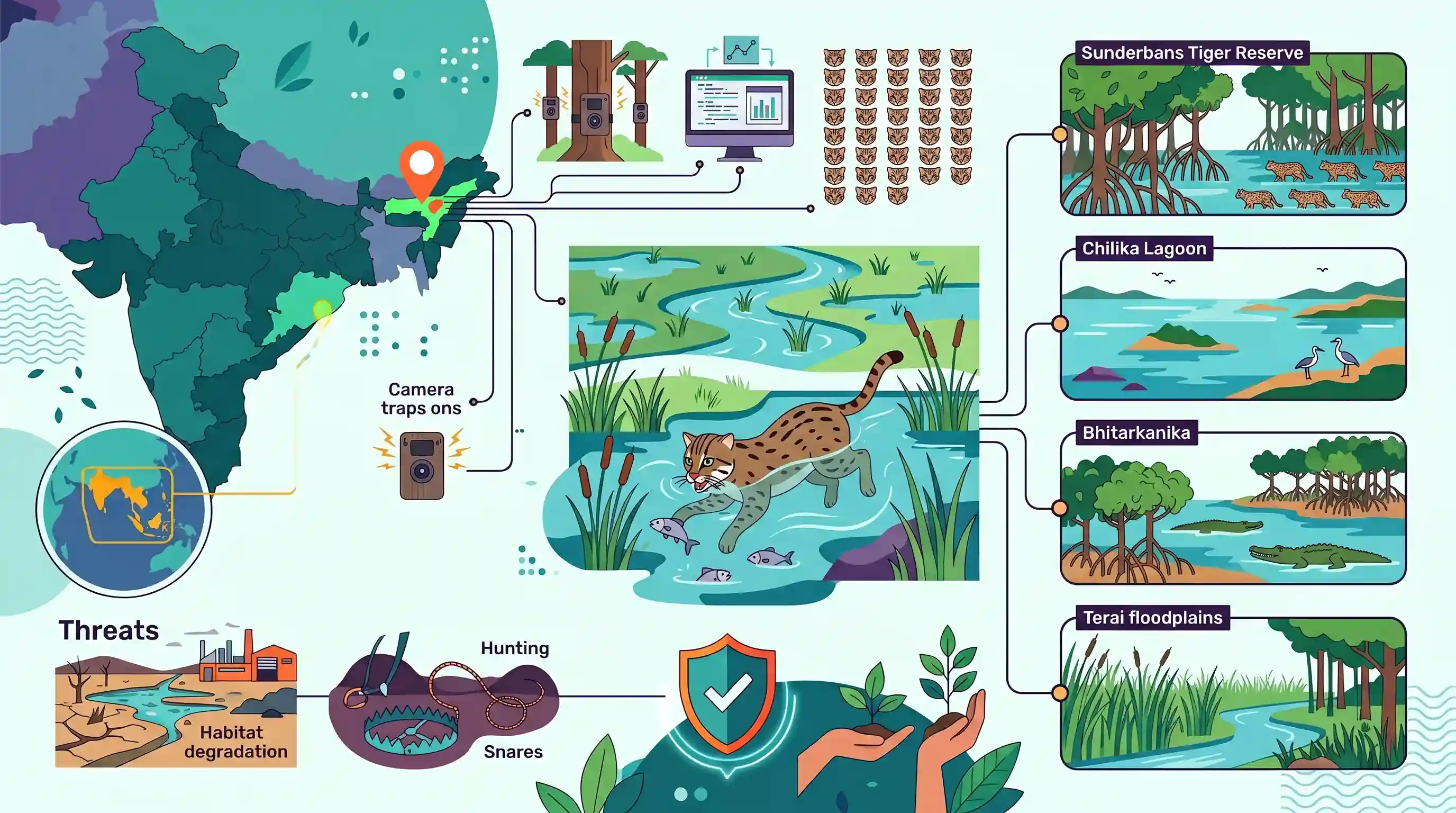
The first scientific assessment of the globally vulnerable fishing cat has identified Assam's Kaziranga National Park and Tiger Reserve as a major stronghold, with 57 unique individuals documented. Based on camera-trap data from the all-India tiger estimation, the study emphasizes Kaziranga's importance as a crucial wetland habitat in the Brahmaputra floodplains. While Sunderban Tiger Reserve holds the highest number of these elusive cats, other key habitats include Chilika Lagoon, Bhitarkanika, and the Terai floodplains. Protected under Schedule I of the Wildlife Protection Act, the fishing cat faces threats from habitat degradation and hunting across its range in South and Southeast Asia.
Key Points
- The fishing cat (Prionailurus viverrinus) is listed as globally Vulnerable by the IUCN and is protected under Schedule I of India's Wildlife (Protection) Act, 1972.
- A recent scientific assessment using camera-trap images identified 57 unique individuals in Kaziranga National Park, establishing it as a stronghold for the species.
- Fishing cats are wetland carnivores that inhabit wet alluvial grasslands, shallow beels, estuarine ecosystems, and woodland refugia.
- The highest known population of fishing cats (385 individuals) resides in the Sunderban Tiger Reserve, followed by other estuarine regions like Chilika, Bhitarkanika, and Coringa.
Important Terms
Fishing Cat

A medium-sized wild cat (Prionailurus viverrinus) and wetland specialist with webbed feet. Found in South and Southeast Asia, it is an expert swimmer primarily preying on fish.
UPSC context
GS Paper III: Biodiversity. Tests species in news, specific habitat requirements, and status under Indian conservation laws.
Kaziranga National Park
A UNESCO World Heritage Site in Assam, located in the Brahmaputra floodplains. It is famous for hosting two-thirds of the world's one-horned rhinoceros population and high tiger density.
UPSC context
GS Paper III: Protected Areas. Tests knowledge of ecological hotspots, riverine ecosystems, and site-specific conservation success.
Wildlife Protection Act (WPA), 1972
India's primary legislation for biodiversity conservation. It provides a legal framework for protecting wild animals and plants and regulating their trade through various schedules.
UPSC context
GS Paper III: Environmental Legislation. Essential for understanding Indian conservation law, recent 2022 amendments, and legal protections.
Schedule I (WPA)
The highest level of protection under the WPA. Species listed here (e.g., Fishing Cat, Tiger) are prohibited from hunting and attract the most severe legal penalties for offenses.
UPSC context
GS Paper III: Environment & Ecology. Tests understanding of the hierarchy of legal protection and species classification in India.
IUCN Red List
A global inventory maintained by the International Union for Conservation of Nature to assess the extinction risk of species (e.g., Fishing Cat is currently 'Vulnerable').
UPSC context
GS Paper III: Biodiversity. Standard benchmark for testing species' conservation priorities and global risk assessments in Prelims/Mains.
Important Bird Area (IBA)
A designation by BirdLife International for sites critical for bird conservation. Kaziranga's IBA status reflects its importance for migratory waterfowl and threatened avian species.
UPSC context
GS Paper III: Ecology. Tests knowledge of international designations for habitat conservation beyond standard National Park/Sanctuary status.
Prelims Trap
Kaziranga National Park hosts the highest population of fishing cats in India, a species endemic to the region.
While Kaziranga is a newly identified stronghold, the Sunderban Tiger Reserve actually holds the highest known population of fishing cats in India. Additionally, the species is not endemic to India.
Static Concepts Connected
What are the key adaptations and ecological niches of the Fishing Cat?
- Obligate Wetland Carnivore: Restricted to wet alluvial grasslands, shallow oxbow lakes (beels), estuaries, and mangroves, making it highly vulnerable to wetland degradation.
- Aquatic Adaptations: Features partially webbed paws and a water-resistant double coat, allowing it to dive into water to hunt fish and crustaceans.
- Conservation Status: Listed as Vulnerable by the IUCN and protected under Schedule I of India's Wildlife (Protection) Act, 1972.
How does the Wildlife (Protection) Amendment Act, 2022 categorize species?
- Schedule I: Grants the highest level of protection with the most severe penalties for hunting or trade. Covers endangered species like the tiger and fishing cat.
- Schedule II: Provides protection to species requiring lesser conservation priority than Schedule I, but still strictly regulates hunting and trade.
- Schedule IV (CITES): A newly introduced schedule specifically designed to implement the provisions of CITES and regulate international trade in endangered species.
Cross-Topic Patterns
Camera Trap Bycatch & Biodiversity Data
The all-India tiger estimation utilizes extensive camera-trap networks, which increasingly generate critical baseline data for elusive, non-target species like fishing cats, caracals, and pangolins.
Ramsar Sites as Mammalian Refuges
Beyond avifauna, India's Ramsar wetlands (Chilika, Sunderbans, Bhitarkanika) are vital mammalian refugia. UPSC often tests these overlapping ecosystems, such as linking Irrawaddy dolphins to Chilika or fishing cats to mangroves.

Expect a 2026 prelims question pairing the fishing cat's IUCN status, webbed-paw adaptations, and specific wetland/Ramsar site habitats.
Linked PYQs · 5
Linked PYQs · 5
- 2023PrelimsGS1
Which one of the following makes a tool with a stick to scrape insects from a hole in a tree or a log of wood?
- 2017PrelimsGS1
In India, if a species of tortoise is declared protected under Schedule I of the Wildlife (Protection) Act, 1972, what does it imply?
- 2022PrelimsGS1
With reference to Indian laws about wildlife protection, consider the following statements : 1. Wild animals are the sole property of the government. 2. When a wild animal is declared protected, such animal is entitled for equal protection whether it is found in protected areas or outside. 3. Apprehension of a protected wild animal becoming a danger to human life is sufficient ground for its capture or killing. Which of the statements given above is/are correct?
- 2020PrelimsGS1
Among the following Tiger Reserves, which one has the largest area under "Critical Tiger Habitat"?
- 2023PrelimsGS1
Which one of the following is the best example of repeated falls in sea level, giving rise to present-day extensive marshland?
