First phase of Census and digital self-enumeration in Himachal Pradesh
Source:thenewshimachal ↗
Why It Matters
Census data is foundational for understanding demographic dividends, shifting populations, and framing public policy. Its transition to digital execution (e-governance) touches on the changing administrative landscape in India. Both demographic trends and e-governance are recurring themes in HPAS Prelims.
Summary
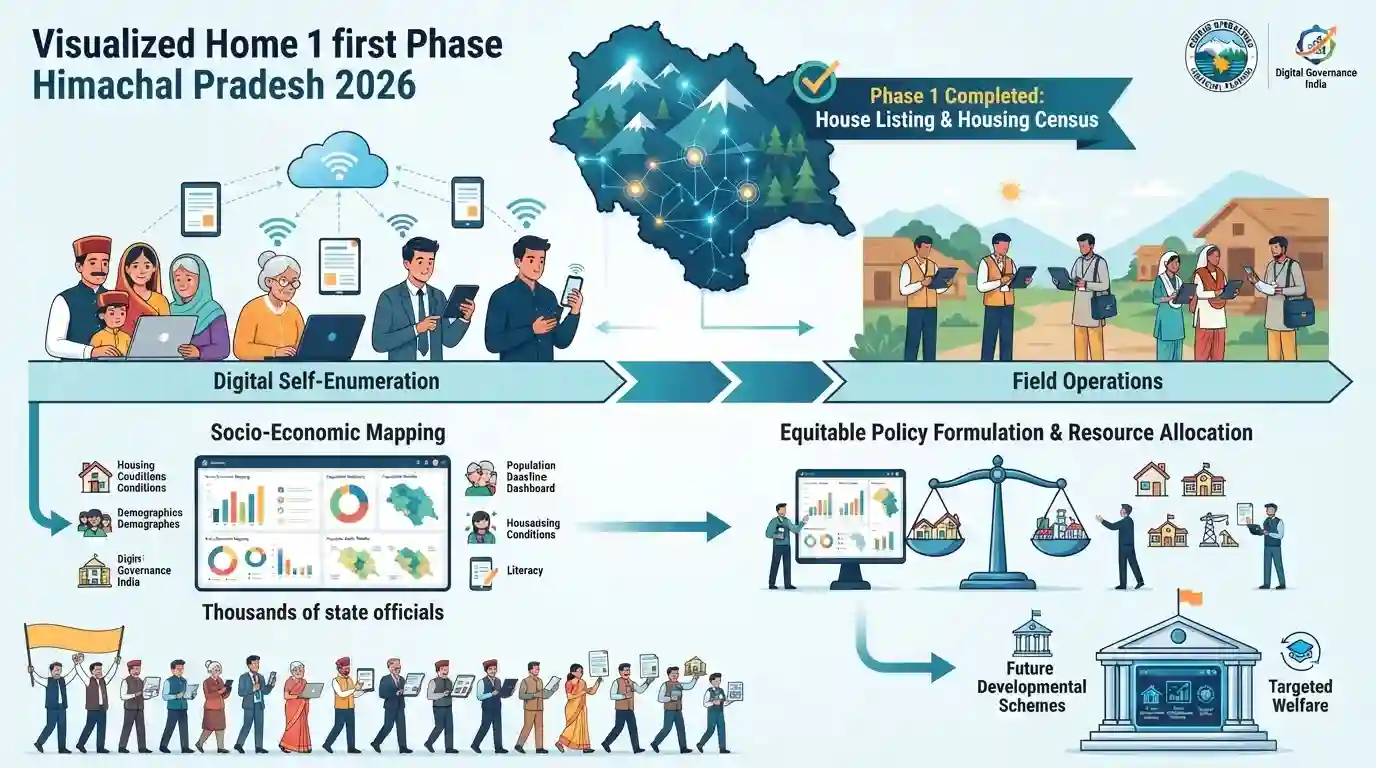
The first phase of the Census 2026, encompassing the House Listing and Housing Census, has successfully concluded across Himachal Pradesh. This milestone marks a significant step in mapping the state's socio-economic and demographic parameters. Utilizing digital platforms for the first time, citizens could self-enumerate via a web portal, reflecting a major shift towards e-governance in massive state exercises. Conducted under the Directorate of Census Operations with thousands of state officials, the data gathered will form the baseline for equitable policy formulation, future developmental schemes, and resource allocation.
Key Points
- The first phase of Census 2026 (House Listing and Housing Census) has been successfully completed in Himachal Pradesh.
- This phase focused on collecting crucial socio-economic data and information on housing conditions to guide policy-making and resource allocation.
- For the first time, self-enumeration was permitted via a dedicated web portal, leveraging digital tools under the e-Governance framework to minimize human error and streamline data collection.
- Over 20,000 enumerators and supervisors from the state government were deployed, operating under the Directorate of Census Operations.
Important Terms
Registrar General and Census Commissioner of India

The statutory authority under the Ministry of Home Affairs responsible for conducting the decennial Census of India, overseeing the Civil Registration System, and managing national demographic surveys.
UPSC context
GS Paper II (Governance): Tests understanding of statutory bodies, demographic administration, and federal policy databases.
Directorate of Census Operations
State and Union Territory-level supervisory offices under the Registrar General of India, responsible for planning, executing, and monitoring census-related operations and fieldwork within their respective jurisdictions.
UPSC context
GS Paper II (Polity & Administration): Tests knowledge of decentralized administrative machinery executing large-scale federal governance operations.
Census of India 2027
The 16th decennial national population count of India and the country's first fully digital census, employing mobile applications and self-enumeration; its first phase commenced in 2026.
UPSC context
GS Paper I (Demography): Tests knowledge of population trends, socio-economic planning, and e-governance reforms in massive data exercises.
National Statistical Office
The nodal statistical body under the Ministry of Statistics and Programme Implementation, responsible for compiling key economic indicators like GDP and CPI, and conducting large-scale sample surveys.
UPSC context
GS Paper III (Indian Economy): Tests understanding of the institutional framework for national accounting, economic planning, and statistical monitoring.
Prelims Trap
The decennial Census is conducted by MoSPI under the Concurrent List to ensure state-level legislative coordination.
The Census is a Union Subject under Entry 69, executed by the Ministry of Home Affairs (MHA), not MoSPI. States assist in operations but lack independent legislative jurisdiction.
Static Concepts Connected
What is the constitutional and legislative framework of the Census in India?
- Constitutional Status: Listed as Entry 69 under the Union List of the Seventh Schedule, making it an exclusive Central subject.
- Statutory Framework: Conducted under the Census Act, 1948, which guarantees data confidentiality and makes participation legally binding on citizens.
- Nodal Authority: Managed by the Office of the Registrar General and Census Commissioner of India (ORGI) under the Ministry of Home Affairs.
What are the two distinct phases of the Indian Census?
- House Listing Phase: Phase I focuses on housing characteristics, household amenities, assets, and identifying residential/non-residential structures.
- Population Enumeration Phase: Phase II captures individual-level data including age, marital status, religion, mother tongue, literacy, and migration details.
Cross-Topic Patterns
Digital Census + Digital Divide challenges
Shifting to digital-first and self-enumeration tests state-level digital literacy, as high-altitude regions face connectivity bottlenecks, highlighting the rural-urban digital divide.
Census data + Fiscal Federalism
Delays and updates in Census data directly impact Finance Commission horizontal tax devolution formulas and the critical delimitation of electoral constituencies under Article 82.

Constitutional basis of Census (Entry 69) vs Socio-Economic Caste Census (SECC) mandate likely to be tested in Prelims 2026.
Linked PYQs · 4
Linked PYQs · 4
- 2020HPAS_PRELIMSGS1
The phenomenon of 'demographic dividend' of a country is related to:
- 2024HPAS_PRELIMSGS1
Match List I with List II : | List I | List II | |---|---| | (a) Sandeep Shastri | (i) "Gender Demographics and Empowerment in India" | | (b) Kalpana Srivastava | (ii) "Demographic Profile and Health Status of Older Adults in India" | | (c) N. Neetha | (iii) "Demographic Dividend in India : Myth or Reality" | | (d) Mridul Eapen | (iv) "Demographic Shift and its Impact on Indian Politics" | Choose the correct answer from the options given below : Code: (a) (b) (c) (d)
- 2023HPAS_PRELIMSGS1
Digital India Act, 2023 will replace which of the following ?
- 2025HPAS_PRELIMSGS1
Which of the following is not a constituent body of National Statistics Office ?
