Rural employment scheme restructuring and federal financial devolution
Source:The Hindu ↗
Why It Matters
The replacement of MGNREGA with VB-GRAM G represents a fundamental policy shift in India's social security framework. This development is highly critical for UPSC aspirants as it bridges multiple core topics: federalism (the shifting financial burden on states), decentralized governance (the eroding autonomy of Gram Sabhas in selecting shelf of works), and the technological challenges of e-governance (geospatial mapping and digital barriers in rural development).
Summary
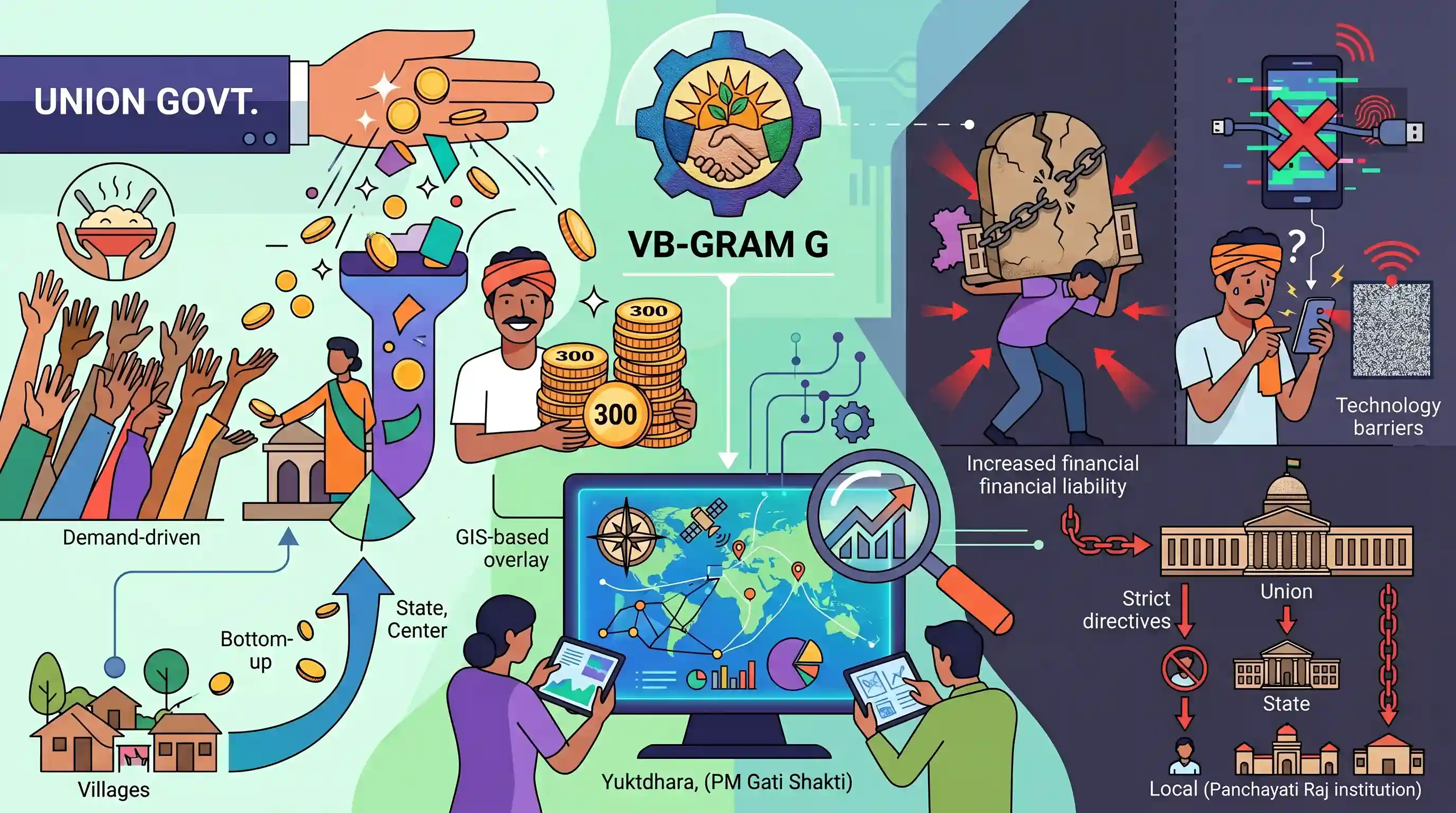
The Union government released the first instalment of ₹25,863 crore under the newly-implemented Viksit Bharat-Guarantee for Rozgar and Ajeevika Mission (Gramin) Act (VB-GRAM G), which replaced the landmark MGNREGA on July 1, 2026. The new scheme offers a minimum daily wage of ₹300 and utilizes digital, GIS-based tools like Yuktdhara and PM Gati Shakti to formulate local plans (VGPP). While the government pushes for tech-enabled efficiency, civil society groups and policy analysts have raised concerns regarding increased financial liability for states, technology barriers for rural workers, and a shift from a bottom-up, demand-driven model to a top-down, centralized approach.
Key Points
- Policy Transition: On July 1, 2026, the newly enacted Viksit Bharat-Guarantee for Rozgar and Ajeevika Mission (Gramin) Act (VB-GRAM G) officially replaced the Mahatma Gandhi National Rural Employment Guarantee Act (MGNREGA).
- Initial Disbursal & Minimum Wage: The Union Government released the first instalment of ₹25,863 crore under the new Act. The scheme mandates a minimum wage rate of ₹300 per day, as notified by the Centre.
- Geographic Allocation: Uttar Pradesh received the highest initial allocation (₹3,210.76 crore), followed by Andhra Pradesh, Rajasthan, and Tamil Nadu, while Kerala received ₹925.33 crore.
- Technology-Led Planning: Work execution relies on a Viksit Gram Panchayat Plan (VGPP). Panchayats are required to prepare a geospatial and non-spatial inventory of assets mapped through ISRO's Yuktdhara portal and the PM Gati Shakti National Master Plan.
- Federal Concerns: Critics argue that the reform increases the financial burden on state governments six-fold (from ₹7,600 crore to ₹51,000 crore) because states must now co-fund centrally-designed programs.
- Grassroots Impact: Activists express concern that replacing a demand-driven, bottom-up system with a centralized, technology-driven infrastructure model creates entry barriers for rural labor and curtails the autonomy of Gram Sabhas.
Important Terms
Viksit Bharat-Guarantee for Rozgar and Ajeevika Mission (Gramin) Act (VB-GRAM G)

A landmark 2025 social welfare legislation replacing MGNREGA. It guarantees 125 days of unskilled manual work per rural household annually, focusing on scientific, convergence-driven local infrastructure and a 60:40 Centre-State funding ratio.
UPSC context
GS Paper II: Welfare schemes, issues in federal devolution of finances, and transition from demand-driven to centralized planning.
Mahatma Gandhi National Rural Employment Guarantee Act (MGNREGA)
A historic 2005 legislative framework guaranteeing 100 days of wage employment annually to rural households. It was highly demand-driven, decentralized, and entirely funded by the Centre for wage costs.
UPSC context
GS Paper II: Poverty alleviation, rights-based governance, and performance of flagship social welfare schemes.
Yuktdhara
A geospatial planning portal developed by ISRO and the Ministry of Rural Development. It utilizes remote sensing and GIS technology to facilitate scientific, data-driven planning of rural infrastructure at the Gram Panchayat level.
UPSC context
GS Paper II & III: E-governance applications in rural development, spatial technology in planning, and transparent asset creation.
PM Gati Shakti
A national master plan launched in October 2021 integrating 16 Ministries on a digital GIS platform. It enables coordinated planning and multi-modal connectivity for infrastructure projects nationwide.
UPSC context
GS Paper III: Infrastructure development, multimodal connectivity planning, and institutional coordination in public spending.
Mazdoor Kisan Shakti Sangathan (MKSS)
A prominent Rajasthan-based grassroots civil society organisation founded by Aruna Roy and others. It pioneered the Right to Information movement and played a foundational role in drafting the original MGNREGA.
UPSC context
GS Paper II: Role of civil society organizations, pressure groups, and grassroots struggles in policy formulation.
Prelims Trap
Under the new VB-GRAM G, daily wages continue to be determined by indexing them to state-wise CPI-AL.
VB-GRAM G departs from MGNREGA's CPI-AL-linked interstate wage system, mandating a flat, uniform minimum daily wage of ₹300 across the country.
Static Concepts Connected
How were wage rates historically determined under MGNREGA?
- Section 6(1): Empowered Centre to notify wage rates under MGNREGA independently of the Minimum Wages Act, 1948.
- CPI-AL indexation: Wages were adjusted annually using the Consumer Price Index for Agricultural Labourers to mitigate rural inflation.
- Disparity issue: Variation in CPI-AL led to wide interstate wage differences, often falling below state-mandated minimum wages.
What is ISRO's 'Yuktdhara' portal and its role in rural planning?
- Bhuvan integration: It is a geospatial planning portal hosted on ISRO's Bhuvan platform, serving the Ministry of Rural Development.
- Asset mapping: Facilitates planning and tracking of rural assets using remote sensing, GIS data, and decentralized inputs.
Cross-Topic Patterns
Fiscal federalism & Central mandates
Shifting massive financial liabilities to states for centrally-designed schemes restricts their fiscal autonomy, challenging the balance of cooperative federalism.
Rights-based safety nets vs Technocracy
Replacing demand-driven work rights with top-down, GIS-planned infrastructure tests whether technocratic efficiency undermines the democratic agency of Gram Sabhas.

The transition from CPI-AL indexed, demand-driven MGNREGA to the flat-wage, GIS-planned VB-GRAM G will likely feature in GS-2/GS-3.
Linked PYQs · 3
Linked PYQs · 3
- 2025MainsGS2
e-governance projects have a built-in bias towards technology and back-end integration than user-centric designs. Examine.
- 2021MainsGS2
Has digital illiteracy, particularly in rural areas, coupled with lack of Information and Communication Technology (ICT) accessibility hindered socio-economic development? Examine with justification.
- 2020MainsGS2
The strength and sustenance of local institutions in India has shifted from their formative phase of 'Functions, Functionaries and Funds' to the contemporary stage of 'Functionality'. Highlight the critical challenges faced by local institutions in terms of their functionality in recent times.
