First Department of Military Medicine Established in Lucknow
Source:The Hindu ↗
Why It Matters
This is a significant milestone for India's Armed Forces and an important piece of current affairs for Uttar Pradesh, as the first-of-its-kind facility is located in Lucknow. It is highly relevant for UPPSC Prelims questions related to state-specific defence infrastructure and national security preparedness.
Summary
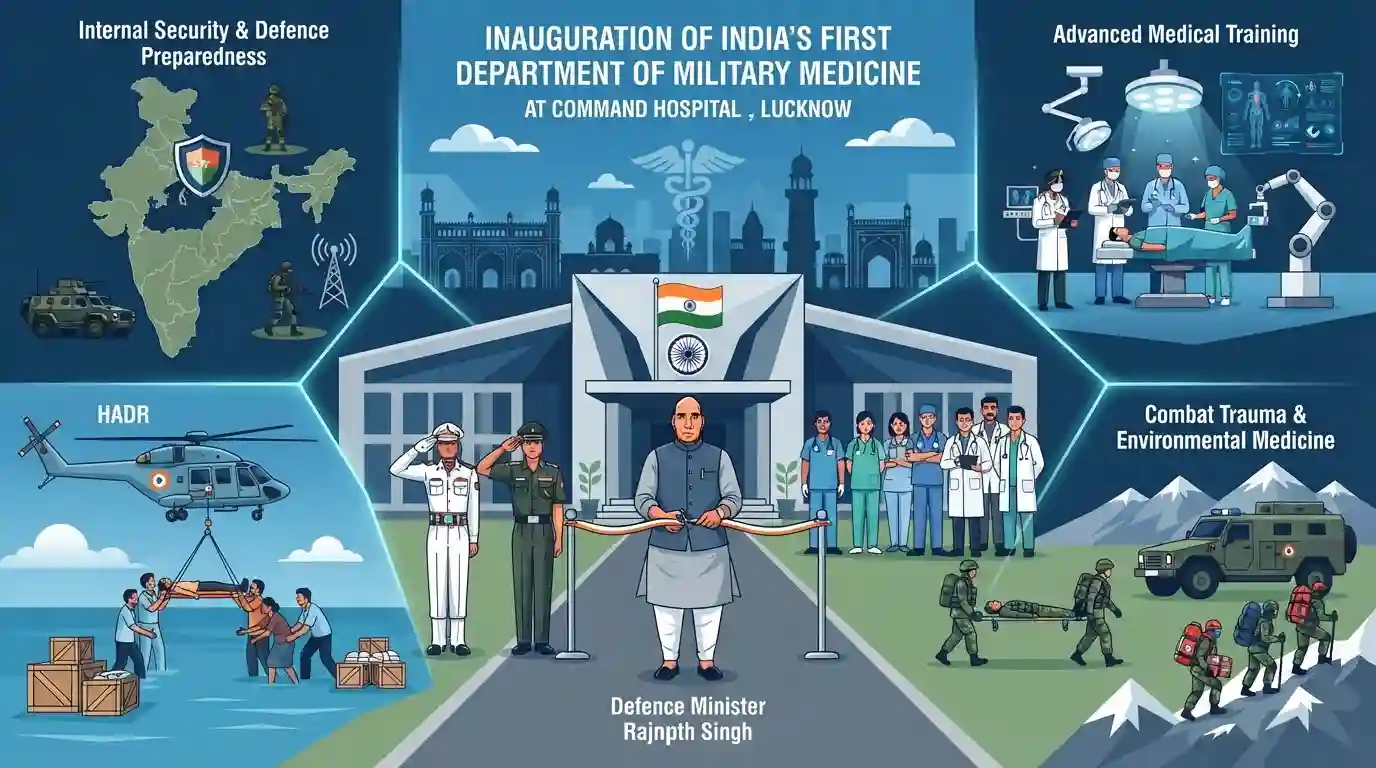
The Ministry of Defence has established India's first dedicated Department of Military Medicine at the Command Hospital in Lucknow. Inaugurated by Defence Minister Rajnath Singh, the department is designed to bolster the operational medical capabilities of the Armed Forces Medical Services (AFMS). It will focus on advanced medical training and research in specialized areas such as Humanitarian Assistance and Disaster Relief (HADR), CBRNE defence, combat trauma, and environmental medicine, thereby strengthening India's battlefield healthcare and disaster response frameworks.
Key Points
- India's first dedicated Department of Military Medicine has been inaugurated at the Command Hospital (Central Command) in Lucknow by Defence Minister Rajnath Singh.
- The facility focuses on enhancing the operational medical preparedness of the Armed Forces Medical Services (AFMS).
- It will specialize in fields like military trauma, combat psychiatry, environmental medicine, and humanitarian assistance and disaster relief (HADR).
- The department aims to develop indigenous doctrines, promote research, and strengthen the Armed Forces' capabilities in responding to CBRNE (Chemical, Biological, Radiological, Nuclear, and Explosives) threats.
Important Terms
Armed Forces Medical Services (AFMS)

The tri-service medical organization of the Indian Armed Forces, established in 1948, providing comprehensive healthcare to military personnel, dependents, and veterans, while overseeing medical training, research, and disaster relief operations.
UPSC context
GS Paper 3 (Security forces & their mandate); tests understanding of military healthcare infrastructure and operational readiness.
Department of Military Medicine
India's first dedicated academic and operational department focused on combat medicine, casualty care, disaster response, and research. Established at Lucknow's Command Hospital, it operates under the Directorate General of Medical Services (Army).
UPSC context
GS Paper 3 (Internal Security/Defence Preparedness); tests awareness of military healthcare modernization and national security capabilities.
Humanitarian Assistance and Disaster Relief (HADR)
Coordinated civil-military operations providing rapid relief, evacuation, and medical aid during disasters. It serves as a vital component of India's disaster management framework and regional diplomacy.
UPSC context
GS Paper 3 (Disaster Management) & GS Paper 2 (IR); tests India's strategic role as a first responder in the Indo-Pacific.
CBRN Defence
Protective measures and response protocols against Chemical, Biological, Radiological, and Nuclear hazards. It encompasses detection, personal protection, decontamination, and medical response to mitigate threats from weapons of mass destruction.
UPSC context
GS Paper 3 (Security/Disaster Management); tests awareness of non-conventional threats, emergency response, and defense preparedness.
Command Hospital (Central Command)
A premier multi-specialty military tertiary care referral hospital in Lucknow. It serves over three lakh armed forces personnel, veterans, and their dependents across central India and Nepal.
UPSC context
GS Paper 3 (Defence Infrastructure); tests knowledge of key medical support installations of the Indian Armed Forces.
Prelims Trap
The Department of Military Medicine is a specialized agency operating under the NDMA in New Delhi.
Aspirants may wrongly assume a CBRNE/HADR medical center is under NDMA or DRDO in New Delhi. It is under the Armed Forces Medical Services (Army) in Lucknow.
Static Concepts Connected
What constitutes CBRNE threats and how does India manage them?
- CBRNE meaning: Chemical, Biological, Radiological, Nuclear, and Explosives.
- Nodal authorities: NDMA drafts national guidelines, while specialized NDRF battalions serve as the primary on-ground responders.
- Military integration: The Armed Forces, now aided by the DMM, provide secondary, specialized medical response and research for CBRNE casualties.
What is the role of India's Armed Forces in HADR operations?
- First responder: The Indian Armed Forces are the primary responders for Humanitarian Assistance and Disaster Relief in the Indian Ocean Region (IOR).
- Medical diplomacy: Operations like Maitri (Nepal) and Dost (Turkey) demonstrate India's use of military medical capabilities for diplomacy.
- Joint exercises: Multilateral drills like PANEX (BIMSTEC) and Tiger Triumph (US-India) heavily integrate military medical and HADR interoperability.
Cross-Topic Patterns
HADR as soft-power diplomacy
Military medicine and HADR capabilities bolster India's 'Neighborhood First' and SAGAR policies, serving as a critical diplomatic tool for rapid disaster response across the Indian Ocean Region.
Biosecurity and CBRNE defense
The specific focus on CBRNE trauma highlights an evolving internal security landscape, linking traditional military preparedness to emerging biological and chemical warfare threats.

Expect a multi-statement prelims question linking India's CBRNE defense architecture with AFMS's new mandate and NDRF's primary role.
Linked PYQs · 2
Linked PYQs · 2
- 2024UPPSC_PRELIMSGS1
CPR stands for :
- 2022UPPSC_PRELIMSGS1
Consider the following cities of Uttar Pradesh and arrange them in descending order in terms of their population. I. Ghaziabad II. Kanpur III. Agra IV. Lucknow Select the correct answer from the code given below :
