Delhi to Conduct First Cloud Seeding Trials to Combat Smog
Source:The Hindu ↗
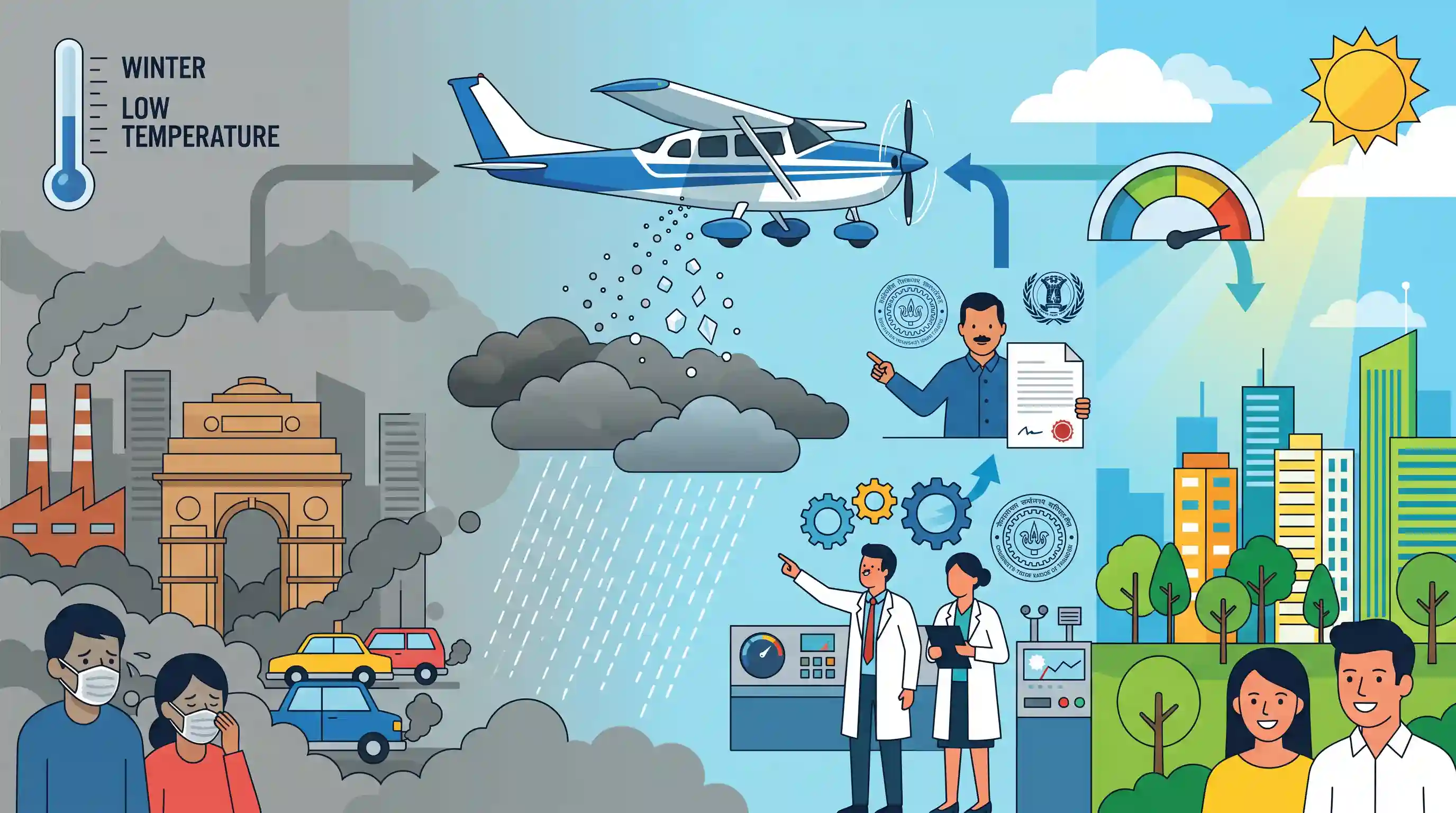
Why It Matters
Urban air pollution, particularly winter smog in Delhi, is a recurring environmental and public health crisis. The deployment of weather modification technologies like cloud seeding represents an intersection of Science & Technology and Environmental Governance. Aspirants must understand the underlying science of artificial rain (e.g., seeding agents like silver iodide), its efficacy against particulate matter, and the regulatory framework governing airspace for such interventions.
Summary
The Delhi government has partnered with IIT Kanpur to conduct the city's first cloud-seeding trials between October 7 and 9 in an effort to combat severe winter air pollution and smog. Supported by an MoU worth ₹3.2 crore, the pilot project will use a Cessna 206-H aircraft operated by IIT Kanpur's Department of Aerospace Engineering. The initiative has received the necessary regulatory clearances from the DGCA under the Aircraft Rules, 1937, and will be carried out in coordination with meteorological experts from IITM Pune and the IMD. This marks a significant technological intervention in environmental governance to address chronic urban air quality challenges.
Key Points
- Delhi is scheduled to conduct its first cloud-seeding trial between October 7 and 9 as an emergency measure to mitigate winter air pollution and smog.
- The Delhi government signed a ₹3.2 crore Memorandum of Understanding (MoU) with IIT Kanpur to execute the pilot project.
- Regulatory clearance was obtained from the Directorate General of Civil Aviation (DGCA) under Rule 26(2) of the Aircraft Rules, 1937.
- The operation will utilize a Cessna 206-H aircraft operated by IIT Kanpur's Department of Aerospace Engineering, with meteorological support from IITM Pune and IMD.
Important Terms
Cloud Seeding

A weather modification technique that disperses substances like silver iodide or dry ice into clouds to stimulate precipitation through nucleation.
UPSC context
GS Paper 3 (Science & Tech/Environment); tests knowledge of technological interventions for pollution mitigation and drought management.
Aircraft Rules, 1937
Statutory framework under the Aircraft Act, 1934, governing aircraft registration, pilot licensing, airworthiness, and safety standards for all civil aviation operations in India.
UPSC context
GS Paper 3 (Infrastructure/Aviation); relevant for understanding the legal and safety regulations of Indian airspace and emerging technologies.
Directorate General of Civil Aviation (DGCA)
The apex statutory regulatory body under the Ministry of Civil Aviation responsible for ensuring safety, airworthiness, and licensing in the Indian civil aviation sector.
UPSC context
GS Paper 2 (Statutory Bodies) and Paper 3 (Aviation); focuses on institutional roles in regulating infrastructure and safety.
India Meteorological Department (IMD)
The principal government agency under the Ministry of Earth Sciences responsible for meteorological observations, weather forecasting, and early warning systems for natural disasters.
UPSC context
GS Paper 1 (Geography) and GS Paper 3 (Disaster Management); crucial for monsoon studies and climate governance.
Indian Institute of Tropical Meteorology (IITM) Pune
An autonomous research institute under the Ministry of Earth Sciences, Pune, specializing in monsoon meteorology, atmospheric physics, and weather modification research.
UPSC context
GS Paper 3 (Science & Tech); highlights indigenous R&D efforts in climate science and weather modification technologies.
Indian Institute of Technology (IIT) Kanpur
A premier technical university in India leading research in aerospace engineering and environmental solutions, such as the cloud-seeding technology used in urban pollution control.
UPSC context
GS Paper 3 (Science & Tech); relevant for the role of premier academic institutions in national technological missions.
Prelims Trap
Cloud seeding can artificially create rain in clear skies during severe drought or smog.
Cloud seeding strictly requires pre-existing, moisture-laden clouds. It cannot conjure rain out of a clear, dry sky, making it highly weather-dependent.
Static Concepts Connected
What chemicals are used in cloud seeding and how do they work?
- Cold Clouds: Agents like Silver Iodide or Dry Ice act as ice-nucleating particles, freezing super-cooled water droplets in higher-altitude, cooler clouds.
- Warm Clouds: Salts like Sodium Chloride act as giant condensation nuclei, absorbing moisture to form larger rain droplets in lower-altitude clouds.
- Wash-out Effect: Falling artificial precipitation physically scavenges suspended particulate matter (PM2.5 and PM10) from the air, temporarily cleansing the lower atmosphere.
What is the SAFAR system and who developed it?
- Developer: It was developed by the Indian Institute of Tropical Meteorology (IITM) Pune and is operationalized by the India Meteorological Department (IMD).
- Function: It provides location-specific, real-time air quality data and 72-hour advance weather and AQI forecasts for metropolitan cities.
- Pollutants Tracked: Monitors PM2.5, PM10, Ozone, CO, NOx, SO2, Benzene, Toluene, Xylene, and Mercury.
Cross-Topic Patterns
Geoengineering and Ecological Ethics
Cloud seeding connects to broader geoengineering debates (e.g., solar radiation management). Repeated use risks silver toxicity in soil and aquatic ecosystems, disrupting local food chains.
Winter Smog: Tech vs Structural Fixes
Highlights the governance trend of relying on 'end-of-pipe' emergency tech interventions (smog towers, artificial rain) rather than resolving root causes like stubble burning and vehicular emissions.

Expect a Prelims question combining cloud seeding chemicals (Silver Iodide vs NaCl) and its strict prerequisite of pre-existing moisture.
Linked PYQs · 2
Linked PYQs · 2
- 2025PrelimsGS1
Artificial way of causing rainfall to reduce air pollution makes use of
- 2022MainsGS3
Discuss in detail the photochemical smog emphasizing its formation, effects and mitigation. Explain the 1999 Gothenburg Protocol.
