Defence Budget Hike and Capital Outlay for Military Modernization
Source:Indian Express ↗
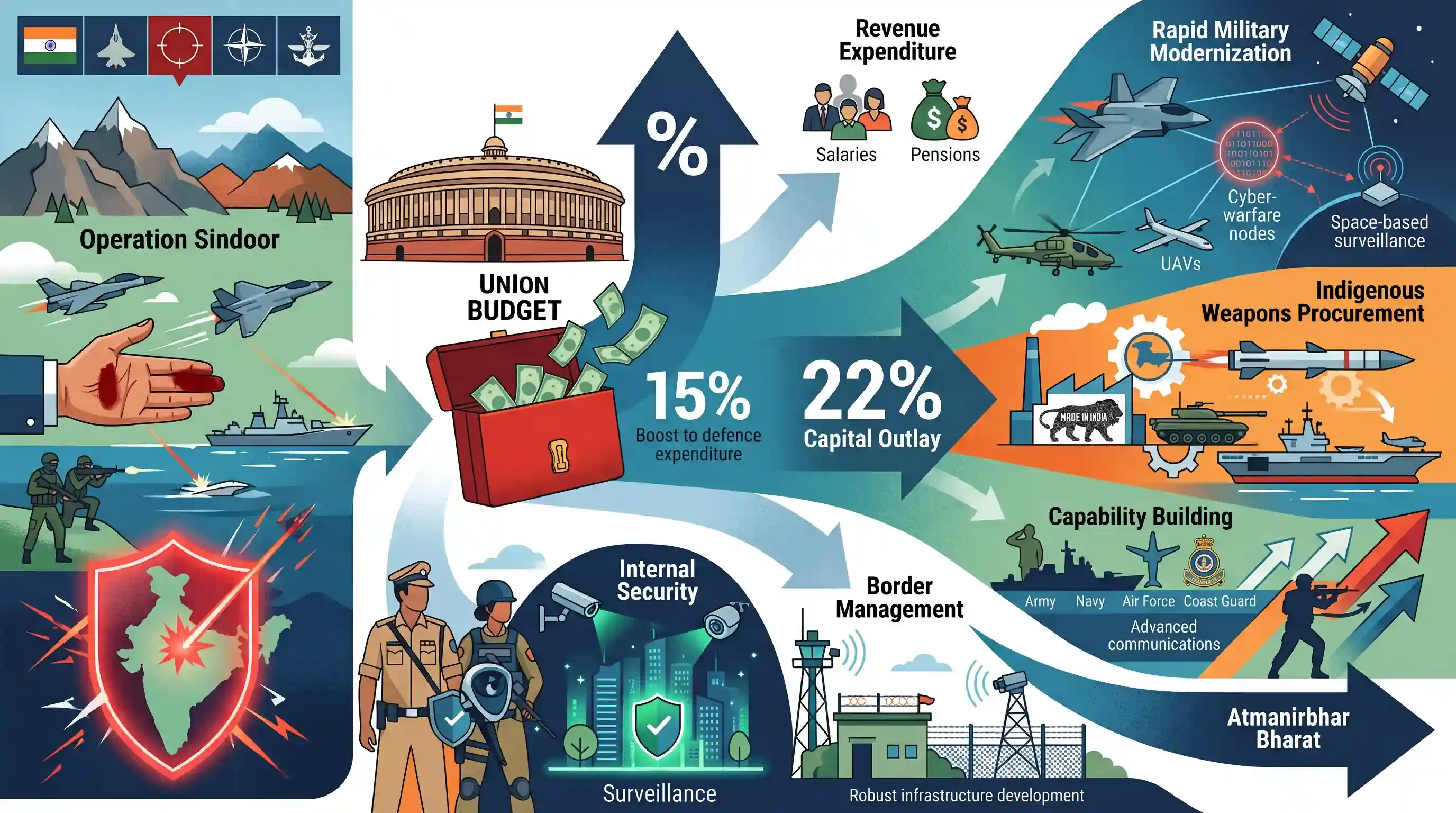
Why It Matters
The sharp 22% rise in capital outlay highlights a critical policy shift towards hard military modernization and self-reliance in the aftermath of 'Operation Sindoor'. This is highly relevant for GS3, spanning both Union Budgeting (capital vs. revenue expenditure) and Security (defence preparedness).
Summary
In the first Union Budget following 'Operation Sindoor', India has significantly increased its defence allocation by 15% to ₹7.85 lakh crore. Notably, the capital outlay for the defence sector has been hiked by 22%, indicating a clear strategic shift towards rapid military modernization, indigenous weapons procurement, and capability building rather than just revenue expenditure like salaries and pensions.
Key Points
- India has hiked its overall defence budget by 15%, allocating ₹7.85 lakh crore in the Union Budget.
- The capital outlay for defence has witnessed a sharp 22% increase, signalling a strong focus on military modernization and equipment acquisition.
- This is the first budget following 'Operation Sindoor', reflecting a strategic priority on bolstering defence preparedness and internal security.
Important Terms
Operation Sindoor

A 2025 Indian tri-services operation involving precision strikes against terrorist camps in Pakistan and PoK, launched in response to the Pahalgam terror attack.
UPSC context
GS Paper III: Internal Security; analyzes India's 'proactive' defense posture and the shift toward technology-driven retaliatory strikes.
Capital Outlay
Budgetary allocation for long-term assets like fighter jets, warships, and infrastructure. It signifies investment in the future combat capabilities and modernization of the armed forces.
UPSC context
GS Paper III: Economy (Budgeting); tests the balance between asset creation and operational maintenance in fiscal planning.
Revenue Expenditure
Recurring expenditure on day-to-day operations, including salaries, pensions, maintenance, and ammunition. It ensures the immediate operational readiness of the military.
UPSC context
GS Paper III: Economy; highlights fiscal challenges like the high burden of pensions and salaries on the total defense budget.
Indigenous Procurement
A policy mandate to procure defense equipment from domestic manufacturers. In the 2026-27 budget, 75% of capital acquisition funds were reserved for this.
UPSC context
GS Paper III: Science & Tech / Security; evaluates 'Aatmanirbharta' and the goal of reducing strategic import dependence.
Modernisation
The process of upgrading legacy systems with cutting-edge technology, such as drones, AI, and advanced missile systems, to meet evolving geopolitical threats.
UPSC context
GS Paper III: Security; focuses on the military's transformation from conventional to technology-intensive warfare (Theaterisation).
Operational Readiness
The state of being prepared to deploy forces immediately. Post-Operation Sindoor, revenue hikes prioritized ammunition stockpiling and maintenance of critical platforms.
UPSC context
GS Paper III: Internal Security; concerns the 'teeth-to-tail' ratio and immediate response capability against cross-border threats.
Prelims Trap
India's defence budget allocation has now crossed the strategic threshold of 3% of GDP.
Despite a 15% hike and record absolute numbers, India's defence spending remains around 1.9% to 2% of GDP, below the recommended 3%.
Static Concepts Connected
What distinguishes Capital from Revenue expenditure in the Defence Budget?
- Capital Outlay: Covers asset creation, technological modernization, purchasing new weaponry, aircraft, ships, and infrastructure development.
- Revenue Outlay: Covers routine operational costs including salaries, pensions (like OROP), rations, and day-to-day maintenance of existing equipment.
How was defence spending classified prior to the 2017-18 Budget reforms?
- Non-Plan Classification: Prior to 2017-18, India's entire defence expenditure (both capital acquisitions and revenue maintenance) was categorized as Non-Plan Expenditure.
- Post-2017 Reform: The scrapping of the Plan and Non-Plan distinction shifted the budgetary focus entirely onto the Capital vs. Revenue expenditure split.
Cross-Topic Patterns
Capital Outlay & Defence Indigenisation
Earmarking 75% of the capital acquisition budget for domestic industries merges defense preparedness directly with the 'Make in India' initiative and import substitution goals.
Border Management & Asymmetric Threats
The sharp 22% capital hike aligns with internal security needs highlighted by Op Sindoor, emphasizing counter-drone tech and border infrastructure over routine troop maintenance.

Expect a 2026 Prelims statement mixing defence capital outlay trends, GDP percentage realities, and domestic procurement earmark targets.
Linked PYQs · 4
Linked PYQs · 4
- 2021MainsGS3
Distinguish between Capital Budget and Revenue Budget. Explain the components of both these Budgets.
- 2014PrelimsGS1
With reference to Union Budget, which of the following is/are covered under Non-Plan Expenditure? 1. Defence expenditure 2. Interest payments 3. Salaries and pensions 4. Subsidies Select the correct answer using the code given below.
- 2022PrelimsGS1
With reference to the expenditure made by an organisation or a company, which of the following statements is/are correct? 1. Acquiring new technology is capital expenditure. 2. Debt financing is considered capital expenditure, while equity financing is considered revenue expenditure. Select the correct answer using the code given below:
- 2020MainsGS3
Analyze internal security threats and transborder crimes along Myanmar, Bangladesh and Pakistan borders including Line of Control (LoC). Also discuss the role played by various security forces in this regard.
