Air defense interception of cross border attacks targeting Jammu
Source:Indian Express ↗
Why It Matters
The incident represents a critical escalation in conventional military hostilities between India and Pakistan. For UPSC aspirants, it is highly relevant for understanding active security threats along the border, evaluating the practical effectiveness of India's air defense systems (like the S-400 or indigenous shields), and analyzing the broader geopolitical ramifications for India's neighborhood first policy and regional stability.
Summary
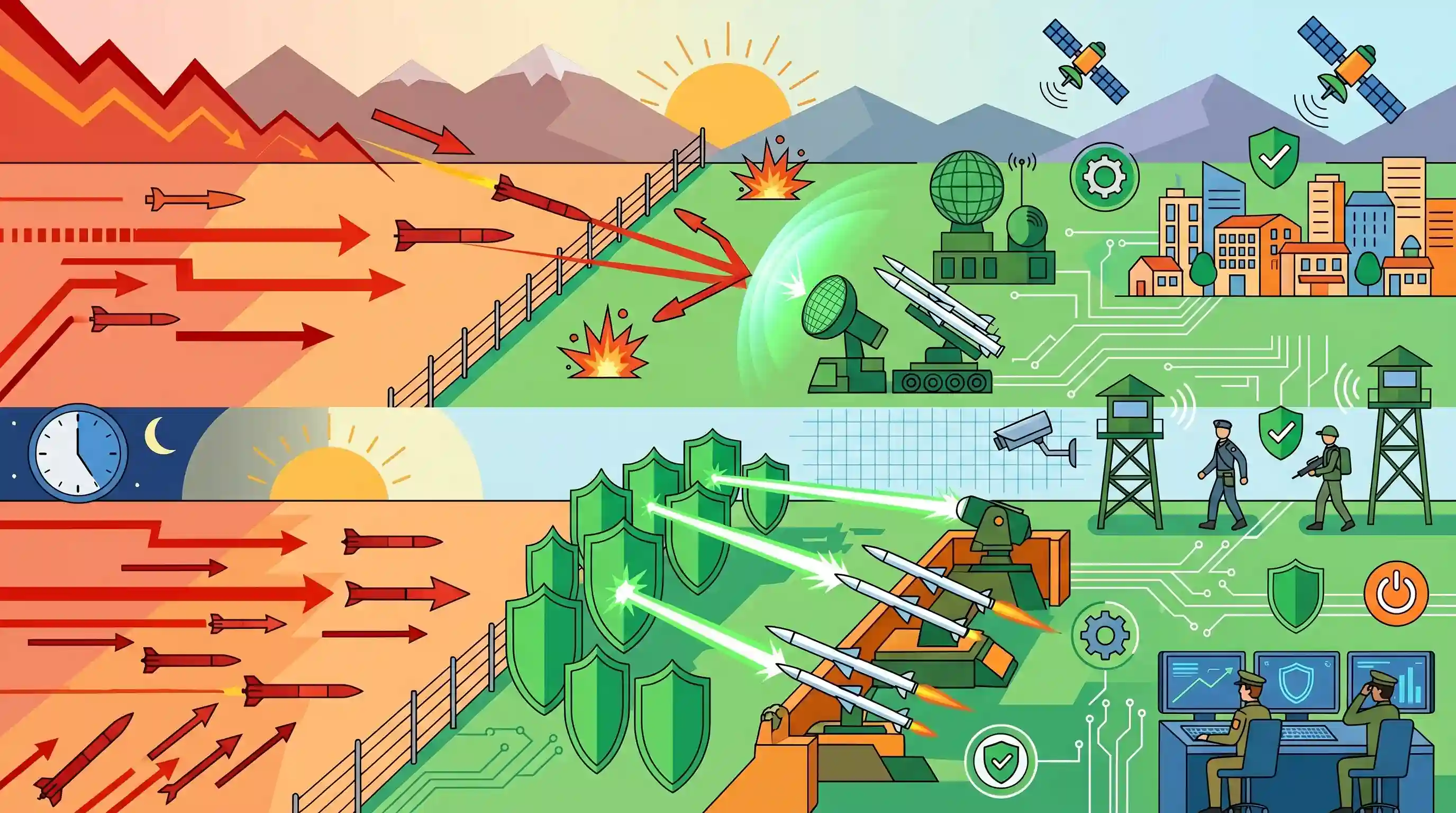
Tensions between India and Pakistan escalated sharply after Pakistani forces attempted a direct strike on Jammu city. Indian defense systems successfully intercepted the initial assault. Hours later, in the early morning, Pakistan launched a secondary barrage, which was also successfully repelled by Indian forces. The incident underscores a significant spike in cross-border hostilities, while simultaneously validating the effectiveness and high alert status of India's air defense network and border security mechanisms.
Key Points
- Pakistan launched direct military strikes targeting Jammu city, marking a severe escalation in cross-border aggression.
- Indian defense forces successfully intercepted the initial attack.
- A second barrage launched by Pakistan in the early morning was also repelled, demonstrating the continuous operational readiness of India's air defense systems.
- The back-to-back strikes highlight a sustained hostile intent, increasing the risk of a broader conventional conflict in the region.
Important Terms
Air Defence Network

A multi-layered military framework comprising sensors, command units, and interceptors (like S-400 or Akash) designed to detect and neutralize aerial threats such as missiles and drones before impact.
UPSC context
GS Paper III (Security): Essential for discussing defense technology, asymmetric warfare, and safeguarding strategic assets from aerial/missile threats.
Border Management
The strategic effort to secure national boundaries against infiltration, smuggling, and external aggression while facilitating legitimate transit; involves the BSF on the India-Pakistan International Border.
UPSC context
GS Paper III (Internal Security): Tests knowledge of border security forces, terrain challenges, and the management of sensitive frontiers.
Cross-border Hostility
Direct or proxy military aggression originating from across a sovereign border; often manifested through ceasefire violations, infiltration, or direct strikes by external state or non-state actors.
UPSC context
GS Paper III (Security): Evaluates the role of external state actors in challenging India's internal security and territorial integrity.
Jammu (Strategic Importance)
A critical administrative and strategic hub on India's International Border (IB), distinct from the Line of Control (LoC), serving as a frequent target for cross-border infiltration and strikes.
UPSC context
GS Paper II (International Relations): Essential for understanding India-Pakistan bilateral disputes and the geopolitical significance of the J&K region.
Mission Sudarshan Chakra
India's initiative to build an integrated, technology-driven air defense shield incorporating AI, space-based surveillance, and long-range interceptors like the S-400 Triumf.
UPSC context
GS Paper III (S&T / Security): Relevant for modern defense indigenization and the transformation of India's national security architecture via AI.
Internal Security
The preservation of peace, law, and order within national borders, threatened by factors like terrorism, insurgency, and organized crime supported by external adversaries.
UPSC context
GS Paper III (Internal Security): Core topic examining challenges to sovereignty and the government's response to domestic and proxy threats.
Prelims Trap
Akash is an indigenous long-range surface-to-air missile system used for intercepting ballistic missiles.
Akash is a short-to-medium-range (up to 25 km) SAM system designed for aircraft, drones, and cruise missiles. It is not an anti-ballistic or long-range system.
Static Concepts Connected
What are the key layers of India's multi-tiered air defense system?
- Long-range (S-400): Procured from Russia; intercepts targets up to 400km including stealth aircraft, drones, and ballistic missiles.
- Medium-range (MRSAM): Jointly developed with Israel; defends against aircraft and precision-guided munitions at a 70-100km range.
- Short-range (Akash): Indigenous SAM system; protects critical infrastructure against low-altitude threats like drones and helicopters up to 25km.
What is the role of IACCS in India's defense structure?
- Unified Network: Integrates all ground-based and airborne sensors (like AWACS) to create a comprehensive, real-time air situation picture.
- Civil-Military Synergy: Links civilian air traffic control radars with military networks, preventing friendly fire and identifying hostile intrusions quickly.
Cross-Topic Patterns
From Proxy Terror to Kinetic Strikes
The shift from irregular proxy warfare to direct drone/missile barrages fundamentally alters LoC border management, requiring continuous IAF integration alongside Army ground forces.
Loitering Munitions & Border Security
The rising threat of cross-border loitering munitions ties directly into DRDO's anti-drone system (D4S) development, challenging the efficacy of traditional physical border fencing models.

Expect a Prelims 2026 match-the-following question pairing air defense systems (S-400, MRSAM, Akash) with their specific ranges and origins.
Linked PYQs · 5
Linked PYQs · 5
- 2024MainsGS3
India has a long and troubled border with China and Pakistan fraught with contentious issues. Examine the conflicting issues and security challenges along the border. Also give out the development being undertaken in these areas under the Border Area Development Programme (BADP) and Border Infrastructure and Management (BIM) Scheme.
- 2020MainsGS3
Analyze internal security threats and transborder crimes along Myanmar, Bangladesh and Pakistan borders including Line of Control (LoC). Also discuss the role played by various security forces in this regard.
- 2015MainsGS2
Terrorist activities and mutual distrust have clouded India-Pakistan relations. To what extent the use of soft power like sports and cultural exchanges could help generate goodwill between the two countries? Discuss with suitable examples.
- 2021MainsGS3
How is S-400 air defence system technically superior to any other system presently available in the world?
- 2023MainsGS3
The use of unmanned aerial vehicles (UAVs) by our adversaries across the borders to ferry arms/ammunitions, drugs, etc., is a serious threat to the internal security. Comment on the measures being taken to tackle this threat.
