Nerwa fire station inauguration to bolster rural disaster response
Source:uniindia ↗
Why It Matters
Highlights state efforts in disaster risk reduction in vulnerable hill terrains and emphasizes decentralized governance through Mini Secretariats, which are critical themes for HPAS exams.
Summary
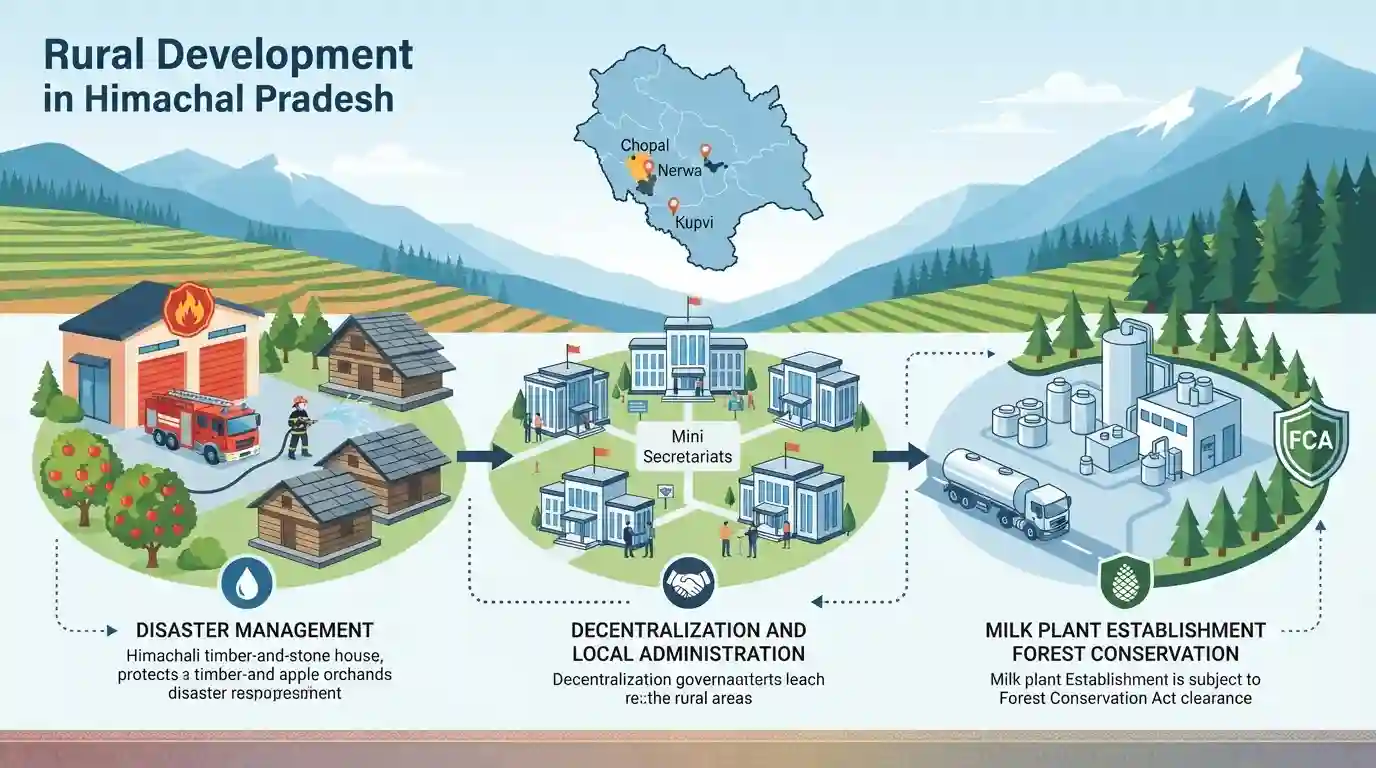
Himachal Pradesh has inaugurated a new fire station at Nerwa in the Shimla district, a strategic move to strengthen rural disaster response and safeguard traditional architecture and apple orchards. Alongside emergency infrastructure, the state government is decentralizing administration by funding Mini Secretariats in Chopal, Nerwa, and Kupvi, and plans to establish a milk plant subject to Forest Conservation Act clearance.
Key Points
- Himachal Pradesh CM Thakur Sukhvinder Singh Sukhu inaugurated a new Fire Station at Nerwa in Shimla district to bolster disaster management and emergency response for over 55,000 rural residents.
- The facility is crucial for protecting traditional wooden houses and valuable apple orchards, and will aid rescue operations during heavy rainfall and landslides in the challenging terrain.
- The state is planning to set up a milk plant in the region, which is currently undergoing the process for clearance under the Forest Conservation Act.
- To decentralize administration, the government released Rs 7 crore for the construction of Mini Secretariats at Chopal, Nerwa, and Kupvi, bringing various government services closer to remote populations.
Important Terms
Forest Conservation Act (FCA), 1980

A 1980 central law enacted to safeguard India's forests, restricting the diversion of forest land for non-forest purposes (like mining or industries) without prior approval from the Central Government.
UPSC context
GS-3 (Environment): Crucial for assessing balancing acts between environmental conservation and infrastructure/economic development, specifically forest diversion.
Decentralization
A process of shifting power, responsibilities, and financial resources from central authorities to local governments. This "Mini Secretariat" initiative integrates various departments at the district level for easier citizen access.
UPSC context
GS-2 (Polity & Governance): Essential concept concerning citizen-centric governance, Local Self-Government (PRIs/ULBs), and administrative efficiency.
Fire Services
State or local authorities acting as primary emergency first responders to fire accidents and disasters, governed under the 12th Schedule (Municipalities) and incorporated into multi-hazard response under the Disaster Management Act.
UPSC context
GS-3 (Disaster Management): Focuses on emergency preparedness, first-responder capacity building, and institutional frameworks for mitigating community hazards.
Prelims Trap
"State governments have autonomous authority to divert forest land for rural infrastructure without Central approval."
Under Section 2 of the Forest Conservation Act 1980, state governments must obtain prior approval from the Central Government to divert forest land.
Static Concepts Connected
What are the key features of Kath-Kuni architecture in Himachal Pradesh?
- Materials: Utilizes alternating, interlocking layers of wood (like deodar) and stone.
- Dry Masonry: Constructed entirely as dry masonry without the use of mortar.
- Disaster Profile: Flexible joints provide excellent seismic shock absorption, but the heavy use of timber makes settlements highly susceptible to rapid fire spread.
How does the Forest Conservation Act 1980 regulate the diversion of forest land?
- Central Mandate: State governments are prohibited from diverting forest land for non-forest purposes without prior mandatory approval from the Central Government.
- Non-Forest Purposes: Includes establishing agricultural industries (like a milk plant), construction, or mining within designated forest zones.
Cross-Topic Patterns
Vernacular Architecture + Disaster Risk
Vernacular architectures like Kath-Kuni are celebrated for seismic resilience, but their timber reliance exposes a critical fire vulnerability, merging Art & Culture with Disaster Management.
Local Governance vs Eco-Clearances
The push for localized infrastructure like agro-plants frequently bottlenecks at central environmental clearances (FCA), highlighting the administrative tension between decentralized governance and ecological oversight.

Expect a multi-statement Prelims question contrasting the seismic resilience of Kath-Kuni architecture with its high fire vulnerability.
Linked PYQs · 5
Linked PYQs · 5
- 2025HPAS_PRELIMSGS1
Mountain Soil Zone in Himachal Pradesh is found between :
- 2025HPAS_PRELIMSGS1
According to PLFS 2023-24, share of secondary and tertiary sector in total employment in Himachal Pradesh respectively are :
- 2024HPAS_PRELIMSGS1
For the year 2023-24, match the type/name of banks with their total number of branches in Himachal Pradesh : | List I (Type/Name of Bank) | List II (No. of Branches in HP) | |---|---| | (a) Public Sector Banks (PSBs) | (i) 267 | | (b) Private Sector Banks (PSBs) | (ii) 568 | | (c) Himachal Pradesh Gramin Bank (HPGB) | (iii) 1,170 | | (d) Himachal Pradesh Co-operative Sector Banks | (iv) 274 | Choose the correct option : Code: (a) (b) (c) (d)
- 2022HPAS_PRELIMSGS1
Match List I with List II : | List I (Policy) | List II (Year) | |---|---| | (a) Wildlife | (i) 1992 | | (b) Forest | (ii) 1972 | | (c) Environment | (iii) 1988 | | (d) Pollution | (iv) 2006 | Choose the correct answer from the options given below : Code: (a) (b) (c) (d)
- 2022HPAS_PRELIMSGS1
Select the correct statements from the following : (i) Supreme Court of India has allowed the State for silviculture green felling of three species on experimental basis. (ii) Forests in H.P. cover an area of 37947 sq. kms of total geographical area of the state (iii) In H.P. presently 30% of the total geographical areas support forest cover. (iv) The aim of the forest department is to enhance the forest cover in the state to 35% of its geographical area by 2030.
