Maritime disasters and India marine salvage response capabilities
Source:The Hindu ↗
Why It Matters
With India positioned near critical global trade routes, incidents like ship fires and oil spills are ever-present risks. This topic is crucial for UPSC aspirants as it bridges disaster management, environmental conservation (marine pollution), and maritime security, all of which are frequent themes in Mains GS-3.
Summary
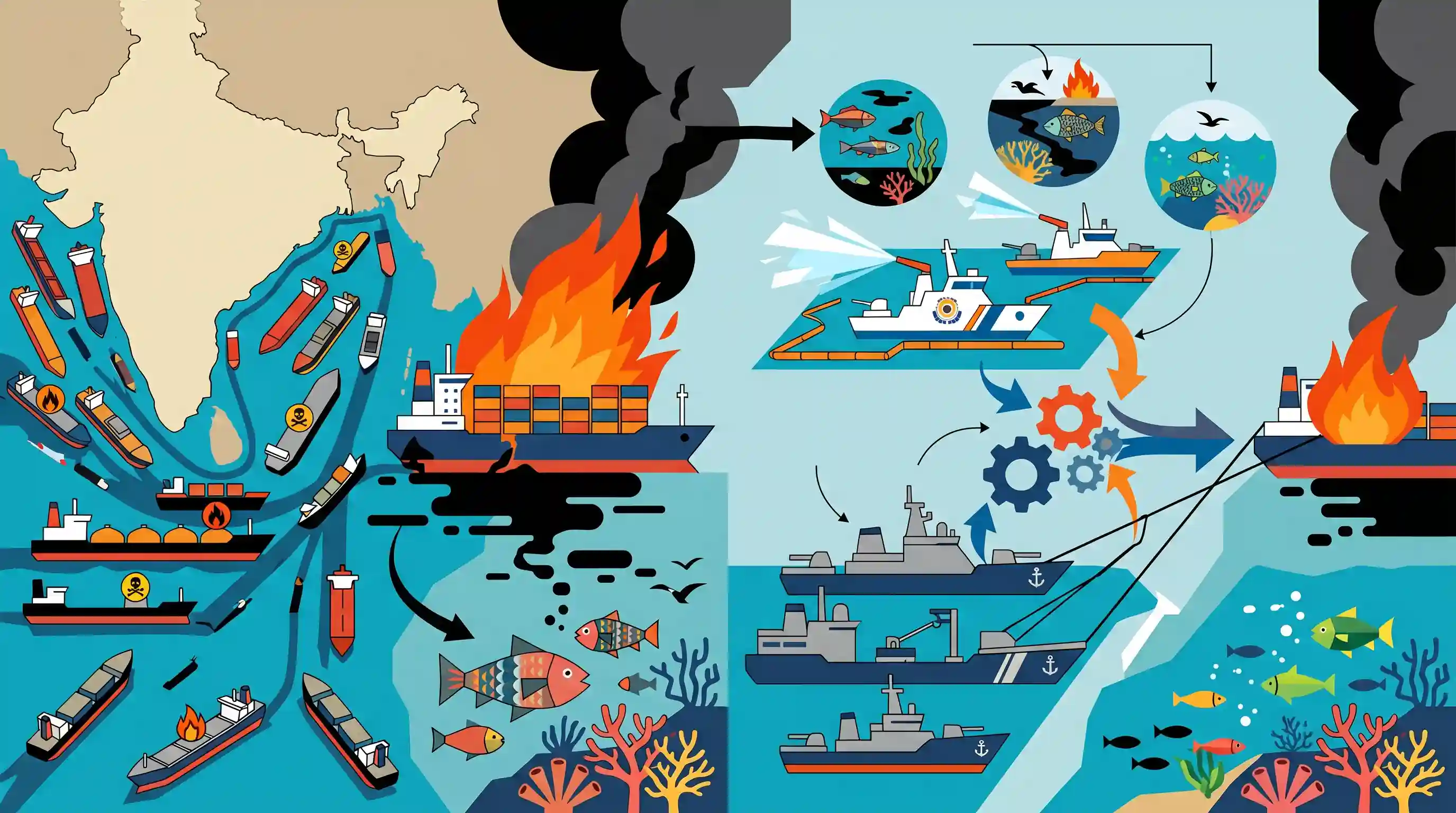
Recent maritime accidents, including a ship fire off the Kerala coast, highlight India's urgent need to bolster its maritime firefighting and salvage capabilities. Given the dense shipping traffic carrying hazardous and flammable cargo near India's long coastline and critical global choke points, the risk of catastrophic oil spills and fires is high. The editorial stresses that mitigating such environmental and security threats demands swift, multi-agency coordination—primarily involving the Indian Coast Guard and Navy—to rapidly secure, tow, and salvage distressed vessels, thereby protecting marine ecosystems.
Key Points
- The recent fire onboard the merchant vessel MV Wan Hai 503 off the Kerala coast underscores the vulnerability of India's maritime zones to ship accidents.
- India's proximity to major global shipping choke points like the Strait of Malacca, Suez Canal, and Strait of Hormuz increases the frequency of hazardous cargo passing near its shores.
- Maritime accidents involving oil spills or chemical fires pose severe threats to marine ecosystems, coastal livelihoods, and local economies.
- Effective maritime disaster management requires seamless, multi-agency coordination among the Coast Guard, Navy, and specialized salvage operators for quick containment and towing.
Important Terms
Indian Coast Guard

A multi-mission force protecting India's coastal interests, enforcing maritime law, and acting as the lead agency for search, rescue, and marine environment protection.
UPSC context
GS Paper III (Internal Security). Focuses on coastal policing, disaster response, and protection of the maritime environment.
Indian Navy
The maritime branch of the Indian Armed Forces responsible for national defense at sea and providing heavy support during complex maritime salvage operations.
UPSC context
GS Paper III (Security). Tests maritime doctrine, blue water capabilities, and regional HADR (Humanitarian Assistance and Disaster Relief) roles.
National Oil Spill Disaster Contingency Plan (NOS-DCP)
The central framework, originally approved in 1993, designating the Indian Coast Guard as the coordinating authority for responding to oil spills in Indian waters.
UPSC context
GS Paper III (Environment & Disaster Management). Key for questions on institutional readiness for marine pollution disasters.
Maritime Salvage
The specialized process of rescuing a ship, its cargo, and preventing environmental hazards from oil or chemical leaks during maritime accidents or shipwrecks.
UPSC context
GS Paper III (Disaster Management). Concerns India's capacity to mitigate economic and ecological losses from maritime shipping accidents.
Exclusive Economic Zone (EEZ)
A sea zone extending 200 nautical miles from a coastal state's baseline where the state has sovereign rights for resource exploitation and environmental management.
UPSC context
GS Paper I & III (Geography/Security). Essential for understanding maritime jurisdiction, resource management, and international laws like UNCLOS.
Prelims Trap
The Indian Navy is the nodal agency for responding to marine oil spills in India's EEZ.
Aspirants often confuse the Navy's broader security role with the specific mandate of the Indian Coast Guard (ICG), which is the designated Central Coordinating Authority for marine oil spills under NOS-DCP.
Static Concepts Connected
What is the mandate of the MARPOL Convention?
- Core Objective: It is the main international convention aimed at preventing pollution of the marine environment by ships from operational or accidental causes.
- Key Annexes: It contains six annexes regulating pollution by oil, noxious liquid substances, harmful packaged substances, sewage, garbage, and air pollution (emissions).
- Indian Implementation: India is a signatory, and the convention is legally enforced domestically through provisions in the Merchant Shipping Act, 1958.
Which maritime chokepoints are critical to India's energy and trade security?
- Strait of Hormuz: Connects the Persian Gulf to the Gulf of Oman; a vital geopolitical artery handling approximately 20% of global oil consumption, critical for India's imports.
- Strait of Malacca: Links the Indian and Pacific Oceans; handles around 25% of global shipping trade, making it essential for India's Act East policy and trade with Asia.
- Suez Canal: Connects the Mediterranean and Red Seas; functions as the shortest and most critical maritime route for India's bilateral trade with Europe.
Cross-Topic Patterns
Marine Pollution + SAGAR Initiative
India's domestic salvage capability directly impacts its SAGAR vision, as smaller Indian Ocean littorals frequently rely on India for maritime disaster response, such as the MV X-Press Pearl fire off Sri Lanka.
Maritime Chokepoints + Energy Security
The heavy traffic through the Strait of Hormuz and Malacca links maritime disaster management directly to India's broader energy security, strategic petroleum reserves, and supply-chain vulnerabilities.

A combined map-based Prelims question on maritime chokepoints and the ICG's statutory role under NOS-DCP is highly probable for 2026.
Linked PYQs · 3
Linked PYQs · 3
- 2023MainsGS3
What is oil pollution? What are its impacts on the marine ecosystem? In what way is oil pollution particularly harmful for a country like India?
- 2022MainsGS3
What are the maritime security challenges in India ? Discuss the organisational, technical and procedural initiatives taken to improve the maritime security.
- 2024MainsGS2
Discuss the geopolitical and geostrategic importance of Maldives for India with a focus on global trade and energy flows. Further also discuss how this relationship affects India's maritime security and regional stability amidst international competition ?
