Balancing Cultural Traditions and Public Health in Delhi Pollution
Source:The Hindu ↗
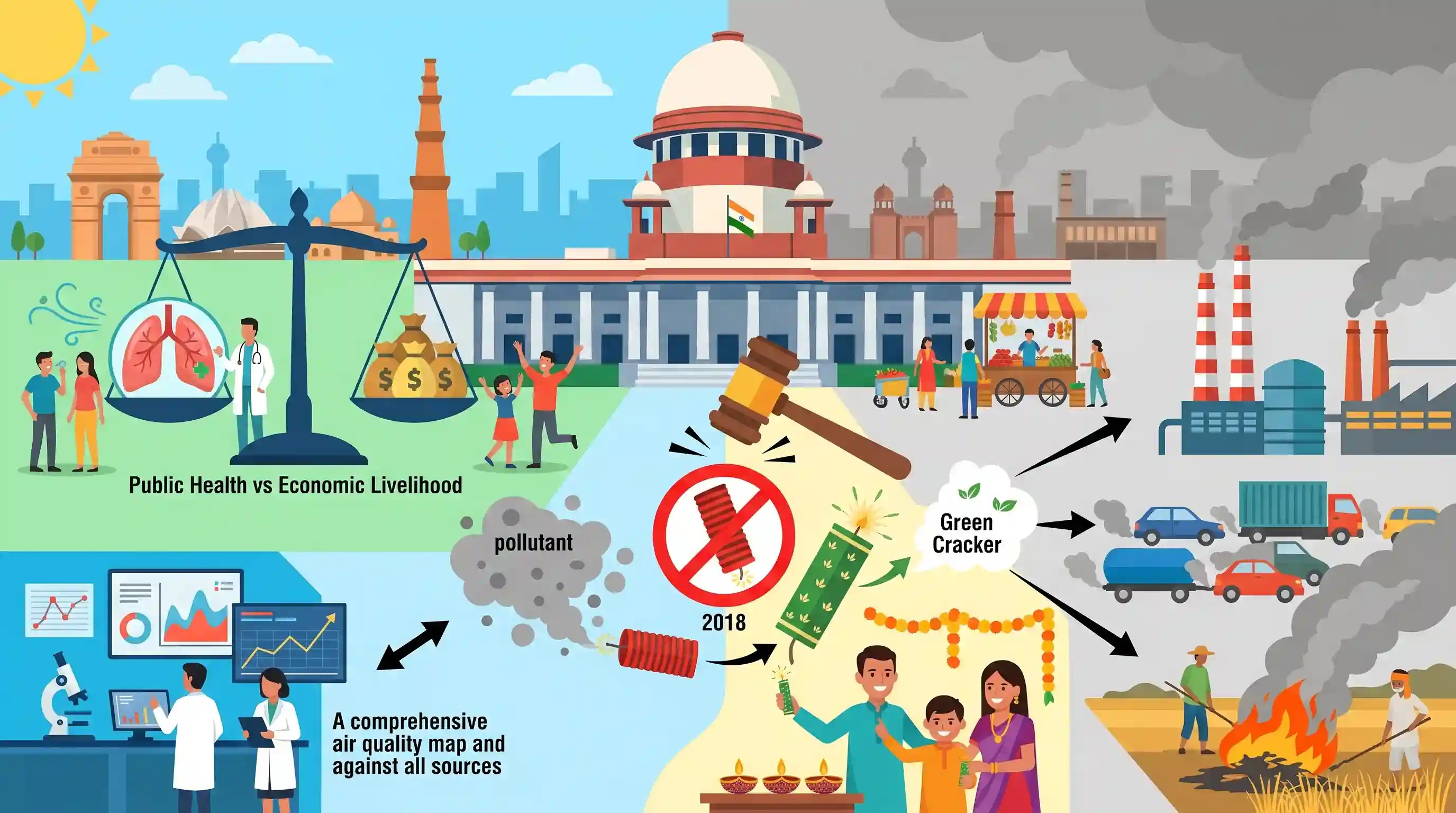
Why It Matters
Delhi's air pollution and the debate surrounding the ban on firecrackers directly relates to the GS-3 syllabus on environmental pollution and the GS-2 syllabus on judicial activism (Article 21 - Right to Clean Environment). It is a recurring case study on the challenge of balancing environmental conservation, public health, cultural practices, and economic livelihoods.
Summary
The editorial examines the Supreme Court's decision to permit the use of green crackers in Delhi during Deepavali, modifying a blanket ban instituted in 2018. It highlights the intricate challenge of balancing cultural traditions and the economic livelihood of lakhs of people with pressing public health and environmental concerns. While acknowledging that firecrackers cause temporary but severe spikes in Delhi's winter air pollution, the article notes that allowing green crackers—which are two-thirds less noxious—acts as a pragmatic middle ground. Ultimately, it calls for continuous, comprehensive, and science-driven action against all diverse sources of Delhi's air pollution, such as transport, industry, and agriculture-waste, rather than relying solely on ad-hoc or faith-based measures.
Key Points
- The Supreme Court has modified its 2018 ban, allowing the use of green crackers during Deepavali in Delhi to accommodate traditional celebrations and economic livelihoods.
- The firecracker industry supports the livelihoods of lakhs of people, making economic considerations a vital part of the environmental regulatory landscape.
- Delhi's winter air pollution is driven by a complex interplay of meteorology and diverse sources including transport, industry, agriculture-waste burning, and road dust.
- While pollution from firecrackers is temporary, it leads to severe spikes that drastically worsen an already precarious air quality situation in the capital.
- Scientifically developed green crackers are estimated to be about two-thirds less noxious than conventional ones but are still not zero-emission products.
- The editorial emphasizes that legalising less-polluting options must not detract from the need for comprehensive, consistent, and science-based action against all sources of pollution.
Important Terms
Green Crackers

Eco-friendly fireworks developed by CSIR-NEERI that reduce particulate matter emissions by 30-35% and avoid banned chemicals like barium nitrate to mitigate air pollution.
UPSC context
GS-III (Environment); relevant for understanding technological and judicial interventions to balance religious traditions with public health.
Graded Response Action Plan (GRAP)
A set of emergency measures triggered by rising Air Quality Index (AQI) levels in Delhi-NCR, ranging from dust control (Stage I) to industrial shutdowns (Stage IV).
UPSC context
GS-III (Pollution Management); tests knowledge of reactive administrative frameworks for handling seasonal environmental crises.
Commission for Air Quality Management (CAQM)
A powerful statutory body established in 2021 to coordinate research, monitoring, and resolution of air quality issues in the National Capital Region and adjoining states.
UPSC context
GS-II (Statutory Bodies); central to governance and federal coordination in tackling transboundary air pollution.
Stubble Burning
The practice of intentionally setting fire to crop residue after harvest, a major external contributor to northern India's winter smog during October and November.
UPSC context
GS-III (Agriculture/Environment); highlights the socio-economic challenges in transitioning to sustainable agricultural waste management.
Article 21
The constitutional "Right to Life," which the Supreme Court has expanded to include the right to breathe clean air and live in a healthy environment.
UPSC context
GS-II (Fundamental Rights); provides the legal bedrock for PILs and judicial activism regarding environmental protection.
CSIR-NEERI
The National Environmental Engineering Research Institute, a CSIR laboratory that developed the chemical formulations for Green Crackers (SWAS, STAR, and SAFAL).
UPSC context
GS-III (Science & Technology); focuses on indigenous R&D and institutional roles in addressing environmental degradation.
Prelims Trap
Green crackers developed by CSIR-NEERI are zero-emission fireworks that use Barium nitrate to produce eco-friendly green light.
Green crackers are NOT zero-emission; they reduce emissions by 30-40%. Furthermore, highly toxic Barium nitrate is strictly banned in them.
Static Concepts Connected
What are the key variants of Green Crackers developed by CSIR-NEERI?
- SWAS: Safe Water Releaser crackers suppress dust by releasing water vapor upon bursting.
- STAR & SAFAL: Safe Thermite Cracker and Safe Minimal Aluminium variants significantly reduce particulate matter emissions.
- Banned Chemicals: They strictly exclude highly toxic compounds like Barium nitrate, lithium, arsenic, and lead.
How do constitutional rights conflict over the firecracker ban?
- Article 21: The Supreme Court prioritizes the fundamental right to a clean environment and public health over absolute commercial interests.
- Article 25: The Court ruled that bursting firecrackers is not an 'essential religious practice' protected under the right to freedom of religion.
- Article 19(1)(g): Blanket bans conflict with the fundamental right to livelihood for lakhs of unorganized workers in manufacturing hubs.
Cross-Topic Patterns
Sivakasi livelihood vs. Environmental rights
The Sivakasi firecracker industry clusters bring Article 19(1)(g) (right to profession) into direct conflict with Article 21 (right to clean environment), a classic environmental jurisprudence theme.
CSIR-NEERI's mitigation technologies
Beyond SWAS and STAR crackers, CSIR-NEERI frequently features in UPSC for developing the WAYU air purifier and microbial bioremediation methods, linking scientific R&D to air quality management.

Expect a 2026 Prelims question on green crackers targeting Barium bans, NEERI's SWAS/STAR tech, and their non-zero emission status.
Linked PYQs · 3
Linked PYQs · 3
- 2015MainsGS2
Does the right to clean environment entail legal regulations on burning crackers during Diwali? Discuss in the light of Article 21 of the Indian Constitution and Judgement(s) of the Apex Court in this regard.
- 2022MainsGS2
“The most significant achievement of modern law in India is the constitutionalization of environmental problems by the Supreme Court.” Discuss this statement with the help of relevant case laws.
- 2022MainsGS3
Discuss in detail the photochemical smog emphasizing its formation, effects and mitigation. Explain the 1999 Gothenburg Protocol.
