Fire safety protocols and emergency preparedness in transport hubs
Source:Indian Express ↗
Why It Matters
The incident highlights the vulnerability of critical urban infrastructure, such as airports, to localized emergencies like fires. It underscores the importance of robust disaster preparedness, rapid emergency response mechanisms, and resilience frameworks to minimize operational downtime and protect citizens.
Summary
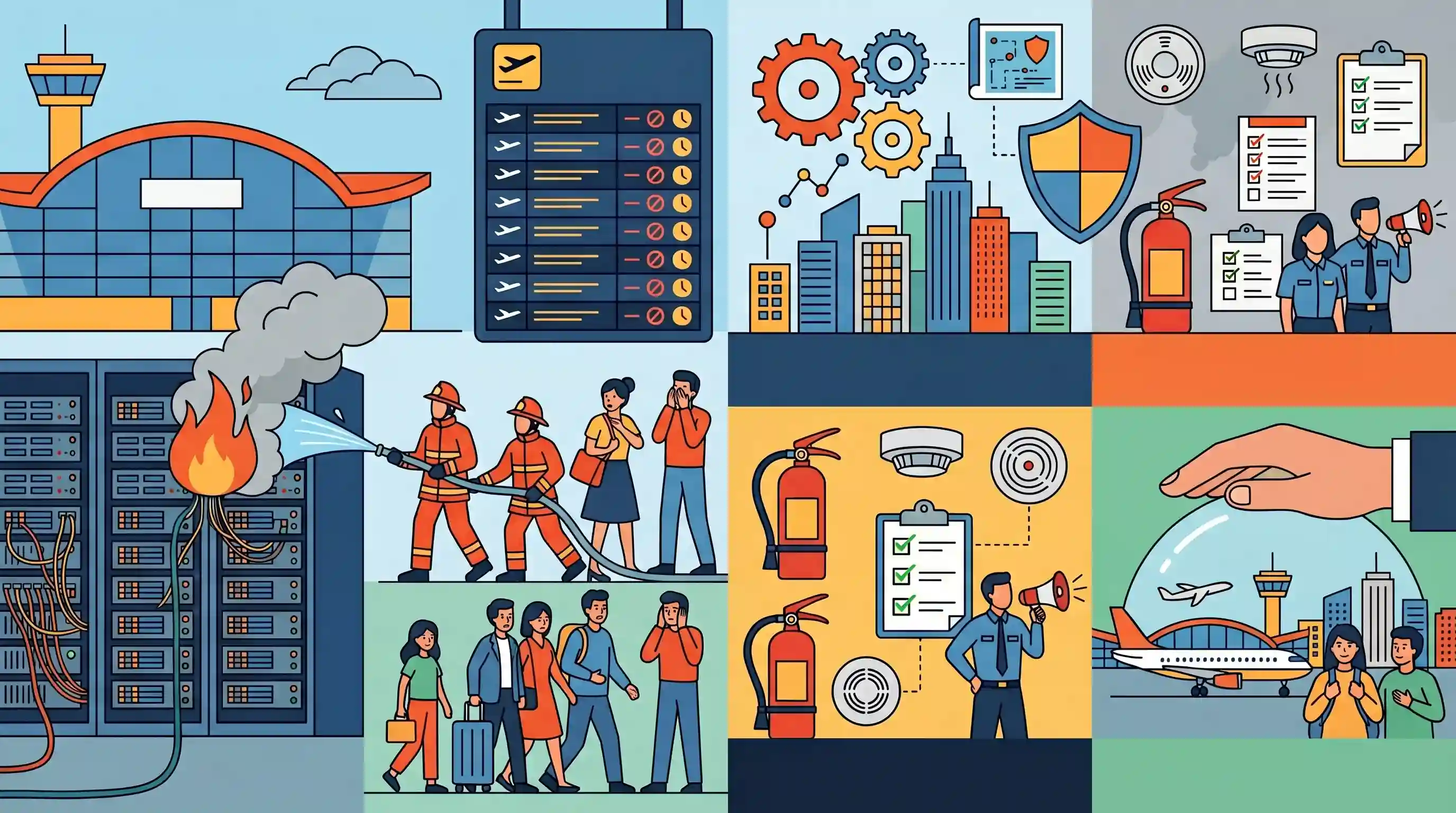
A minor "level-one" fire erupted due to a short circuit in the server room at Terminal 1 of the Chhatrapati Shivaji Maharaj International Airport (CSMIA) in Mumbai. Despite a swift and effective response from the Mumbai Fire Brigade that ensured no injuries, the incident generated smoke and panic among passengers, leading to the delay of roughly 23 flights. The event brings attention to the necessity of stringent fire safety protocols and disaster resilience in critical urban transport infrastructure to prevent operational disruptions and safeguard public safety.
Key Points
- A level-one (minor) fire broke out in the CCTV server room on the ground floor of CSMIA Terminal 1, affecting electrical wiring and installations.
- The fire was reportedly triggered by a short circuit and caused thick smoke to fill the passenger waiting areas.
- No casualties or injuries were reported, but the incident led to chaos and the delay of around 23 domestic flights.
- The Mumbai Fire Brigade promptly contained the situation using multiple fire engines, jumbo water tankers, and a breathing apparatus van.
Important Terms
Chhatrapati Shivaji Maharaj International Airport (CSMIA)

India's second-busiest airport and a key brownfield project managed via a Public-Private Partnership (PPP). It serves as Mumbai's primary aviation hub and critical transport node.
UPSC context
GS Paper 3: Infrastructure; tests understanding of PPP models and the strategic importance of aviation hubs in national connectivity.
Brihanmumbai Municipal Corporation (BMC)
Established in 1888, it is India’s wealthiest municipal corporation. It functions as the Urban Local Body (ULB) responsible for Mumbai's civic infrastructure, administration, and essential services.
UPSC context
GS Paper 2: Local Governance; relevant for the 74th Amendment Act and challenges of governing high-density metropolitan areas.
Mumbai Fire Brigade (MFB)
The specialized firefighting and rescue arm of the BMC. It manages urban disaster response, including firefighting, building collapse rescues, and emergency assistance during natural disasters.
UPSC context
GS Paper 3: Disaster Management; highlights the role of specialized frontline agencies in mitigating urban and industrial hazards.
Critical Infrastructure
Physical and virtual systems (like airports, power grids, or telecom) essential to society and the economy. Their destruction or disruption can cause significant national security and economic impacts.
UPSC context
GS Paper 3: Internal Security and Disaster Management; focuses on resilience strategies and the cascading effects of infrastructure failure.
Disaster Management
A systematic framework for the organization and management of resources and responsibilities to deal with all humanitarian aspects of emergencies, specifically preparedness, response, and recovery.
UPSC context
GS Paper 3: Disaster Management; tests knowledge of India's institutional frameworks (DM Act 2005) and proactive risk reduction policies.
Prelims Trap
"The National Building Code (NBC) of India is a legally binding central legislation for fire safety."
The NBC is a recommendatory document by the Bureau of Indian Standards (BIS). It only becomes legally binding if state governments or local municipal bodies incorporate it into their local building bye-laws.
Static Concepts Connected
What is the Coalition for Disaster Resilient Infrastructure (CDRI)?
- Origin & Aim: Launched by India at the 2019 UN Climate Action Summit to promote resilience of infrastructure systems to climate and disaster risks.
- Structure: Secretariat is in New Delhi. It is a multi-stakeholder global partnership of national governments, UN agencies, and multilateral banks.
- Core Focus: Focuses on critical infrastructure like transport, telecom, and power networks to minimize economic losses and service disruptions.
What are the key features of the Sendai Framework (2015-2030)?
- Nature: Successor to the Hyogo Framework. It is a voluntary, non-binding agreement recognizing the State's primary role in reducing disaster risk.
- Core Shift: Shifted focus from mere disaster response to holistic disaster risk reduction (DRR) and prevention.
- Target D: Target D explicitly mandates substantially reducing disaster damage to critical infrastructure and disruption of basic services.
Cross-Topic Patterns
Physical hazards to cyber infrastructure
A physical fire in a server room demonstrates how conventional hazards directly threaten digital continuity, bridging GS3 Disaster Management with Cyber Security and critical information infrastructure vulnerabilities.
Urban Governance vs NDMA Guidelines
Frequent fires in critical urban spaces (airports, hospitals) frequently expose the enforcement gap between NDMA advisory guidelines and local municipal governance (e.g., BMC) under the 74th Amendment.

Expect a GS3 Mains question evaluating India's global leadership in disaster-resilient critical infrastructure via CDRI and Sendai Target D.
Linked PYQs · 2
Linked PYQs · 2
- 2024MainsGS3
What is disaster resilience? How is it determined? Describe various elements of a resilience framework. Also mention the global targets of Sendai Framework for Disaster Risk Reduction (2015–2030).
- 2013MainsGS3
How important are vulnerability and risk assessment for pre-disaster management ? As an administrator, what are key areas that you would focus on in a Disaster Management System.
