Jaipur Illegal Firecracker Warehouse Blast And Safety Lapses
Source:The Hindu ↗
Why It Matters
This incident is crucial for RPSC GS paper analysis because it highlights regulatory, zoning, and administrative failures in managing hazardous substances in urban residential zones. It brings into focus the enforcement capabilities of the Jaipur Development Authority, local municipal bodies, the implementation of the Explosives Act, and the state's readiness to manage fire disasters and trauma care.
Summary
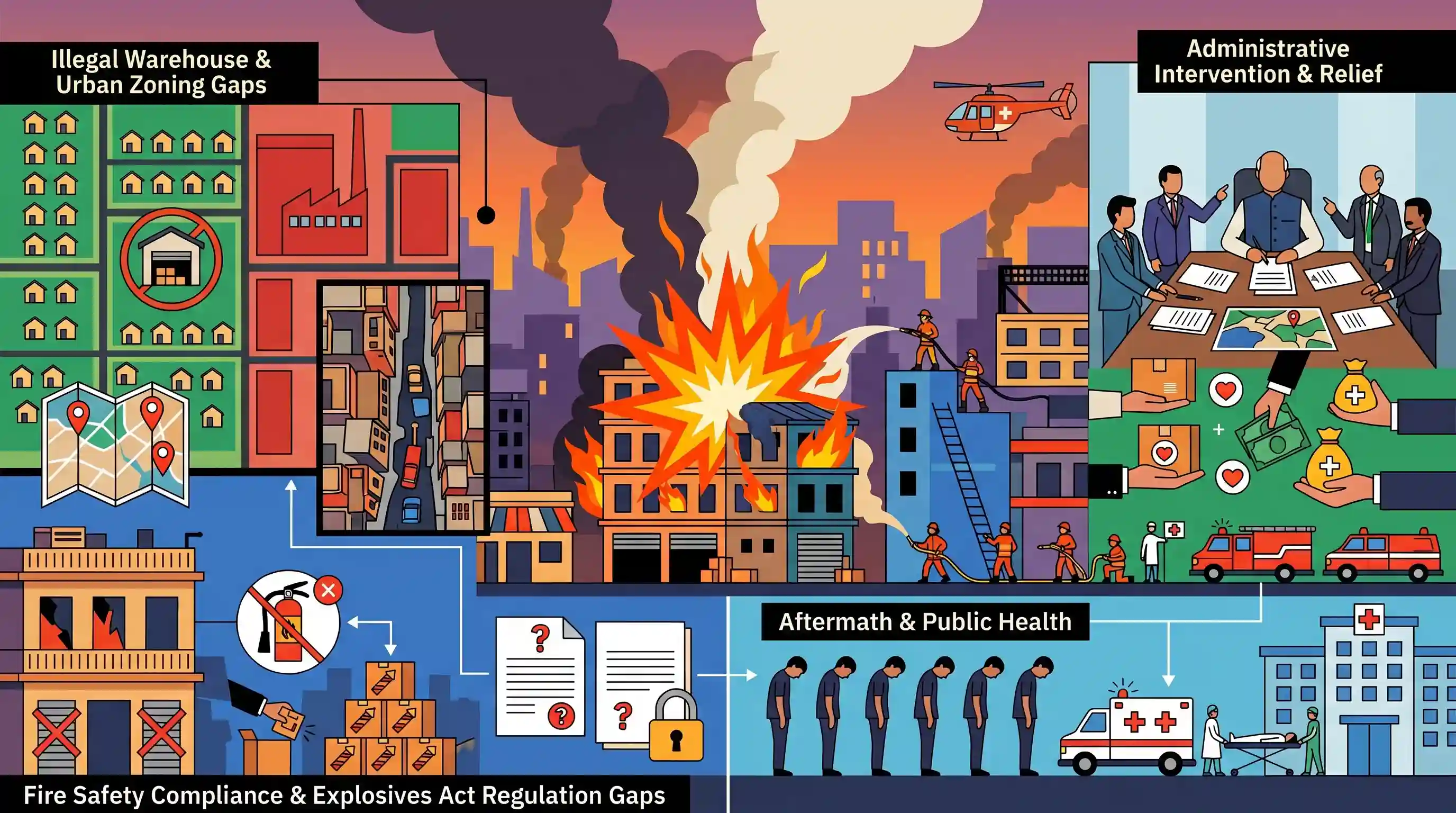
A powerful blast and fire at an illegal firecracker warehouse in the residential area of Khoh Nagoriyan, Jaipur, resulted in seven deaths. Operating without necessary clearance in a congested neighborhood, the tragedy underscores gaps in municipal zoning, fire safety compliance, and regulation under the Explosives Act, drawing urgent administrative intervention and relief directives from Chief Minister Bhajan Lal Sharma.
Key Points
- On June 9, 2026, a devastating fire and powerful blast occurred at an illegal firecracker warehouse in Ayesha Nagar Talai Colony, Khoh Nagoriyan, Jaipur, causing 7 deaths.
- Victims sustained catastrophic burns ranging from 75% to 100% and were rushed to SMS Government Hospital in Jaipur, where several succumbed to their injuries.
- The warehouse was operating illegally in a highly congested residential neighborhood, violating basic safety, zoning laws, and licensing protocols under the Explosives Act, 1884.
- Rajasthan Chief Minister Bhajan Lal Sharma and former Chief Minister Ashok Gehlot expressed deep grief, directing the district administration to facilitate immediate relief, a thorough probe, and advanced medical treatment.
- The incident emphasizes the critical need for strict enforcement of urban planning norms, industrial zoning, and fire-hazard compliance by local municipal authorities and the Jaipur Development Authority (established under the JDA Act, 1982).
Important Terms
Explosives Act, 1884

A colonial-era central legislation that regulates the manufacture, possession, use, sale, transport, import, and export of explosive substances in India to maintain public and industrial safety.
UPSC context
GS Paper 3 (Disaster Management) and GS Paper 2 (Governance); tests regulatory oversight of hazardous substances.
Explosives Rules, 2008
Rules framed under the Explosives Act, 1884, detailing the technical procedures for licensing, safe storage, transport, handling, and safety inspections of explosives, managed by PESO.
UPSC context
GS Paper 3 (Disaster Management); tests knowledge of specific guidelines and institutional mechanisms for handling hazardous materials.
Jaipur Municipal Corporation
The urban local self-government body responsible for civic infrastructure, public health, waste management, and local fire safety regulations within the municipal limits of Jaipur.
UPSC context
GS Paper 2 (Urban Local Governance); tests understanding of municipal administration and devolution of powers under the 74th Amendment Act.
Jaipur Development Authority
A statutory body established in 1982 under Rajasthan state law, responsible for urban planning, master development plan execution, and rapid infrastructural development in the Jaipur region.
UPSC context
GS Paper 2 (Urban Planning & Governance); tests functions of state parastatal bodies vs. elected urban local bodies.
Prelims Trap
The Petroleum and Explosives Safety Organisation (PESO) is an attached office under the Ministry of Home Affairs.
Aspirants confuse explosives and public security with the Ministry of Home Affairs. PESO actually operates under DPIIT, Ministry of Commerce and Industry.
Static Concepts Connected
What is the regulatory mandate of the Petroleum and Explosives Safety Organisation (PESO)?
- Parent Ministry: Operates as an autonomous regulatory body under the DPIIT, Ministry of Commerce and Industry.
- Nodal Laws: Administers the Explosives Act 1884 and Petroleum Act 1934, regulating hazardous substances and safety distances.
What are the scientific features of eco-friendly 'Green Crackers'?
- Emission Reduction: Developed by CSIR-NEERI, they reduce particulate matter emissions by 30-35% and use no toxic barium salts.
- SWAS and STAR: SWAS releases water vapor to suppress dust; STAR reduces sound. Both eliminate sulfur and potassium nitrate.
Cross-Topic Patterns
Green technology and fundamental rights
The Supreme Court's mandate on green crackers highlights the intersection of technological solutions (by CSIR-NEERI) with judicial enforcement of the Right to Health under Article 21.
Hazardous industries and municipal zoning
Tragedies in unauthorized residential units reveal gaps where municipal zoning laws (74th Amendment mandates) fail to coordinate with industrial safety regulators like PESO.

PESO's administrative ministry and the chemical components of SWAS, STAR, SAFAL green crackers are prime targets for 2026 Prelims.
Linked PYQs · 2
Linked PYQs · 2
- 2025RPSC_PRELIMSGS1
By which Act was the Jaipur Development Authority established?
- 2023RPSC_PRELIMSGS1
Match the following list – P (Directive Principles) with list – R (Article): List – P List – R A. Equal justice and free legal aid I. Article 48 A B. Protection of the environment II. Article 39 A C. Right to work III. Article 41 D. Preservation of monuments IV. Article 49 Choose the correct option: . A B C D
