Operation Sindoor and Evolving Military Doctrines against Terrorism
Source:The Hindu ↗
Why It Matters
The article is crucial for understanding the ongoing evolution of India's military doctrines (like 'Hot Pursuit' and surgical strikes) against state-sponsored terrorism. It also highlights the diplomatic tightrope India walks when balancing proactive security measures with the risks of major powers (like the US and China) intervening in its bilateral disputes.
Summary
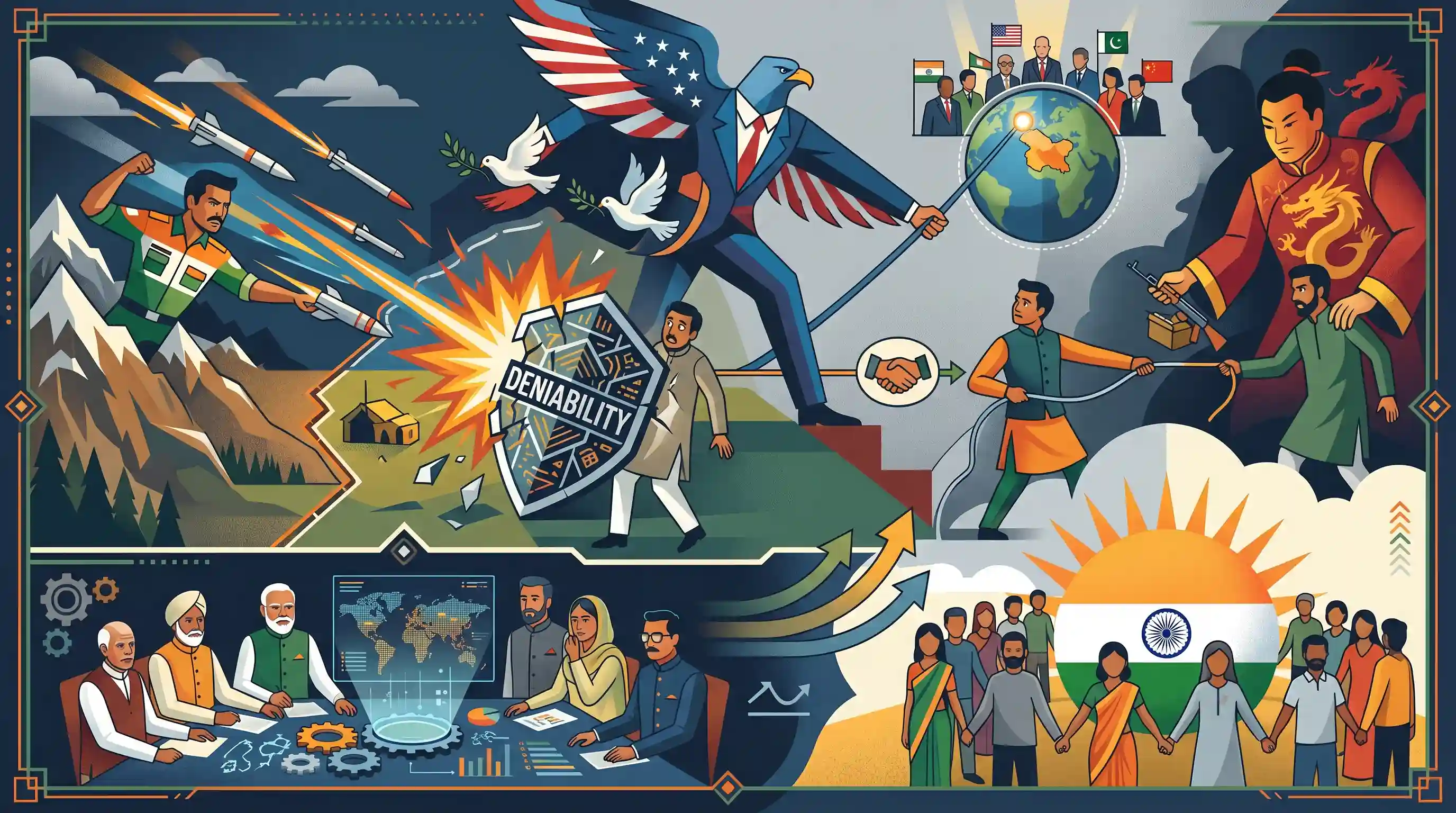
The editorial examines the strategic and diplomatic fallout of 'Operation Sindoor', a proactive military strike by India against Pakistan in retaliation for a terrorist attack in Pahalgam. While the operation successfully signals India's zero-tolerance policy towards cross-border terrorism and shatters Pakistan's cover of deniability, the ensuing US-brokered ceasefire introduces diplomatic complications. Active mediation by the US administration risks internationalising the Kashmir issue, counter to India's preference for bilateral resolution. Furthermore, potential Chinese support for Pakistan adds a layer of regional instability. The article calls for cool-headed strategic thinking and a strong domestic political consensus to navigate these multifaceted security and diplomatic challenges.
Key Points
- 'Operation Sindoor' marks a critical shift in India's security doctrine, demonstrating a willingness to undertake overt military action to punish cross-border terrorism.
- Pakistan's longstanding strategy of maintaining 'plausible deniability' while using terrorism as state policy has been severely tested by India's decisive response.
- The rapid US intervention, led by top officials, to broker an 'understanding' raises concerns about the internationalisation of the Kashmir dispute, diluting India's traditional stance on strict bilateralism.
- Reports of Chinese diplomatic or strategic backing for Pakistan underscore the complex, multi-front geopolitical challenges India faces in its neighborhood.
- The Indian government must navigate domestic political pressures, such as opposition demands for all-party meetings, to build a unified national consensus on security and foreign policy.
Important Terms
Shimla Agreement (1972)

A 1972 peace treaty between India and Pakistan committing both nations to resolve disputes through bilateral negotiations and respect the Line of Control after the 1971 war.
UPSC context
GS Paper II (IR); defines the legal framework for Indo-Pak relations and India's opposition to third-party mediation in Kashmir.
Bilateralism
A diplomatic principle where two nations resolve conflicts directly without the mediation or intervention of third parties or international organizations, a core tenet of India's foreign policy.
UPSC context
GS Paper II (IR); tests understanding of India's preference for direct diplomacy in neighborhood relations.
Internationalisation of Kashmir
The attempt to bring the Kashmir dispute into international forums (like the UN) or involve third-party mediators, which India opposes as a violation of the Shimla Agreement.
UPSC context
GS Paper II (IR); key conceptual challenge in India’s diplomatic struggle over Jammu and Kashmir's status.
Cross-border Terrorism
Terrorism originating in one country (Pakistan) and targeting another (India), often involving state-supported non-state actors; it is India's primary external security threat.
UPSC context
GS Paper III (Internal Security); central to topics on border management and external state actors.
Operation Sindoor
A 2025 Indian military campaign involving precision strikes against terror infrastructure in Pakistan; it signaled a doctrine of proactive, technology-driven retaliation for terrorist attacks.
UPSC context
GS Paper III (Security); relates to evolving military doctrines and India's 'zero-tolerance' policy toward terrorism.
Strategic Autonomy
A nation's capacity to pursue its foreign policy and national interests independently, without being constrained by the influence or interference of other states or alliances.
UPSC context
GS Paper II (IR); vital for understanding India's balancing act with global powers like the US.
Prelims Trap
India has accepted US mediation on the Kashmir dispute following the Operation Sindoor ceasefire.
India strictly maintains bilateralism under the 1972 Simla Agreement. Brokering a tactical military ceasefire does not equate to India accepting formal third-party mediation on the core Kashmir dispute.
Static Concepts Connected
What are the core tenets of the 1972 Simla Agreement?
- Strict Bilateralism: Settling differences exclusively through peaceful bilateral negotiations, explicitly rejecting third-party or international mediation.
- LoC Inviolability: Mutual commitment by both nations to respect the Line of Control (LoC) resulting from the December 1971 ceasefire.
- Non-aggression: Abstaining from the threat or use of force against the territorial integrity or political independence of each other.
How is 'plausible deniability' utilized in state-sponsored asymmetric warfare?
- Non-state Proxies: State actors deliberately employ non-state militant groups to conduct asymmetric strikes, creating a buffer between the state and the act.
- Nuclear Deterrence: The sponsor state uses a nuclear arsenal to prevent massive conventional retaliation, keeping conflicts below the threshold of all-out war.
- Diplomatic Cover: It allows the sponsor state to claim ignorance or lack of control over proxy groups, avoiding international sanctions and diplomatic isolation.
Cross-Topic Patterns
Collusive Threat: The China-Pak Nexus
Chinese strategic backing of Pakistan during crises transforms the two-front war paradigm into a 'collusive threat', necessitating a recalibration of India's border defense and integration of theater commands.
Offensive Defense in Border Management
India's shift from 'strategic restraint' to proactive kinetic strikes against terror proxies ties into internal security themes of border management and the erosion of Pakistan's nuclear umbrella deterrence.

Mains 2026 could test how India's shift to 'offensive defence' impacts its strict adherence to bilateralism in dispute resolution.
Linked PYQs · 4
Linked PYQs · 4
- 2016MainsGS3
The terms 'Hot Pursuit' and 'Surgical Strikes' are often used in connection with armed action against terrorist attacks. Discuss the strategic impact of such actions.
- 2020MainsGS3
Analyze internal security threats and transborder crimes along Myanmar, Bangladesh and Pakistan borders including Line of Control (LoC). Also discuss the role played by various security forces in this regard.
- 2015MainsGS2
Terrorist activities and mutual distrust have clouded India-Pakistan relations. To what extent the use of soft power like sports and cultural exchanges could help generate goodwill between the two countries? Discuss with suitable examples.
- 2024MainsGS3
India has a long and troubled border with China and Pakistan fraught with contentious issues. Examine the conflicting issues and security challenges along the border. Also give out the development being undertaken in these areas under the Border Area Development Programme (BADP) and Border Infrastructure and Management (BIM) Scheme.
