Bhopal Police Register FIR Under New Criminal Laws Against Cricketer
Source:bhaskarhindi.com ↗
Why It Matters
The article showcases the real-world application of newly implemented criminal statutes (BNS) replacing the old IPC. It touches upon administrative accountability, All India Services (IPS) misconduct, and is highly relevant to state-level administrative and legal-transition questions in the MPPSC State Service Prelims.
Summary
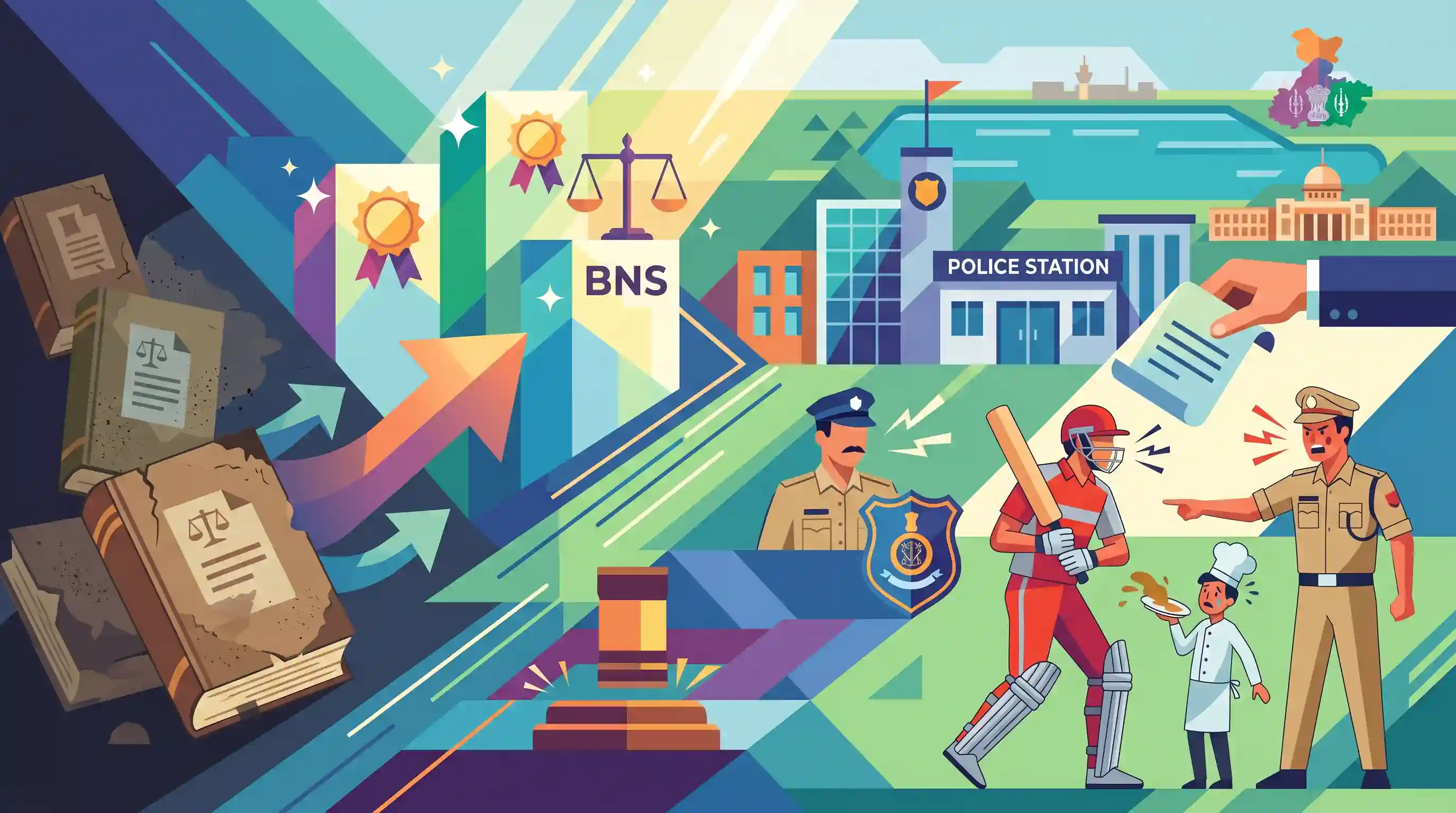
An FIR has been registered in Bhopal, Madhya Pradesh, against Punjab Kings IPL cricketer Shashank Singh and his IPS father, Shailesh Singh, under the newly enacted Bharatiya Nyaya Sanhita (BNS) for allegedly assaulting and abusing their family cook, Vipendra Singh. The charges include BNS Sections 296(B), 115(2), and 3(5), showcasing the ongoing legal transition from the historic Indian Penal Code (IPC).
Key Points
- An FIR has been lodged against IPL cricketer Shashank Singh (Punjab Kings) and his father, IPS officer Shailesh Singh, at the Ratibadh police station in Bhopal, Madhya Pradesh.
- The charges filed are under the newly enforced Bharatiya Nyaya Sanhita (BNS), 2023, specifically Section 296(B) (obscenity/verbal abuse), Section 115(2) (voluntarily causing hurt), and Section 3(5) (common intention/joint criminal liability).
- The complainant, Vipendra Singh, a cook hailing from Rewa, alleged that he was verbally abused, physically assaulted, and kept in forced confinement when he tried to quit his job.
- The case highlights the practical application of BNS sections replacing old Indian Penal Code (IPC) provisions (e.g., IPC Section 323 replaced by BNS 115(2), IPC Section 294 replaced by BNS 296, and IPC Section 34 replaced by BNS 3(5)).
- For MPPSC Prelims, the context bridges the newly implemented criminal laws of 2024, the administration of state police, and profiles of high-profile sports personalities connected to Madhya Pradesh.
Important Terms
Bharatiya Nyaya Sanhita, 2023

India's primary criminal code that repealed and replaced the British colonial-era Indian Penal Code (IPC) on July 1, 2024, modernizing provisions on offences, punishments, and justice administration.
UPSC context
GS Paper II (Polity & Governance); tests knowledge of criminal justice reforms and statutory changes in India.
Indian Penal Code, 1860
The historical official criminal code of India, drafted under Thomas Babington Macaulay and enacted in 1860, which defined major offences and punishments before being replaced by the Bharatiya Nyaya Sanhita in 2024.
UPSC context
GS Paper II (Polity & Governance); tests understanding of colonial legal legacy, historical legal frameworks, and comparative criminal jurisprudence in India.
Indian Police Service (IPS)
One of the three All India Services, whose officers provide senior leadership and command to state police forces, central armed police forces, and national security agencies.
UPSC context
GS Paper II (Governance); tests awareness of administrative structures, internal security machinery, and federal police oversight.
All India Services (AIS)
The civil services common to both the Union and State governments, created under Article 312 of the Constitution, comprising the Indian Administrative Service, Indian Police Service, and Indian Forest Service.
UPSC context
GS Paper II (Polity and Governance); tests knowledge of federal relations, constitutional provisions, and the role of permanent civil services.
Prelims Trap
Any FIR registered after July 1, 2024, must exclusively apply the Bharatiya Nyaya Sanhita (BNS) for charging the accused.
Under Article 20(1) (protection against ex-post facto laws) and BNS Section 531, any offence committed before July 1, 2024, must be charged under the old IPC, even if the FIR is registered after the transition date.
Static Concepts Connected
How does the Seventh Schedule distribute power over criminal justice and policing?
- State List (List II): Placed under Entry 1 (Public Order) and Entry 2 (Police) of List II, giving states administrative control.
- Concurrent List (List III): Placed under Entry 1 (Criminal Law) and Entry 2 (Criminal Procedure) of List III, allowing joint central-state legislation.
What is the constitutional safeguard against retrospective criminal legislation in India?
- Article 20(1) Protection: Prohibits convicting a person under a law that was not in force at the time the act was committed.
- Penalty Limitation: Ensures no person faces a penalty greater than what was prescribed under the law active at the time of the offence.
- BNS Transition Application: Mandates that crimes committed prior to July 1, 2024, are prosecuted under the IPC, 1860, rather than the BNS, 2023.
Cross-Topic Patterns
IPS conduct and criminal prosecution
Explores the intersection of All India Services (Conduct) Rules and criminal charges, where joint liability (BNS 3(5)) triggers immediate statutory suspension and departmental inquiry.
Criminal law reform and federalism friction
While the Centre codifies substantive criminal laws (Concurrent List), state-controlled police departments (State List) bear the administrative and training burdens of operationalizing the BNS transition.

2026 Prelims may test Article 20(1) ex-post facto limits specifically framed around BNS implementation dates and Seventh Schedule distribution.
Linked PYQs · 4
Linked PYQs · 4
- 2021MPPSC_PRELIMSGS1
Player of Madhya Pradesh Chinki Yadav is associated with sports.
- 2021MPPSC_PRELIMSGS1
Player of Madhya Pradesh Vivek Sagar is associated with the sports of
- 2020MPPSC_PRELIMSGS1
Which is the Highest Award given by Madhya Pradesh Government to sports coaches mentioned below?
- 2019MPPSC_PRELIMSGS1
Which of the following Sports Award is related to Madhya Pradesh State?
