Criminal Law Reforms: Statutory Timelines for Judicial Delivery
Source:Indian Express ↗
Why It Matters
India's massive judicial backlog and the plight of undertrial prisoners have long been critical governance and human rights concerns. For UPSC aspirants, understanding the mechanisms, statutory timelines, and intended impacts of the three new criminal codes is essential for answering questions on judicial reform, the decolonization of Indian law, and the expanding horizons of Article 21 (Right to a Speedy Trial).
Summary
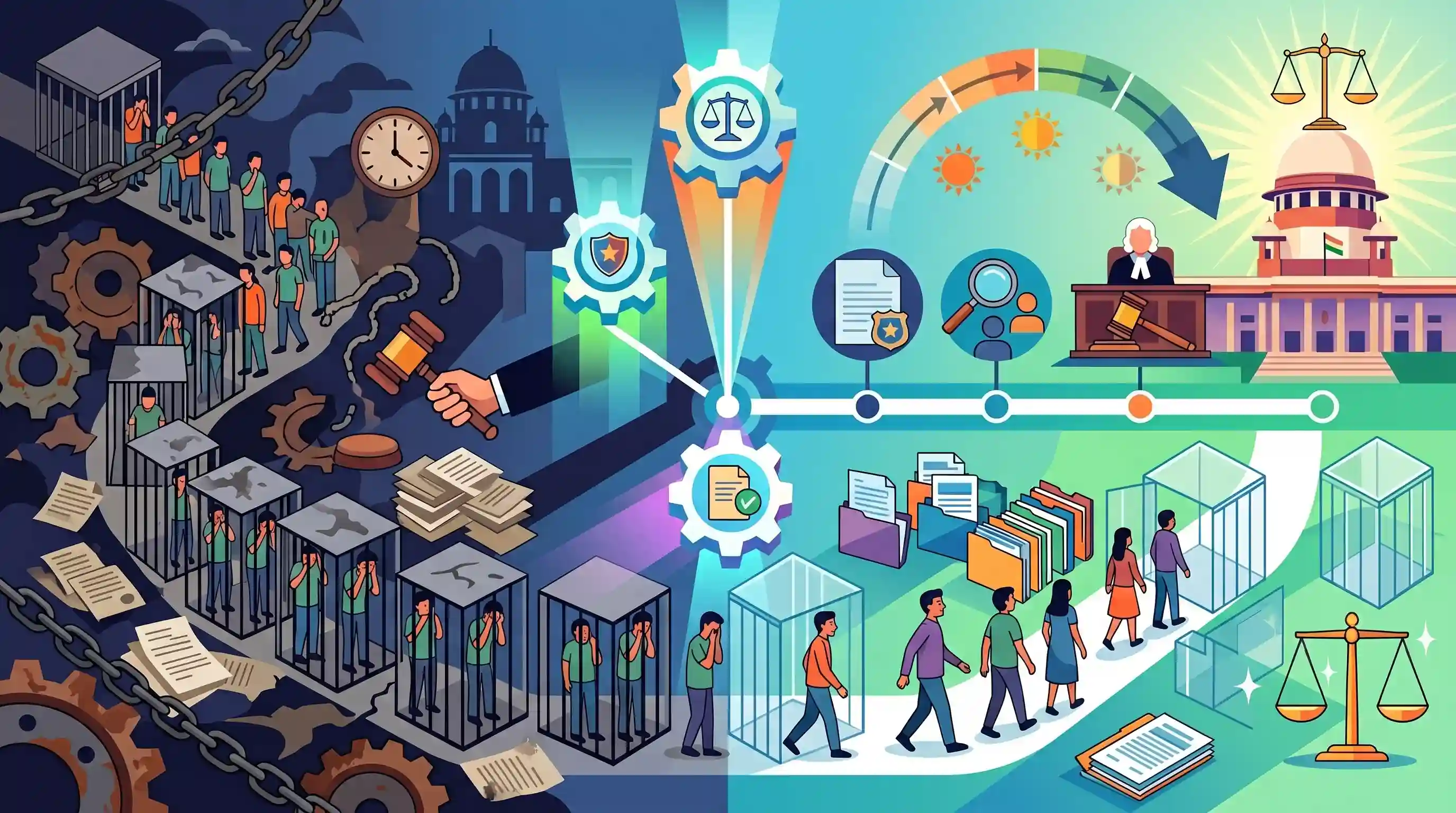
Union Home Minister Amit Shah has stated that the implementation of India's three new criminal laws will ensure that the entire legal process—from the filing of a First Information Report (FIR) to the final judgment by the Supreme Court—is completed within three years. The Bharatiya Nyaya Sanhita (BNS), Bharatiya Nagarik Suraksha Sanhita (BNSS), and Bharatiya Sakshya Adhiniyam (BSA) have been designed to completely overhaul the colonial-era criminal justice system, pivoting its core objective from inflicting punishment to delivering swift justice. By mandating strict timelines across investigations and trials, the government aims to definitively address India's chronic judicial pendency and the resulting humanitarian issue of overcrowded prisons filled with undertrials.
Key Points
- Union Home Minister Amit Shah promised that under the newly enacted criminal codes, the entire legal journey from registering an FIR to a Supreme Court verdict will conclude within three years.
- The new laws—Bharatiya Nyaya Sanhita, Bharatiya Nagarik Suraksha Sanhita, and Bharatiya Sakshya Adhiniyam—replace the colonial-era IPC, CrPC, and Indian Evidence Act.
- The structural focus of the new framework shifts from a punitive 'punishment-oriented' model to a 'justice-delivery' model.
- Strict statutory timelines have been introduced for various stages of investigation, framing of charges, and judicial pronouncements to drastically reduce systemic judicial pendency.
- The swift resolution of cases is expected to significantly alleviate prison overcrowding by reducing the massive undertrial population in India.
Important Terms
Bharatiya Nyaya Sanhita (BNS)

Substantive criminal code that replaced the colonial-era Indian Penal Code (IPC) on July 1, 2024. It modernizes definitions, introduces community service, and codifies offenses like mob lynching and terrorism.
UPSC context
GS Paper 2 (Polity/Governance); tests understanding of substantive legal reforms and the transition from punitive to reformative justice.
Bharatiya Nagarik Suraksha Sanhita (BNSS)
Procedural law that replaced the Code of Criminal Procedure (CrPC) in 2024. It mandates strict timelines for investigations and trials, promotes digital evidence, and enhances victim-centric mechanisms.
UPSC context
GS Paper 2 (Criminal Justice Reform); essential for questions on judicial pendency, police accountability, and use of technology in governance.
Bharatiya Sakshya Adhiniyam (BSA)
The new legislation governing the admissibility and evaluation of evidence, replacing the Indian Evidence Act, 1872. It broadens the scope of 'documents' to include digital and electronic records.
UPSC context
GS Paper 2 & 3; relevant for evidence law evolution and the role of forensic science in modern investigations.
Supreme Court of India
The apex judicial body and highest court of appeal under the Constitution of India. It acts as the guardian of fundamental rights and the final interpreter of laws.
UPSC context
GS Paper 2 (Polity); foundational for topics on judicial review, appellate jurisdiction, and the protection of Article 21 rights.
Prelims Trap
"The Right to a Speedy Trial is explicitly guaranteed under Article 21 of the Indian Constitution."
The Constitution does not explicitly mention a right to speedy trial. It was interpreted by the Supreme Court as an implicit Fundamental Right under Article 21 in the Hussainara Khatoon (1979) case.
Static Concepts Connected
How is prison administration constitutionally governed in India?
- State Subject: Prisons and persons detained therein fall under Entry 4 of the State List (List II) of the Seventh Schedule.
- MHA Guidance: Though a state subject, the Ministry of Home Affairs guides uniformity through the Model Prisons Act (recently updated in 2023) to replace the colonial 1894 Act.
- Undertrial Review Committees: District-level committees (headed by a District Judge) mandated by the SC to periodically review and recommend the release of eligible undertrial prisoners.
What is the constitutional basis for a Speedy Trial in India?
- Article 21 (Implicit): The Supreme Court expanded the scope of 'procedure established by law' under Article 21 to include the right to a speedy trial.
- Hussainara Khatoon Case: The principle was firmly established in Hussainara Khatoon v. Home Secretary, State of Bihar (1979), highlighting the plight of undertrials.
- Article 39A linkage: This right is bolstered by the Directive Principle directing the state to ensure equal justice and free legal aid.
Cross-Topic Patterns
New Criminal Codes + ICJS Integration
The BNSS mandates electronic evidence and e-FIRs, directly tying the substantive legal overhaul to the Home Ministry's Inter-operable Criminal Justice System (ICJS) and the e-Courts Phase 3 project.
Undertrial reforms + Human Rights mandates
Statutory bail relief for first-time offenders (BNSS Sec 479) bridges procedural legal reform with NHRC mandates regarding the human rights crisis of 75% undertrial overcrowding in state prisons.

Expect a 2026 question mapping BNSS statutory timelines (like Sec 479 bail norms) against the Supreme Court's Article 21 jurisprudence.
Linked PYQs · 3
Linked PYQs · 3
- 2023MainsGS2
“The Constitution of India is a living instrument with capabilities of enormous dynamism. It is a constitution made for a progressive society.” Illustrate with special reference to the expanding horizons of the right to life and personal liberty.
- 2023PrelimsGS1
Consider the following statements: Statement-I: In India, prisons are managed by State Governments with their own rules and regulations for the day-to-day administration of prisons. Statement-II: In India, prisons are governed by the Prisons Act, 1894 which expressly kept the subject of prisons in the control of Provincial Governments. Which one of the following is correct in respect of the above statements?
- 2020MainsGS2
The judicial systems in India and UK seem to be converging as well as diverging in recent times. Highlight the key points of convergence and divergence between the two nations in terms of their judicial practices.
