Fino Bank CEO Arrest links Online Gaming to GST Tax Evasion
Source:Indian Express ↗
Why It Matters
This development is crucial for UPSC aspirants as it bridges topics across GS3, including the regulation of the digital economy, taxation enforcement (GST), and internal security threats like money laundering. It illustrates the vulnerabilities of the banking sector to emerging tech-driven financial crimes and the active role of state enforcement agencies in maintaining economic security.
Summary
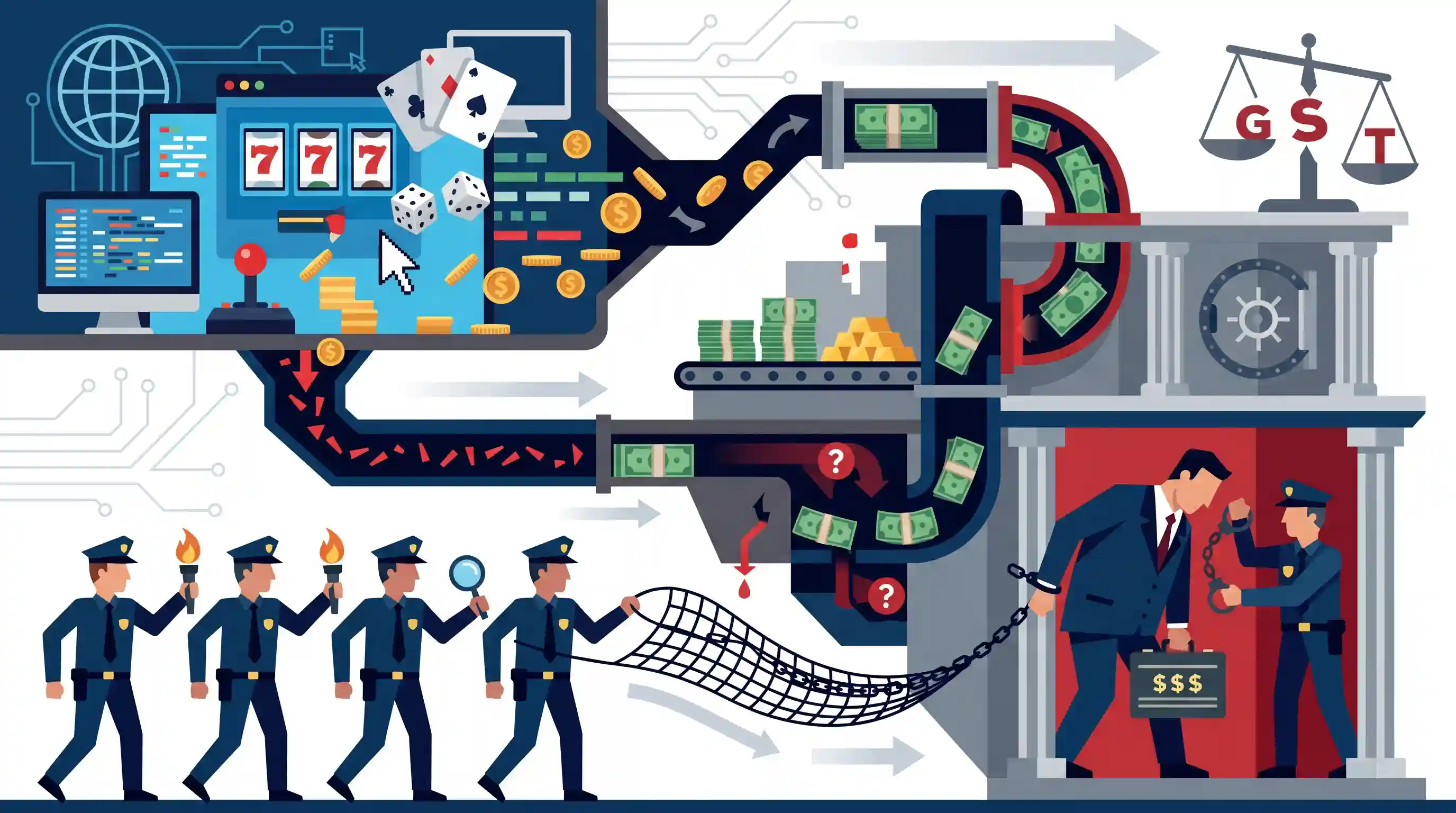
The arrest of Fino Bank's CEO has been linked to an ongoing Goods and Services Tax (GST) investigation concerning illicit fund flows from online money gaming. Regulatory authorities are investigating potential tax evasion and the misuse of banking channels to facilitate unauthorized or unmonitored financial transactions generated by the online gaming sector. The crackdown highlights the evolving challenges of regulating digital economies, enforcing GST compliance, and preventing money laundering through formal financial networks.
Key Points
- The CEO of Fino Bank was arrested in connection with a GST investigation into illicit financial flows originating from online money gaming platforms.
- Authorities are scrutinizing the role of banking and payment channels in facilitating potential tax evasion and money laundering linked to the digital gaming sector.
- The case highlights the increasing regulatory crackdown on online real-money gaming in India, particularly regarding strict adherence to the 28% GST mandate.
- This incident underscores the critical need for robust Know Your Customer (KYC) norms and transaction monitoring within fintech and banking institutions to prevent the misuse of their platforms.
Important Terms
Directorate General of GST Intelligence (DGGI)

Apex intelligence organization under the Central Board of Indirect Taxes and Customs (CBIC) responsible for detecting and preventing tax evasion in GST and other indirect taxes.
UPSC context
GS-III: Indian Economy and mobilization of resources; tests knowledge of tax administration and enforcement mechanisms against economic offenses.
Payments Bank
A specialized category of banks introduced by RBI to promote financial inclusion; they can accept deposits (up to ₹2 lakh) and facilitate payments but cannot provide loans or credit cards.
UPSC context
GS-III: Indian Economy and Banking; tests understanding of differentiated banking models and their role in rural financial inclusion.
Actionable Claim
A claim to an unsecured debt or beneficial interest in movable property; under GST, online gaming is categorized here to allow for 28% taxation on face value.
UPSC context
GS-III: Taxation; essential for understanding the legal classification of digital services and betting under the GST regime.
Money Laundering
The illegal process of concealing the origins of money obtained through criminal activity to make it appear legitimate, often using layered banking transactions or shell entities.
UPSC context
GS-III: Internal Security; tests knowledge of financial crimes, the role of banking channels, and the Prevention of Money Laundering Act (PMLA).
Shell Company
A company that exists on paper without active business operations or significant assets, frequently used to disguise the ownership of funds or evade taxes.
UPSC context
GS-III: Economy and Internal Security; tests understanding of tax evasion tactics and the regulatory challenge of identifying beneficial ownership.
Section 132 of the CGST Act
The provision in the Central GST Act, 2017, that details offenses and prescribes punishments, including arrest, for serious tax evasion exceeding specified monetary thresholds.
UPSC context
GS-II/III: Law and Economy; tests knowledge of the statutory powers of tax authorities and the penal provisions for economic crimes.
Prelims Trap
A 28% GST is levied on the Gross Gaming Revenue (platform fee) of online gaming platforms.
In October 2023, the GST Council mandated that the 28% tax applies to the full face value of the bets placed, not just the platform’s fee (GGR).
Static Concepts Connected
How are actionable claims like online gaming taxed under the GST framework?
- Schedule III status: Traditionally under Schedule III, actionable claims (except lottery, betting, and gambling) were considered neither goods nor services, keeping them out of the GST net.
- 2023 GST Amendment: The 2023 amendment explicitly categorized online money gaming, casinos, and horse racing as taxable actionable claims, applying a flat 28% GST on the face value.
- Offshore platforms: Under the amended IGST Act, offshore online gaming platforms providing services to Indian residents must mandate registration and pay IGST.
What are the obligations of "Reporting Entities" under the PMLA, 2002?
- Legal Definition: Banks, financial institutions, fintech intermediaries, and designated non-financial businesses and professions are legally classified as Reporting Entities under the Act.
- FIU-IND Reporting: They are statutorily required to furnish information about specific cash transactions and suspicious transactions (STRs) to the Financial Intelligence Unit-India (FIU-IND).
- Record keeping: Entities must strictly verify client identity (KYC norms) and maintain records of transactions and identity documents for at least five years.
Cross-Topic Patterns
FinTech intermediaries & cyber money laundering
The integration of formal banking channels with unregulated digital platforms (gaming/crypto) turns minor KYC loopholes into major national security vulnerabilities, linking GS3 economy to internal security.
Nodal Ministry overlaps in digital domains
UPSC frequently tests regulatory jurisdictions. MeitY regulates online gaming, the Department of Sports handles e-sports, while the DGGI (Ministry of Finance) oversees the sector's GST compliance and evasion intelligence.

Expect a multi-statement Prelims question combining the 28% GST rule on online gaming with PMLA 'reporting entity' obligations in 2026.
Linked PYQs · 3
Linked PYQs · 3
- 2021MainsGS3
Discuss how emerging technologies and globalisation contribute to money laundering. Elaborate measures to tackle the problem of money laundering both at national and international levels.
- 2013MainsGS3
Money laundering poses a serious security threat to a country's economic sovereignty. What is its significance for India and what steps are required to be taken to control this menace?
- 2017PrelimsGS1
What is/are the most likely advantages of implementing 'Goods and Services Tax (GST)'? 1. It will replace multiple taxes collected by multiple authorities and will thus create a single market in India. 2. It will drastically reduce the 'Current Account Deficit' of India and will enable it to increase its foreign exchange reserves. 3. It will enormously increase the growth and size of economy of India and will enable it to overtake China in the near future. Select the correct answer using the code given below:
