National Climate Finance Taxonomy Framework for Clean Energy
Source:The Hindu ↗
Why It Matters
A national climate taxonomy establishes the foundational rules for sustainable investments, ensuring that capital actively supports climate goals without the risk of greenwashing. For UPSC aspirants, understanding this taxonomy is crucial as it bridges the gap between domestic environmental policy, economic development goals (Viksit Bharat), and India's negotiating stance on climate finance (NCQG) in international forums.
Summary
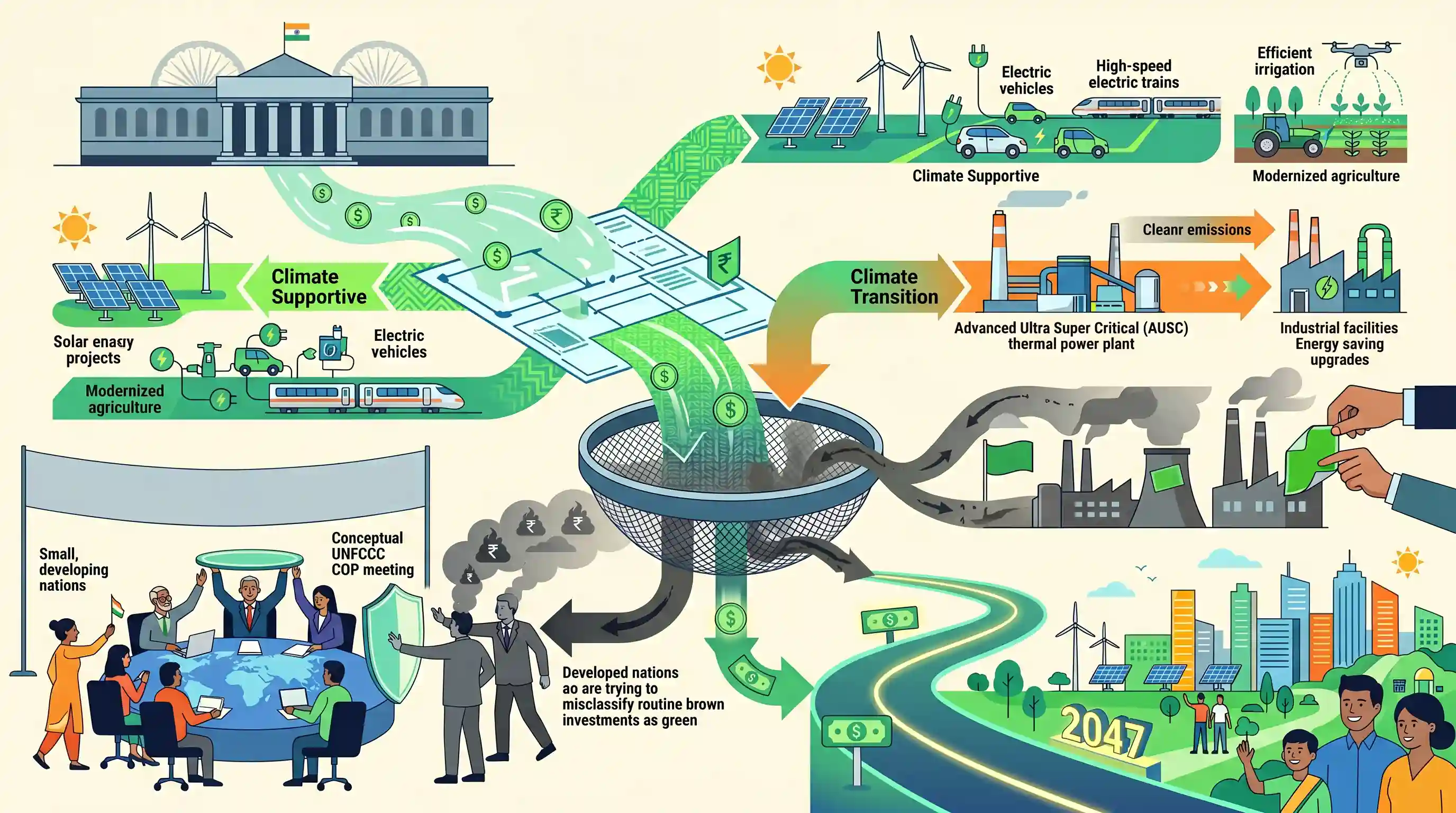
The Finance Ministry has released the draft 'Framework of India's Climate Finance Taxonomy', aimed at directing investments into clean energy and climate adaptation projects. The taxonomy classifies sectors as 'climate supportive' and 'climate transition', helping prevent greenwashing while guiding funds toward India's Net Zero 2070 target and Viksit Bharat 2047 goals. Importantly, standardizing what constitutes 'climate finance' strengthens developing nations' negotiating position at international forums like the UNFCCC COP, countering developed nations' tendency to classify routine business investments as climate contributions. The framework covers critical sectors including power, mobility, agriculture, and highlights the need for substantial investments, such as in Advanced Ultra Super Critical (AUSC) thermal power plants.
Key Points
- The Finance Ministry unveiled a draft 'Framework of India's Climate Finance Taxonomy' to classify sustainable investments and channel capital toward clean energy and climate adaptation.
- The taxonomy seeks to prevent 'green-washing' and support India's pathway to achieving Net Zero emissions by 2070 alongside the developmental goals of 'Viksit Bharat' by 2047.
- It categorizes activities as 'climate supportive' or 'climate transition', covering sectors like power, mobility, agriculture, and water security, and includes strategic investments in Advanced Ultra Super Critical (AUSC) thermal power plants.
- The framework provides clarity on the definition of 'climate finance', equipping India and other developing nations to demand genuine grants and technology transfers at global summits (like COP29), rather than just business investments counted as climate finance by developed countries.
- India's Initial Adaptation Communication estimated an adaptation expenditure requirement of ₹56.68 trillion by 2030 across sectors like agriculture, forestry, infrastructure, and ecosystems.
Important Terms
India's Climate Finance Taxonomy

A Ministry of Finance classification system defining economic activities as 'climate-supportive' or 'transition-supportive' to guide investments toward sustainable projects while preventing greenwashing.
UPSC context
GS Paper III (Economy/Environment); tests understanding of sustainable finance, resource mobilization, and India's regulatory framework for climate action.
Viksit Bharat 2047
A vision to transform India into a developed nation by 2047, targeting a $30–40 trillion economy with high per-capita income, inclusive growth, and modern infrastructure.
UPSC context
GS Paper II (Governance) and III (Economy); tests knowledge of national developmental goals, long-term economic planning, and inclusive development.
New Collective Quantified Goal (NCQG)
A post-2025 climate finance target under the UNFCCC intended to replace the $100 billion annual goal, focusing on the financial needs of developing nations.
UPSC context
GS Paper II (International Relations) and III (Environment); tests knowledge of global climate negotiations, UNFCCC/Paris Agreement, and climate justice.
Greenwashing
The deceptive practice where organizations misrepresent their products or operations as environmentally friendly to attract sustainable investment or improve public image.
UPSC context
GS Paper III (Environment/Ethics); tests awareness of corporate accountability and the integrity of ESG-based financial products.
Net Zero 2070
India's commitment to achieve a balance between anthropogenic greenhouse gas emissions and their removal from the atmosphere by 2047.
UPSC context
GS Paper III (Environment); tests knowledge of India's long-term climate commitments and the energy transition pathway.
Advanced Ultra Super Critical (AUSC) Technology
Indigenous high-efficiency thermal power technology operating at extreme temperatures (~700°C), reducing coal consumption and CO2 emissions by 10-15% compared to current units.
UPSC context
GS Paper III (Science & Technology/Energy); tests knowledge of indigenous innovation and technologies for cleaner fossil-fuel utilization.
Prelims Trap
The Climate Finance Taxonomy strictly excludes any financial allocation toward coal or thermal power plant projects.
The taxonomy includes a 'climate transition' category specifically for hard-to-abate sectors. It explicitly supports efficiency-boosting investments in fossil fuels, like Advanced Ultra Super Critical (AUSC) thermal power plants.
Static Concepts Connected
What is 'Greenwashing' and how is it regulated in India?
- Definition: Misleading consumers or investors by making exaggerated, unsubstantiated, or false claims about the environmental benefits of a product, service, or company.
- Indian Regulation: The Central Consumer Protection Authority (CCPA) recently designated greenwashing as an unfair trade practice under the Consumer Protection Act, 2019.
- UPSC Context: UPSC asked a direct question defining greenwashing in the 2022 Prelims exam.
How do Advanced Ultra Super Critical (AUSC) thermal plants work?
- Higher Efficiency: They operate at extremely high temperatures and pressures, achieving higher efficiency (~46%) compared to traditional subcritical plants (~38%).
- Emissions Reduction: Due to higher fuel efficiency, they reduce CO2 emissions by 10-15% per unit of electricity generated, aiding the 'climate transition' phase.
- Indigenous Tech: The technology is indigenously developed in India by a consortium comprising BHEL, NTPC, and IGCAR.
Cross-Topic Patterns
Climate Taxonomy & EU's CBAM
Defining what constitutes genuine 'green' investments helps Indian industries standardize their emission reduction reporting, a crucial step to navigate unilateral carbon taxes like the EU's Carbon Border Adjustment Mechanism (CBAM).
Sovereign Green Bonds baseline
The taxonomy provides a rigorous baseline for India's Sovereign Green Bonds framework, boosting global investor confidence, reducing the risk of 'greenwashing' allegations, and potentially lowering borrowing costs (the greenium).

Expect a multi-statement Prelims question distinguishing 'climate supportive' from 'climate transition' categories, testing AUSC plants.
Linked PYQs · 5
Linked PYQs · 5
- 2021MainsGS3
Describe the major outcomes of the 26th session of the Conference of the Parties (COP) to the United Nations Framework Convention on Climate Change (UNFCCC). What are the commitments made by India in this conference?
- 2021PrelimsGS1
The 'Common Carbon Metric', supported by UNEP, has been developed for
- 2025PrelimsGS1
Consider the following statements : Statement I: Article 6 of the Paris Agreement on climate change is frequently discussed in global discussions on sustainable development and climate change. Statement II: Article 6 of the Paris Agreement on climate change sets out the principles of carbon markets. Statement III : Article 6 of the Paris Agreement on climate change intends to promote inter-country non-market strategies to reach their climate targets. Which one of the following is correct in respect of the above statements?
- 2022PrelimsGS1
"Climate Action Tracker" which monitors the emission reduction pledges of different countries is a :
- 2022MainsGS3
Discuss global warming and mention its effects on the global climate. Explain the control measures to bring down the level of greenhouse gases which cause global warming, in the light of the Kyoto Protocol, 1997.
