RBI Gold Loan Rules: Balancing Financial Stability and Inclusion
Source:The Hindu ↗
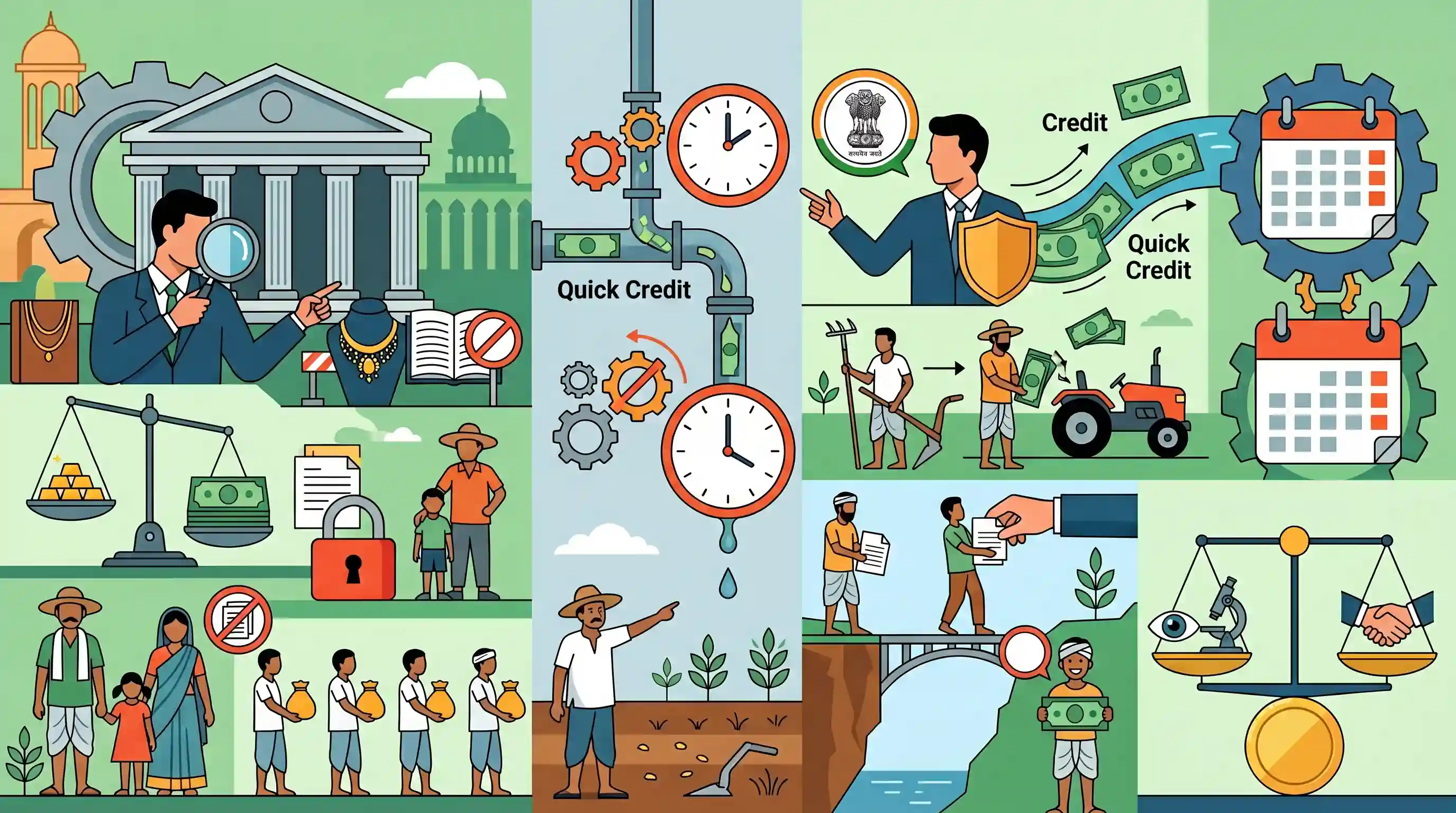
Why It Matters
Illustrates the critical balance the central bank and the government must strike between ensuring systemic financial stability (regulating rapid gold loan growth) and promoting financial inclusion (providing barrier-free credit access to small farmers and marginal borrowers).
Summary
The Finance Ministry has advised the Reserve Bank of India (RBI) to amend its draft regulations on gold loans to protect small borrowers, particularly those seeking loans under ₹2 lakh. The Department of Financial Services (DFS) argued that stringent requirements—such as a 75% loan-to-value cap, mandatory proof of gold ownership, and pledging limits—could delay crucial, speedy credit disbursement. Tamil Nadu Chief Minister M.K. Stalin echoed these concerns, emphasizing that small and marginal farmers frequently rely on gold pledging for quick agricultural credit due to a lack of formal land titles or income documentation. The Ministry has suggested delaying the implementation of the new rules to January 1, 2026, balancing regulatory oversight with financial inclusion.
Key Points
- The Finance Ministry instructed the RBI to ensure its draft gold loan regulations do not harm small borrowers, suggesting an exemption for loans under ₹2 lakh.
- The proposed RBI rules mandate a 75% loan-to-value cap, proof of gold ownership, and limits on gold pledged with a single lender.
- The Department of Financial Services (DFS) raised concerns that stringent rules would delay speedy credit disbursement to vulnerable groups.
- Tamil Nadu Chief Minister M.K. Stalin noted that small and marginal farmers heavily rely on gold loans because they often lack land titles or income documentation.
- The Ministry recommended implementing the new guidelines from January 1, 2026, to allow stakeholders time to adapt.
Important Terms
Loan-to-Value (LTV) Ratio

The percentage of an asset's value that a lender can provide as a loan. It serves as a macro-prudential tool for the RBI to manage credit risk.
UPSC context
GS Paper 3: Banking. Tests knowledge of regulatory tools used to manage credit risk and stabilize the financial sector.
Reserve Bank of India (RBI)
India's central bank and primary regulator of the banking system. It formulates monetary policy, manages foreign exchange, and supervises financial institutions to ensure economic stability.
UPSC context
GS Paper 3: Economy. Essential for topics like monetary management, inflation control, and financial sector reforms.
Department of Financial Services (DFS)
A department under the Ministry of Finance responsible for policy matters regarding public sector banks, financial institutions, insurance, and the National Pension System.
UPSC context
GS Paper 2 & 3: Governance/Economy. Tests understanding of the executive wing managing India's financial architecture and credit policies.
Financial Inclusion
Ensuring access to useful and affordable financial services—like credit, savings, and insurance—delivered in a responsible and sustainable way to underserved and low-income segments.
UPSC context
GS Paper 3: Indian Economy. Key for inclusive growth, poverty alleviation, and digital banking initiatives.
Agricultural Credit
Loans provided to farmers to meet the costs of cultivation and investments in farm assets. It is vital for increasing productivity and rural welfare.
UPSC context
GS Paper 3: Agriculture. Tests knowledge of priority sector lending and institutional credit mechanisms in rural India.
Small and Marginal Farmers
Farmers possessing up to 2 hectares of land. They constitute the majority of India's agricultural workforce and often face barriers in accessing formal credit.
UPSC context
GS Paper 3: Agriculture. Central to discussions on rural distress, credit access, and socio-economic equity.
Prelims Trap
"The Loan-to-Value (LTV) ratio caps for bank loans are mandated by the Ministry of Finance."
The RBI sets LTV limits under its macroprudential regulatory powers. The Finance Ministry (DFS) only advises or requests policy tweaks; it does not set the banking limits.
Static Concepts Connected
What is the Loan-to-Value (LTV) ratio and its macroeconomic purpose?
- Definition: The maximum loan amount a bank can provide expressed as a percentage of the collateral's appraised value.
- Risk mitigation: It creates a buffer, protecting lenders against sudden drops in asset prices (like gold or real estate) in the event of default.
- Macroprudential tool: The RBI adjusts LTV caps to control credit flow, cool down overheated sectors, and curb speculative bubbles.
What are the core mandates of the Department of Financial Services (DFS)?
- Institutional oversight: It formulates policies regarding Public Sector Banks, Insurance companies, and Pension Funds in India.
- Financial inclusion: It drives flagship credit and inclusion schemes like PMJDY, Mudra Yojana, and targeted agricultural credit flow.
- Legislative administration: It administers key financial legislation, including the RBI Act, Banking Regulation Act, and SARFAESI Act.
Cross-Topic Patterns
Land tenure and KCC exclusion
The absence of formalized land records excludes tenant farmers from Kisan Credit Card (KCC) benefits, forcing them to rely on alternative collateral like gold or informal moneylenders.
Regulatory autonomy vs. inclusion mandate
This tension mirrors past debates invoking Section 7 of the RBI Act, where sovereign welfare priorities (financial inclusion) clash with the central bank’s systemic risk management mandate.

Expect a 2026 Prelims statement testing 'Loan-to-Value' (LTV) limits as macroprudential tools alongside Priority Sector norms.
Linked PYQs · 3
Linked PYQs · 3
- 2013PrelimsGS1
The Reserve Bank of India regulates the commercial banks in matters of 1. liquidity of assets 2. branch expansion 3. merger of banks 4. winding-up of banks Select the correct answer using the codes given below.
- 2022MainsGS3
What is Integrated Farming System ? How is it helpful to small and marginal farmers in India?
- 2017MainsGS3
How do subsidies affect the cropping pattern, crop diversity and economy of farmers? What is the significance of crop insurance, minimum support price and food processing for small and marginal farmers?
