West Asia Conflict Impact on Crude Oil Prices and Fuel Inflation
Source:Indian Express ↗
Why It Matters
Understanding the transmission of global geopolitical shocks (like the West Asia conflict) to domestic macroeconomic indicators (inflation, fuel prices, twin deficits) is essential for GS3 Economy and GS2 International Relations.
Summary
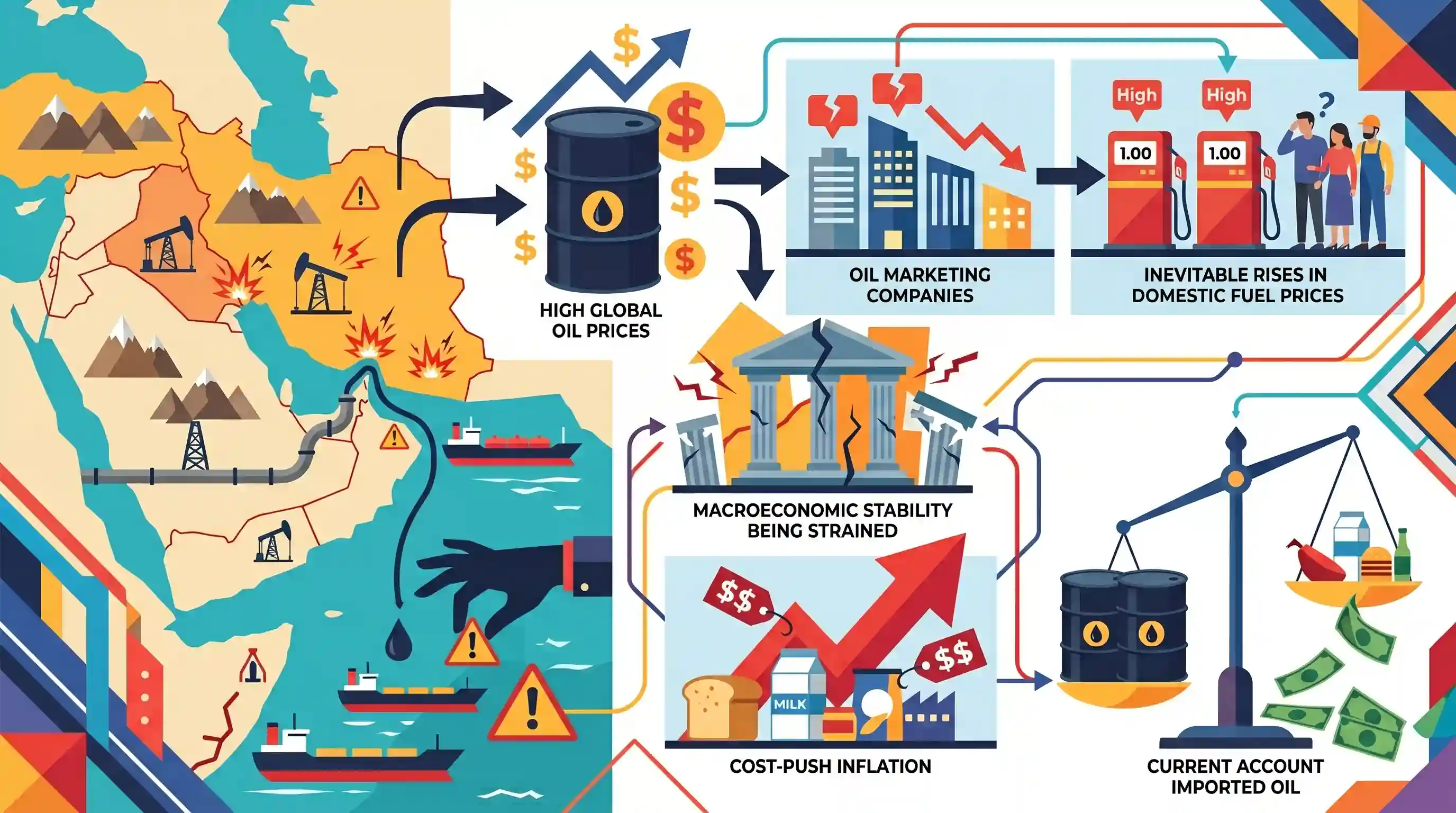
The Finance Ministry has cautioned that a hike in domestic fuel prices is inevitable due to mounting losses faced by Oil Marketing Companies (OMCs) amidst the ongoing conflict in West Asia. Highlighting vulnerabilities in India's energy supply chain, the Ministry noted that a significant portion of the country's crude oil imports passes through the strategically critical Strait of Hormuz. Sustained geopolitical tensions and elevated global crude oil prices threaten to increase cost-push inflation, widen the current account deficit, and strain overall macroeconomic stability.
Key Points
- Oil Marketing Companies (OMCs) in India are incurring substantial under-recoveries (losses) on petrol and diesel as global crude prices have risen while domestic retail prices remained frozen.
- The Finance Ministry's Monthly Economic Review warns that a pass-through of these higher international prices to domestic consumers is inevitable.
- The escalating conflict in West Asia, particularly the potential disruption of trade through the Strait of Hormuz, poses a severe risk to India's energy security, as about 40% of India's oil imports transit this chokepoint.
- Higher crude oil prices threaten macroeconomic stability by widening the current account deficit, triggering cost-push inflation, and presenting downside risks to economic growth.
Important Terms
Oil Marketing Companies (OMCs)

Downstream entities like IOCL, BPCL, and HPCL responsible for refining and retailing fuel. They incur 'under-recoveries' when global oil prices rise but domestic retail rates are capped for consumers.
UPSC context
GS Paper 3: Economics. Critical for questions on fuel subsidies, fiscal health, and the petroleum sector's pricing mechanisms.
Strait of Hormuz
The world's most critical oil chokepoint, connecting the Persian Gulf to the Gulf of Oman. It facilitates approximately 20% of global oil trade and handles a majority of India's crude imports.
UPSC context
GS Paper 2: International Relations. Vital for mapping energy lifelines and assessing geopolitical risks in West Asia.
Current Account Deficit (CAD)
A measure of trade where the value of imported goods, services, and transfers exceeds exports. For India, rising crude oil prices are a primary driver of a widening CAD.
UPSC context
GS Paper 3: Economy. Key to understanding Balance of Payments (BoP) and the external vulnerability of the Indian Rupee.
Cost-push Inflation
Inflation driven by rising production costs, such as raw materials, wages, or fuel. Increased energy prices 'push' the overall price level higher, impacting transportation and manufacturing sectors.
UPSC context
GS Paper 3: Economy. Tests the ability to distinguish between demand-side and supply-side inflationary triggers.
Energy Security
The uninterrupted availability of energy sources at an affordable price. It involves diversifying imports, expanding Strategic Petroleum Reserves (SPR), and transitioning to renewable sources to ensure strategic autonomy.
UPSC context
GS Paper 3: Energy/Environment. Essential for analyzing India's energy transition and mitigation of global supply chain disruptions.
Macroeconomic Stability
A condition where an economy maintains low inflation, steady growth, and sustainable fiscal and trade deficits. It ensures resilience against external shocks like global wars or price spikes.
UPSC context
GS Paper 3: Indian Economy. Central to assessing the effectiveness of government fiscal policy and central bank interventions.
Prelims Trap
Retail prices of petrol and diesel in India are officially regulated by the Government.
Petrol and diesel were officially deregulated in 2010 and 2014. The current price freeze is an informal administrative action by public sector OMCs, not statutory government regulation.
Static Concepts Connected
How do rising global crude oil prices impact India's macroeconomic indicators?
- CAD Widens: Every $10/barrel rise increases CAD by ~0.4-0.5% of GDP due to highly inelastic import demand.
- Cost-Push Inflation: Higher transport and freight costs cascade into general price levels, creating supply-side inflation that the RBI struggles to tame with rate hikes.
- Rupee Depreciation: Higher dollar demand to pay for expensive oil imports drains forex reserves and weakens the INR exchange rate.
What are the key West Asian maritime chokepoints for energy trade?
- Strait of Hormuz: Connects the Persian Gulf to the Gulf of Oman and Arabian Sea. A critical chokepoint handling ~40% of India's crude imports.
- Bab el-Mandeb: Connects the Red Sea to the Gulf of Aden. Crucial for shipping routes heading toward the Suez Canal and Europe.
- Pipeline Bypasses: Saudi Arabia's East-West pipeline and Iran's Goreh-Jask pipeline act as overland bypass routes to avoid maritime blockades at the Strait of Hormuz.
Cross-Topic Patterns
Strategic Petroleum Reserves (SPR) buffer
Rising crude vulnerability highlights India's push for Strategic Petroleum Reserves under ISPRL (Mangaluru, Visakhapatnam, Padur, Chandikhol) to buffer against geopolitical shocks and supply chain disruptions.
Imported inflation + Energy Transition
Sustained high import bills reinforce the macroeconomic urgency behind India's National Green Hydrogen Mission and 20% ethanol blending target to decouple GDP growth from imported crude oil.

A mixed economy-geography Prelims question mapping West Asian maritime chokepoints directly to India's CAD and imported inflation is likely.
Linked PYQs · 3
Linked PYQs · 3
- 2025MainsGS2
"Energy security constitutes the dominant kingpin of India's foreign policy, and is linked with India's overarching influence in Middle Eastern countries.” How would you integrate energy security with India's foreign policy trajectories in the coming years?
- 2017MainsGS2
The question of India's Energy Security constitutes the most important part of India's economic progress. Analyze India's energy policy cooperation with West Asian countries.
- 2024PrelimsGS1
Consider the following statements : Statement-I : Sumed pipeline is a strategic route for Persian Gulf oil and natural gas shipments to Europe. Statement-II : Sumed pipeline connects the Red Sea with the Mediterranean Sea. Which one of the following is correct in respect of the above statements?
