Finance Ministry Report on Crude Oil Prices and Inflation
Source:Indian Express ↗
Why It Matters
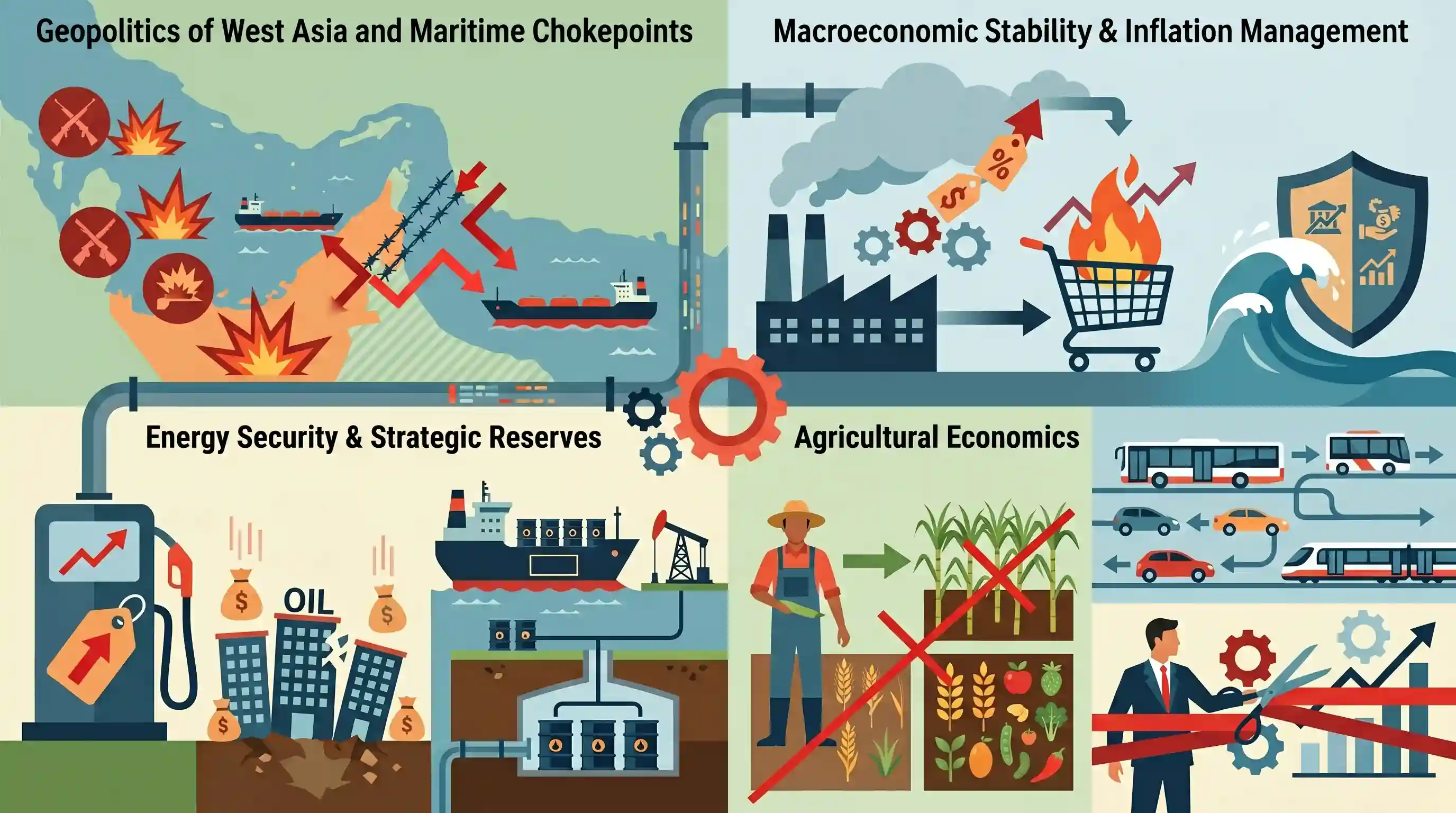
Geopolitical conflicts in West Asia have a direct cascading effect on India's macroeconomic stability due to its heavy import dependence for crude oil. The article highlights the complex policy trilemma of maintaining OMC financial health, controlling inflation, and ensuring national energy security.
Summary
A recent Finance Ministry report emphasizes that passing higher global fuel prices onto end-users is "inevitable," as Oil Marketing Companies (OMCs) continue to bear massive losses amid the West Asia conflict. Highlighting India's 90% reliance on imported crude oil, the report points to supply disruptions in key maritime chokepoints like the Strait of Hormuz, making the establishment of strategic energy buffers a top policy priority. The Ministry cautioned that sustained high energy and freight costs will lead to cost-push inflation, which could quickly spill over from wholesale to consumer inflation. To buffer the economy against external shocks, the report advocates for crucial domestic structural reforms, including the elimination of distorted agricultural crop choices, enhancement of public transportation networks, and further deregulation of business operations.
Key Points
- Indian Oil Marketing Companies are absorbing significant losses (under-recoveries) as elevated global crude prices are not being passed on to domestic retail consumers.
- Geopolitical conflicts in West Asia and disruptions in critical maritime chokepoints like the Strait of Hormuz highlight India's vulnerability, given its 90% dependence on imported crude oil.
- The Finance Ministry report warns that prolonged geopolitical tensions and elevated freight rates will inevitably trigger cost-push inflation, impacting overall consumer retail inflation.
- To build resilience, the report stresses the urgent need for domestic structural reforms, including correcting distorted agricultural cropping patterns, improving public transport, and decriminalizing business laws.
Important Terms
Oil Marketing Companies (OMCs)

Entities (like IOCL, BPCL, HPCL) responsible for refining, transporting, and retailing petroleum products. They often absorb 'under-recoveries' when global crude prices exceed domestic retail price caps.
UPSC context
GS Paper 3 (Economy/Infrastructure); tests understanding of fuel pricing mechanisms, subsidies, and energy supply chains.
Strategic Petroleum Reserves (SPR)
Emergency crude oil stockpiles stored in underground caverns (e.g., Visakhapatnam, Padur) to safeguard energy security during supply disruptions. India's current capacity covers approximately 9.5 days of demand.
UPSC context
GS Paper 3 (Energy Security); critical for discussions on strategic autonomy and buffering external economic shocks.
Strait of Hormuz
A vital maritime chokepoint between Iran and Oman connecting the Persian Gulf to the open ocean. It facilitates nearly 50% of India's crude and 80% of its LPG imports.
UPSC context
GS Paper 2 (Geopolitics/West Asia) and Paper 3 (Energy Security); tests knowledge of maritime vulnerabilities and regional instability.
Cost-push Inflation
A type of inflation triggered by rising costs of production inputs, such as fuel or wages, which decreases aggregate supply and forces higher prices onto consumers.
UPSC context
GS Paper 3 (Macroeconomics); key for analyzing the impact of global commodity price spikes on domestic inflation.
Cropping Pattern
The spatial and temporal arrangement of crops in an area. In India, policy incentives like MSP often lead to 'distorted' patterns, favoring water-intensive cereals over pulses and millets.
UPSC context
GS Paper 3 (Agriculture); essential for questions on sustainable farming, water management, and MSP reforms.
Prelims Trap
Retail prices of petrol and diesel are legally regulated by the Government of India to control inflation.
Petrol and diesel are officially deregulated in India. OMCs bearing 'under-recoveries' is an informal/corporate mechanism to shield consumers, not statutory price control. Aspirants confuse under-recoveries with direct government subsidies.
Static Concepts Connected
What are 'under-recoveries' in the context of Oil Marketing Companies (OMCs)?
- Definition: The revenue loss incurred when OMCs sell fuel in the domestic market at retail prices below the international cost of crude oil procurement.
- Unlike Subsidies: Unlike budgeted government subsidies, under-recoveries are absorbed directly on the balance sheets of the oil companies.
- Economic Impact: It squeezes OMC profit margins, deters private fuel retailers from fair competition, and severely impacts the financial health of public sector oil entities.
Why is the Strait of Hormuz a critical geographical chokepoint?
- Location: A narrow strait situated between Iran and Oman, linking the Persian Gulf to the Gulf of Oman and the Arabian Sea.
- Global Transit: It is the world's most important oil transit chokepoint, handling approximately 20% of global petroleum liquid consumption.
- Strategic Vulnerability: Any geopolitical conflict or blockade immediately spikes global crude prices, heavily impacting import-dependent nations like India and straining foreign exchange reserves.
Cross-Topic Patterns
Energy costs and Cropping Patterns
Subsidized power and fertilizers encourage water-intensive crops like paddy. When global energy prices spike, the fiscal burden of these agricultural inputs forces a macro-level re-evaluation of distorted cropping choices.
Imported Inflation & Monetary Policy Limits
Cost-push inflation driven by external supply-side shocks limits the RBI's ability to use monetary policy effectively, as domestic interest rate hikes cannot resolve global maritime supply constraints.

A mixed-concept Prelims question linking West Asian maritime chokepoints directly to India's CAD and cost-push inflation is highly likely.
Linked PYQs · 5
Linked PYQs · 5
- 2025MainsGS3
Why is maritime security vital to protect India's sea trade? Discuss maritime and coastal security challenges and the way forward.
- 2022MainsGS3
What are the maritime security challenges in India ? Discuss the organisational, technical and procedural initiatives taken to improve the maritime security.
- 2024MainsGS3
What are the causes of persistent high food inflation in India? Comment on the effectiveness of the monetary policy of the RBI to control this type of inflation.
- 2023MainsGS3
Explain the changes in cropping pattern in India in the context of changes in consumption pattern and marketing conditions.
- 2013PrelimsGS1
A rise in general level of prices may be caused by
