Fourth India Singapore Ministerial Roundtable Strengthens Ties
Source:The Hindu ↗
આ શા માટે મહત્વનું છે
India-Singapore relations are pivotal to India's Act East Policy. Understanding the economic integration through CECA and FDI flows, alongside strategic cooperation like Malacca Strait patrols, is crucial for GS2 (International Relations) and GS3 (Economy/Security).
સારાંશ
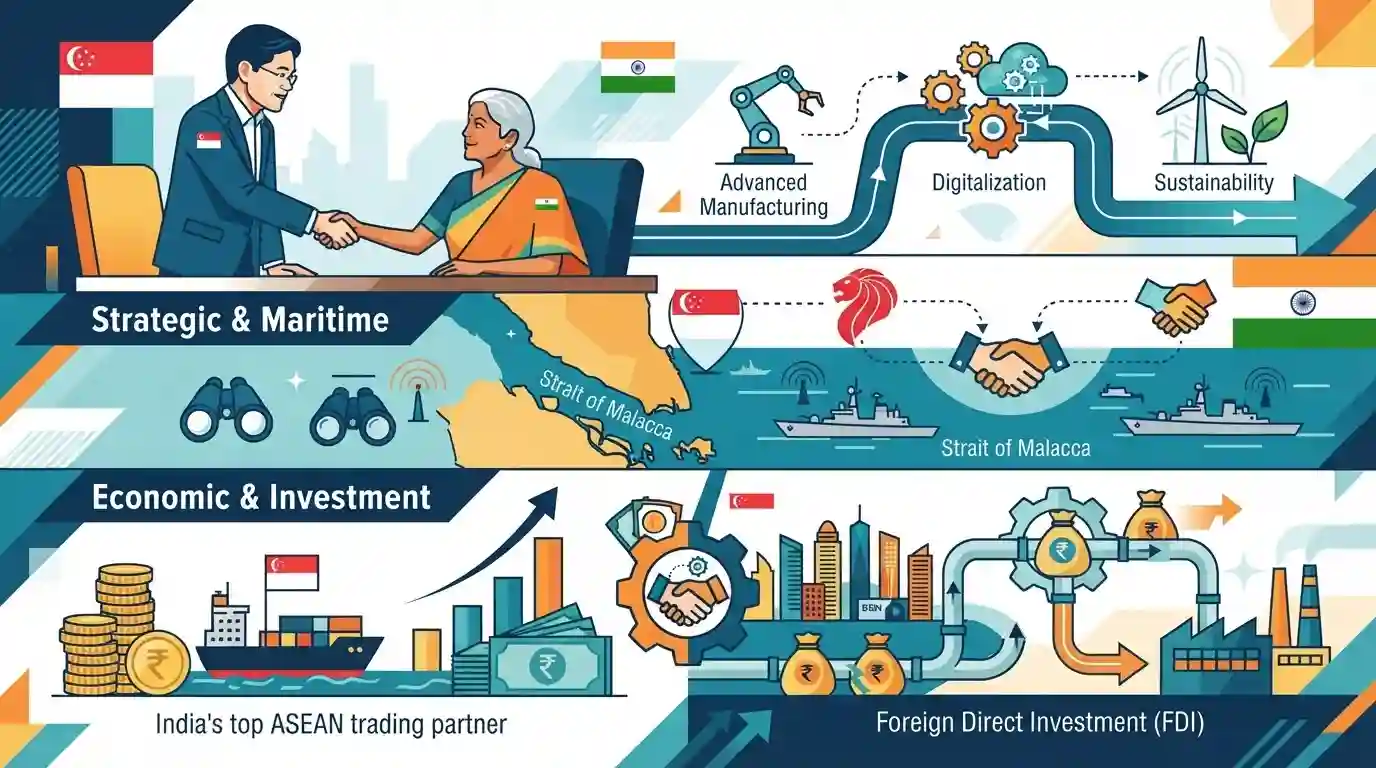
The 4th India-Singapore Ministerial Roundtable (ISMR) saw key discussions between Singapore Prime Minister Lawrence Wong and an Indian delegation led by Finance Minister Nirmala Sitharaman. The talks focused on expanding the Comprehensive Strategic Partnership Roadmap, emphasizing advanced manufacturing, digitalization, and sustainability. Strategically, Singapore backed India's initiative to patrol the Malacca Strait. Economically, Singapore continues to be a cornerstone of India's Act East policy, standing as India's top ASEAN trading partner and the largest source of FDI, aided significantly by the Comprehensive Economic Cooperation Agreement (CECA).
મુખ્ય મુદ્દા
- The 4th India-Singapore Ministerial Roundtable (ISMR) was held, with discussions led by Singapore PM Lawrence Wong and Indian FM Nirmala Sitharaman.
- The meeting focused on deepening bilateral ties across areas like advanced manufacturing, digitalisation, sustainability, and connectivity.
- The ISMR aims to advance the 'Singapore India Comprehensive Strategic Partnership Roadmap', reflecting momentum from PM Modi's recent visit.
- Singapore expressed support for India's strategic plan to patrol the Malacca Strait, a vital chokepoint for regional security and trade.
- Singapore remains India's largest trading partner within ASEAN and the largest source of Foreign Direct Investment (FDI) into India, accounting for $19.8 billion in 2025-26.
- The Comprehensive Economic Cooperation Agreement (CECA) has been instrumental in the robust growth of bilateral trade.
મહત્વપૂર્ણ શબ્દો
India-Singapore Ministerial Roundtable (ISMR)

A high-level bilateral platform launched in 2022 to drive economic and strategic cooperation between India and Singapore, focusing on emerging areas like digital technology, advanced manufacturing, sustainability, and skills development.
UPSC context
GS Paper II (Bilateral Relations); tests structural cooperation and trade mechanisms under India's Act East policy.
Comprehensive Economic Cooperation Agreement (CECA)
A landmark bilateral free trade agreement signed in 2005 between India and Singapore to eliminate tariff barriers, facilitate investment, prevent double taxation, and foster services and technology collaboration.
UPSC context
GS Paper II & III (Bilateral Trade, FDI); tests economic integration with ASEAN and trade policy impacts.
Singapore-India Comprehensive Strategic Partnership (CSP) Roadmap
An ambitious eight-pillar bilateral framework unveiled in September 2025 to structure and accelerate India-Singapore cooperation across domains like trade, advanced manufacturing, digitalisation, sustainability, and defence.
UPSC context
GS Paper II (Bilateral Relations); tests strategic partnerships, middle-power collaborations, and maritime security in the Indo-Pacific.
ASEAN
A 10-member regional intergovernmental organization in Southeast Asia established to promote economic growth, social progress, cultural development, and regional peace and stability.
UPSC context
GS Paper II (Regional Groupings); tests India's Act East Policy, regional connectivity, and Indo-Pacific geopolitics.
પ્રિલિમ્સ ટ્રેપ
India is a founding member of the Malacca Strait Patrol (MSP) alongside Singapore, Malaysia, and Indonesia.
India is not a member of the MSP. It is a joint initiative of Indonesia, Malaysia, Singapore, and Thailand. India has only recently sought participation.
સંલગ્ન સ્થિર ખ્યાલો
What is the Malacca Strait Patrol (MSP) and its composition?
- Core Members: Initiated in 2004 by Indonesia, Malaysia, and Singapore, with Thailand joining in 2008 to secure the critical Malacca Strait.
- Core Components: Comprises the Malacca Strait Sea Patrol (MSSP), Eyes-in-the-Sky (EiS) air patrols, and the Intelligence Exchange Group (IEG).
- Strategic Role: Secures a chokepoint through which over 25% of global trade and oil shipments pass annually.
How does CECA differ from CEPA in trade nomenclature?
- CECA Scope: Focuses primarily on tariff reduction/elimination on listed goods, investment facilitation, and trade cooperation.
- CEPA Depth: Broader and deeper, covering services, investments, intellectual property rights, competition, and regulatory standards.
- Indian Examples: India signed a CECA with Singapore (2005) and a CEPA with Japan (2011) and UAE (2022).
આંતર-વિષય પેટર્ન
Strategic choke points + Net Security Provider
Access to Singapore's Changi Naval Base underpins India's maritime power projection, turning tactical logistics agreements into broader geopolitical influence in the Indo-Pacific.
FDI trends + Double Tax Avoidance
Singapore's dominance as India's top FDI source highlights how bilateral tax treaties (DTAA) influence capital flows and corporate restructuring over standard trade pacts.

Expect questions linking India's Changi Base logistics, Malacca Strait Patrol interest, and its net security provider role in the IOR.
સંલગ્ન PYQ · 2
સંલગ્ન PYQ · 2
- 2016MainsGS2
Evaluate the economic and strategic dimensions of India's Look East Policy in the context of the post Cold War international scenario.
- 2016MainsGS3
Justify the need for FDI for the development of the Indian economy. Why there is gap between MOUs signed and actual FDIs? Suggest remedial steps to be taken for increasing actual FDIs in India.
