SME Growth Fund and TReDS Mandate for MSME Sector Revival
Source:The Hindu ↗
Why It Matters
The MSME sector is the backbone of Indian manufacturing and employment. Budgetary measures like the SME Growth Fund, formalisation incentives, and TReDS integration highlight government strategies to address credit bottlenecks and modernization, which are frequent subjects in GS Paper 3 questions on economic growth and industrial policy.
Summary
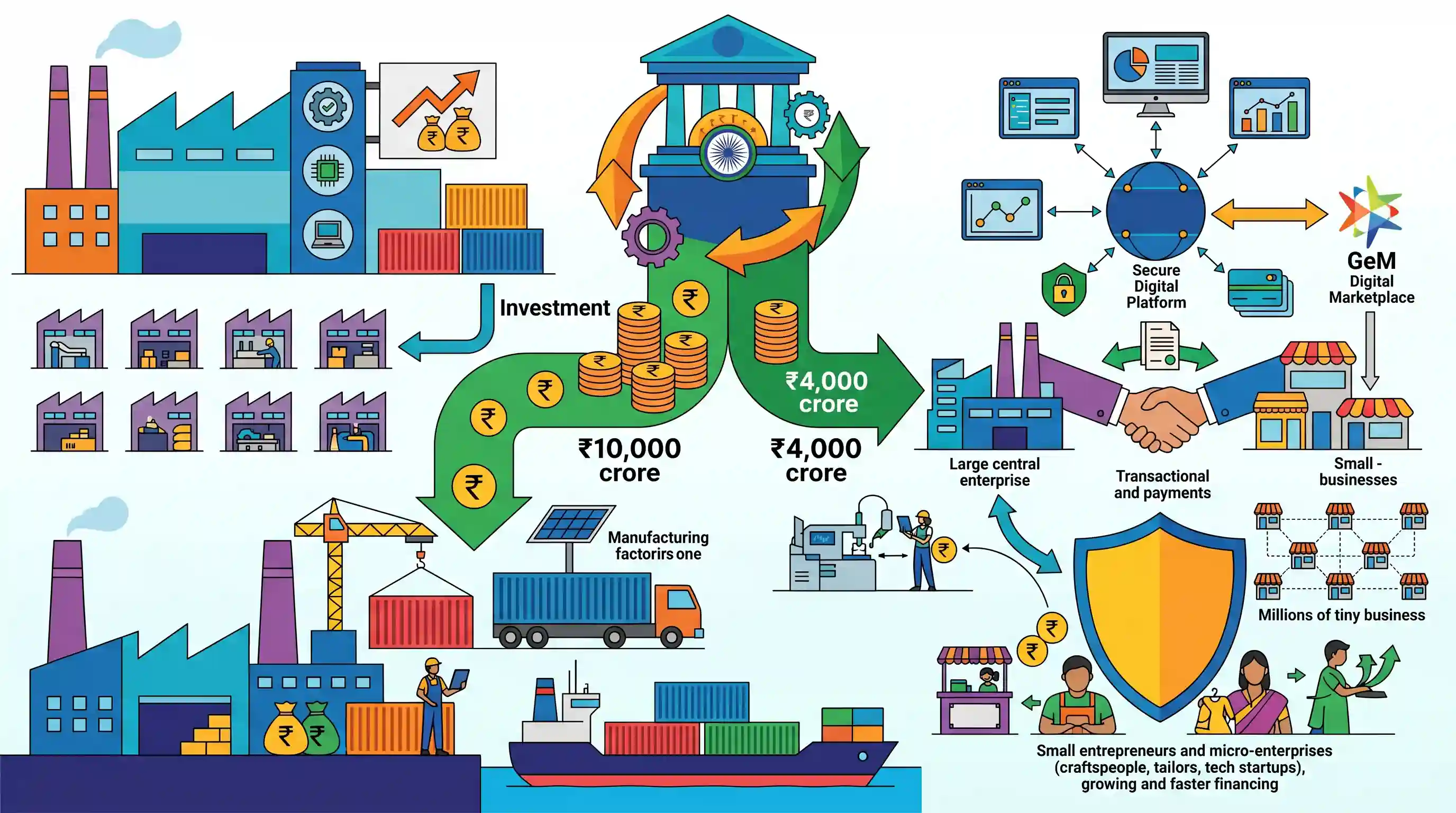
The Union Budget 2026 focuses heavily on reviving and modernising the Micro, Small, and Medium Enterprises (MSME) sector with the establishment of a ₹10,000 crore SME Growth Fund. Finance Minister Nirmala Sitharaman also announced a 'Self-Reliant Fund' seeded with ₹4,000 crores to upgrade infrastructure and technology across 200 legacy industrial clusters and promote container manufacturing. To address persistent liquidity issues, the Trade Receivables Discounting System (TReDS) has been mandated as the exclusive platform for central public sector enterprise purchases from MSMEs. Additionally, linking TReDS with the Government e-Marketplace (GeM) and introducing a credit guarantee scheme are expected to dramatically improve financing cycles and support millions of micro-enterprises.
Key Points
- The Union Budget 2026 allocates a ₹10,000 crore SME Growth Fund to revitalize small businesses, focusing on solving financial stress and boosting credit access.
- A 'Self-Reliant Fund' with an initial top-up of ₹4,000 crores was announced to modernise 200 legacy industrial clusters and support container manufacturing, aiming to upgrade infrastructure and technology.
- SMEs meeting targets in productivity, formalisation, and export-readiness will be granted special rewards under the new framework.
- The Trade Receivables Discounting System (TReDS) has facilitated over ₹7 lakh crore in credit and will now serve as the mandatory, single-step platform for MSME purchases made by central public sector enterprises (CPSEs).
- The government plans to link the Government e-Marketplace (GeM) with TReDS and introduce a credit guarantee scheme to ensure faster and more reliable financing cycles for micro-enterprises.
Important Terms
MSMEs

Enterprises classified by investment and turnover limits under the MSMED Act. They are vital for employment, contributing roughly 30% to India's GDP and nearly 50% to its total exports.
UPSC context
GS Paper III: Economy. Critical for inclusive growth, employment generation, and industrial policy discussions. Tests understanding of sectoral contributions.
Trade Receivables Discounting System (TReDS)
An electronic platform facilitating the financing and discounting of MSME trade receivables from corporate and government buyers through multiple financiers, ensuring quicker access to working capital and improved liquidity.
UPSC context
GS Paper III: Economy/Banking. Relevant for financial inclusion and solving the 'delayed payments' crisis in the small-scale sector.
SME Growth Fund
A dedicated ₹10,000 crore fund announced in Budget 2026 to provide equity and growth capital to high-potential small businesses, aiming to scale them into "champion" enterprises.
UPSC context
Current Affairs/Economy. Illustrates government strategy for industrial scaling and transition from survival-based support to growth-oriented investment.
Government e-Marketplace (GeM)
A one-stop online procurement portal for government departments and public sector units to purchase goods and services. Budget 2026 links it with TReDS to streamline MSME financing.
UPSC context
GS Paper II & III: Governance/Economy. Focuses on transparency in public procurement and digital transformation of government-to-business (G2B) interactions.
Credit Guarantee Scheme
A financial mechanism where the government provides a guarantee to lenders (banks/NBFCs) against MSME loan defaults, encouraging collateral-free lending and reducing the risk for financiers.
UPSC context
GS Paper III: Economy. Key for analyzing credit flow to priority sectors and reducing the finance gap for micro-enterprises.
Central Public Sector Enterprises (CPSEs)
State-owned industrial and commercial companies in which the Central Government holds a majority stake. They are major buyers and are now mandated to settle MSME payments via TReDS.
UPSC context
GS Paper III: Economy. Important for public sector reforms and their role in supporting the domestic MSME ecosystem.
Self-Reliant Fund
A fund-of-funds aimed at providing equity infusion to MSMEs. Budget 2026 proposes a top-up to help viable units upgrade technology and scale into larger enterprises.
UPSC context
Current Affairs/Industrial Policy. Relates to 'Atmanirbhar Bharat' initiatives and the shift toward equity-based financing for small businesses.
Prelims Trap
TReDS is a newly launched platform mandated for all corporate MSME purchases.
TReDS is an older RBI-regulated framework. Budget 2026 simply mandates it specifically for Central Public Sector Enterprises (CPSEs) and links it with GeM.
Static Concepts Connected
What is the Trade Receivables Discounting System (TReDS)?
- Regulatory Origin: Introduced by the Reserve Bank of India to facilitate the financing of MSME trade receivables from corporate and government buyers.
- Mechanism: An institutional mechanism where multiple financiers bid to discount invoices of MSME sellers, ensuring competitive interest rates.
- Risk Allocation: Transactions are 'without recourse' to MSMEs, meaning the financiers bear the default risk of the buyer.
What is the current classification criteria for MSMEs in India?
- Composite criteria: Revised in 2020 to eliminate the manufacturing/service distinction, using a composite criteria of Investment and Annual Turnover.
- Current Thresholds: Micro (Investment <₹1Cr, Turnover <₹5Cr), Small (Inv <₹10Cr, Turn <₹50Cr), Medium (Inv <₹50Cr, Turn <₹250Cr).
Cross-Topic Patterns
DPI bridging MSME credit gaps
Integrating GeM with TReDS showcases how Digital Public Infrastructure is being leveraged to solve the 'missing middle' credit crisis and delayed payments for informal sectors.
Outcome-based subsidies & Global Value Chains
Linking MSME rewards to export-readiness reflects a shift from blanket protectionism to performance-linked support, preparing Indian legacy industrial clusters for Global Value Chains (GVCs).

A Prelims question interlinking the RBI's TReDS framework, Commerce Ministry's GeM platform, and MSME formalisation is highly likely.
Linked PYQs · 2
Linked PYQs · 2
- 2023MainsGS3
Faster economic growth requires increased share of the manufacturing sector in GDP, particularly of MSMEs. Comment on the present policies of the Government in this regard.
- 2023PrelimsGS1
Consider the following statements with reference to India: 1. According to the 'Micro, Small and Medium Enterprises Development (MSMED) Act, 2006', the 'medium enterprises' are those with investments in plant and machinery between ₹ 15 crore and ₹ 25 crore. 2. All bank loans to the Micro, Small and Medium Enterprises qualify under the priority sector. Which of the statements given above is/are correct?
