Union Budget faces criticism for neglecting core agricultural sector
Source:Indian Express ↗
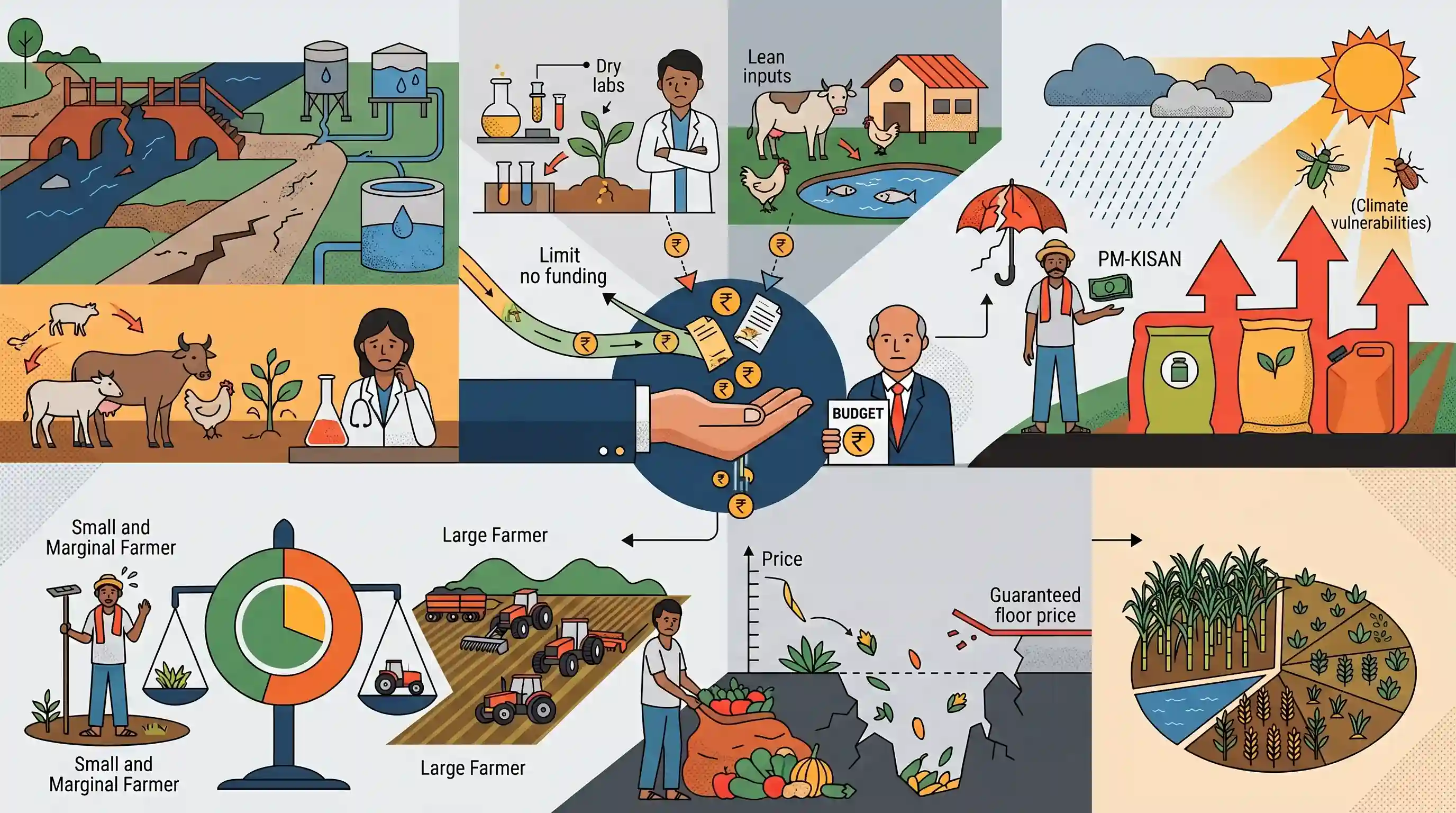
Why It Matters
Agriculture forms the backbone of the Indian rural economy. Analyzing the Union Budget's impact on the farm sector is essential for UPSC aspirants to understand government priorities, policy gaps in addressing rural distress, and the structural reforms needed in agriculture for inclusive economic growth.
Summary
The article provides a critical evaluation of the Union Budget, arguing that the Finance Minister has neglected significant portions of the agricultural sector. It highlights inadequate budgetary allocations for rural infrastructure, agricultural research, and allied sectors. The author contends that existing safety nets like PM-KISAN and crop insurance are insufficient against the backdrop of rising input costs and climate vulnerabilities. Furthermore, the piece emphasizes the ongoing neglect of small and marginal farmers, asserting that the budget lacks a holistic strategy to address rural distress and ensure remunerative prices through mechanisms like MSP.
Key Points
- The Union Budget faces criticism for failing to adequately address the structural issues and distress within the broader agricultural sector.
- There is a noted lack of sufficient investment in agricultural infrastructure, research, and allied activities such as dairy and fisheries.
- Welfare measures like PM-KISAN and crop insurance (PMFBY) have not seen the necessary expansion or funding increases to offset rising input costs and climate risks.
- The budget allegedly overlooks the pressing needs of small and marginal farmers, particularly concerning remunerative prices (MSP) and rural employment generation.
Important Terms
Minimum Support Price (MSP)

A guaranteed price at which the government purchases 22 mandated crops and fair price for sugarcane from farmers, protecting them against sharp price falls during bumper production.
UPSC context
GS Paper 3; critical for understanding farm subsidies, food security, and debates surrounding legal guarantees and agricultural distress.
PM-KISAN
A Central Sector Scheme providing ₹6,000 annual income support in three equal installments to all landholding farmer families across India via direct benefit transfer.
UPSC context
GS Paper 3; tests knowledge of direct income support mechanisms as alternatives to market-distorting subsidies in agriculture.
Union Budget
The 'Annual Financial Statement' under Article 112, detailing the government's estimated receipts and expenditure for a financial year and reflecting its policy priorities.
UPSC context
GS Paper 3; fundamental for analyzing fiscal policy, government spending on agriculture, and the parliamentary budgetary process.
Pradhan Mantri Fasal Bima Yojana (PMFBY)
A flagship crop insurance scheme launched in 2016 providing comprehensive risk protection for crops against non-preventable natural risks, with farmer premiums capped at 1.5%-5%.
UPSC context
GS Paper 3; essential for discussing agricultural risk management, climate resilience, and welfare scheme effectiveness.
Kisan Credit Card (KCC)
A credit delivery mechanism providing farmers with timely and affordable institutional credit for cultivation, post-harvest expenses, and investment needs in allied sectors.
UPSC context
GS Paper 3; core topic for evaluating financial inclusion and formalization of agricultural credit.
Commission for Agricultural Costs and Prices (CACP)
An attached office of the Ministry of Agriculture that recommends Minimum Support Prices (MSPs) based on production costs, demand-supply, and market trends.
UPSC context
GS Paper 3; important for understanding the institutional methodology behind agricultural price discovery and government intervention.
Prelims Trap
"MSP procurement directly benefits the vast majority of small and marginal farmers across India."
The Shanta Kumar Committee (2015) reported that only 6-7% of Indian farmers actually benefit from MSP procurement, mostly due to a lack of local procurement infrastructure.
Static Concepts Connected
What are the premium rates and risks covered under PMFBY?
- Premium Rates: Uniform maximum premium of 2% for all Kharif crops, 1.5% for Rabi crops, and 5% for annual commercial and horticultural crops.
- Risk Coverage: Provides comprehensive insurance cover against non-preventable natural risks, spanning from pre-sowing to post-harvest losses.
How are small and marginal landholdings classified in India?
- Marginal Farmers: Cultivators with an operational landholding of up to 1 hectare (approx. 2.5 acres).
- Small Farmers: Cultivators with an operational landholding between 1 and 2 hectares.
- Structural Share: Together they form about 85% of India's agricultural households but operate only 47% of the cropped area.
Cross-Topic Patterns
The Allied Sector Paradox
Livestock and fisheries grow at 5-8% annually and contribute heavily to Agri-GVA, yet budgetary allocations remain deeply skewed toward traditional, slower-growing crop cultivation.
Climate Vulnerability vs. Farm Subsidies
Stagnant PM-KISAN transfers and fixed PMFBY outlays highlight a systemic disconnect between rigid agricultural budgeting and India's rising, unpredictable climate-induced extreme weather events.

Expect a GS3 Mains question evaluating the mismatch between agriculture's allied sector growth and their disproportionately low budget share.
Linked PYQs · 4
Linked PYQs · 4
- 2023MainsGS3
What are the direct and indirect subsidies provided to farm sector in India? Discuss the issues raised by the World Trade Organization (WTO) in relation to agricultural subsidies.
- 2017MainsGS3
How do subsidies affect the cropping pattern, crop diversity and economy of farmers? What is the significance of crop insurance, minimum support price and food processing for small and marginal farmers?
- 2020PrelimsGS1
Under the Kisan Credit Card scheme, short-term credit support is given to farmers for which of the following purposes ? 1. Working capital for maintenance of farm assets 2. Purchase of combine harvesters, tractors and mini trucks 3. Consumption requirements of farm households 4. Post-harvest expenses 5. Construction of family house and setting up of village cold storage facility Select the correct answer using the code given below:
- 2018MainsGS3
What do you mean by Minimum Support Price (MSP)? How will MSP rescue the farmers from the low income trap?
