Agricultural Allocations and Capital Investment Deficit in Budget
Source:Indian Express ↗
Why It Matters
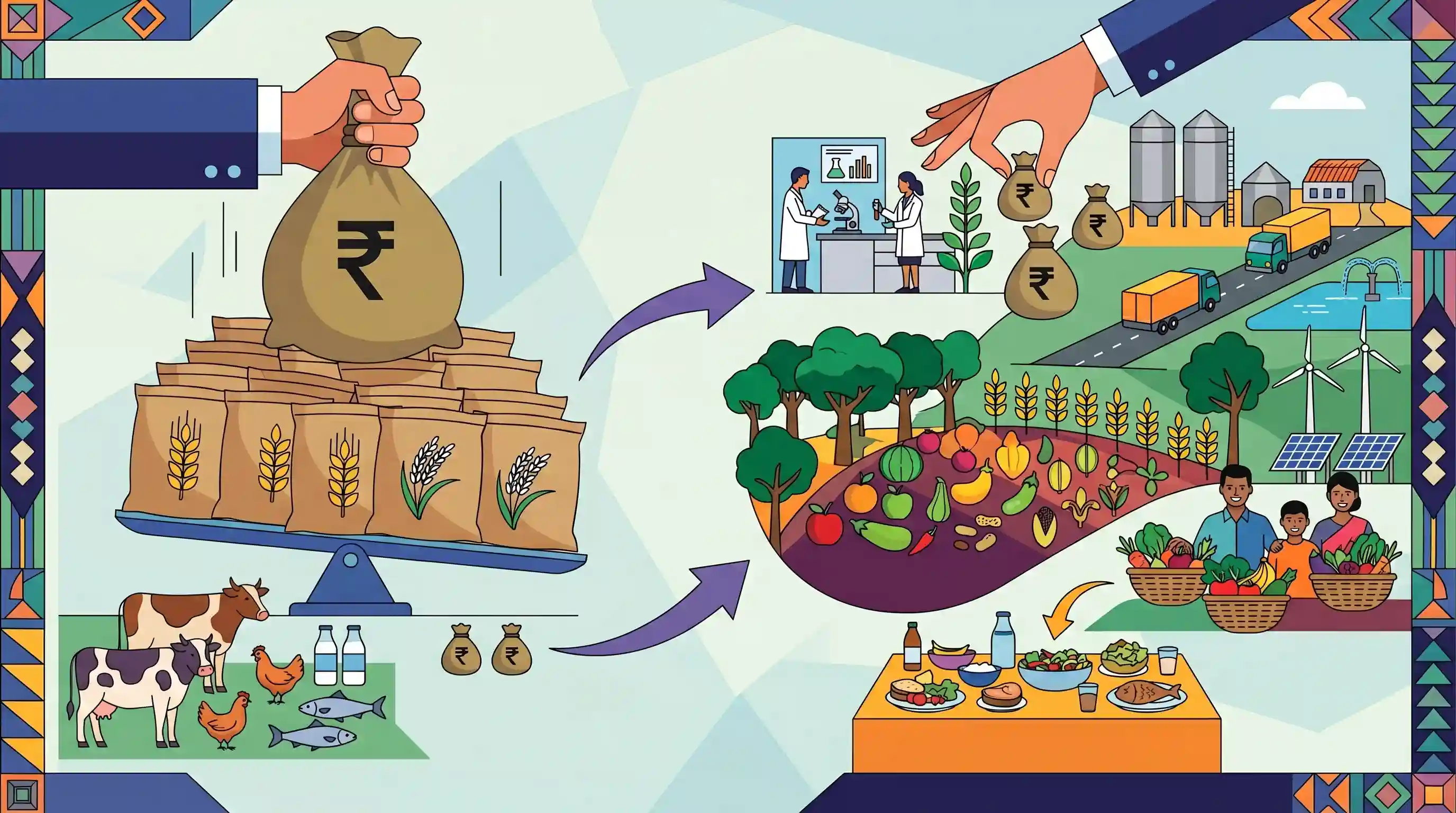
This article provides a critical macroeconomic perspective on the Union Budget's agricultural allocations, contrasting short-term subsidy payouts with the long-term need for capital investment, R&D, and diversification into high-value allied sectors. It directly addresses GS3 syllabus points on farm subsidies, crop patterns, and the economics of animal rearing.
Summary
The article critically analyzes the Union Budget's approach to the agricultural sector, arguing that it disproportionately focuses on traditional staples and subsidies while neglecting high-growth, high-value areas like livestock, dairy, and fisheries. Despite allied sectors contributing significantly to agricultural GDP, they receive a fraction of the budgetary support compared to cereals. The author emphasizes the need for a structural shift in expenditure—from populist subsidies towards capital investments in agricultural R&D, rural infrastructure, and crop diversification—to build climate resilience and sustainably increase farmers' incomes.
Key Points
- Budgetary allocations for agriculture remain heavily skewed towards food and fertilizer subsidies, neglecting essential capital investments in infrastructure and R&D.
- High-value allied sectors like dairy, poultry, and fisheries drive agricultural growth but are disproportionately bypassed in financial support compared to traditional cereals.
- There is a pressing need for a structural policy shift from cereal-centric agriculture (wheat and rice) towards crop diversification to ensure nutritional security and climate resilience.
- Increasing public investment in agricultural Research and Development (R&D) and robust supply chains is critical for sustainably raising farmers' incomes.
Important Terms
Minimum Support Price (MSP)

A government-guaranteed price floor for 22 mandated crops (and FRP for sugarcane) to protect farmers from market volatility and ensure food security through procurement.
UPSC context
GS-3 (Agriculture); tests understanding of price intervention, farm subsidies, and its impact on cropping patterns.
PM-KISAN
A central sector scheme providing ₹6,000 annual income support in three installments to all landholding farmer families via Direct Benefit Transfer (DBT).
UPSC context
GS-3 (Welfare Schemes); examines direct income support as an alternative to price subsidies for rural poverty.
PM-AASHA
An umbrella scheme for pulses and oilseeds featuring physical procurement (PSS), price deficiency payments (PDPS), and private-sector participation (PPPS) to ensure remunerative prices.
UPSC context
GS-3 (Agriculture); tests knowledge of price stabilization and strategies for diversifying away from cereal-centric farming.
Allied Sectors
Economic activities including livestock, dairy, and fisheries that supplement crop farming; they contribute over 40% of agricultural GVA but often receive less budgetary support.
UPSC context
GS-3 (Animal-Rearing); focuses on structural shifts in agriculture, income diversification, and inclusive rural development.
Indian Council of Agricultural Research (ICAR)
The apex autonomous body under the Ministry of Agriculture responsible for coordinating and managing research, education, and innovation across agriculture and allied sciences.
UPSC context
GS-3 (Science & Tech); highlights the role of institutional R&D in building climate resilience and food security.
Agricultural R&D
The systematic expenditure on science and technology in farming, currently around 0.4% of agricultural GDP, aimed at improving yields and climate-resilient crop varieties.
UPSC context
GS-3 (Public Investment); tests awareness of the need to shift from populist subsidies to long-term capital investments.
Prelims Trap
Food and fertilizer subsidies are classified as Capital Expenditure in agriculture as they create productive capacity.
Subsidies are Revenue Expenditures as they do not create physical assets. A recurring UPSC theme highlights how rising revenue expenditures (subsidies) crowd out Capital Expenditures.
Static Concepts Connected
What constitutes Gross Capital Formation (GCF) in agriculture?
- Asset creation: Investments that build physical assets and infrastructure in the farm sector, such as irrigation networks, rural roads, cold storage, and machinery.
- Private sector dominance: The private sector (primarily farmers) accounts for the vast majority of GCF (over 80%), while the public sector's share remains disproportionately low.
- Expenditure crowding: Revenue expenditures like power, water, and fertilizer subsidies do not qualify as GCF and historically crowd out public capital investment.
Why are allied sectors (livestock, dairy, fisheries) crucial for India's farm economics?
- Growth drivers: Allied sectors consistently grow at much faster rates compared to the traditional, cereal-centric crop sector, acting as the primary growth engines of agriculture.
- Income stability: They provide regular daily or weekly cash flows and act as critical insurance against seasonal crop failures, predominantly supporting small and marginal farmers.
- GVA contribution: Despite low budgetary allocations, livestock alone accounts for approximately 30% of the Gross Value Added (GVA) within the agriculture and allied sectors.
Cross-Topic Patterns
MSP distortions and water stress
Open-ended procurement of rice and wheat under MSP drives water-intensive farming in semi-arid regions, directly linking revenue subsidies to India's severe groundwater depletion.
Agri-R&D and Climate Resilience
Stagnant agricultural R&D funding at ~0.5% of Agri-GDP severely bottlenecks the development of drought-resistant seeds, hindering the goals of the National Mission for Sustainable Agriculture.

Expect a 2026 GS3 question on shifting budgetary focus from cereal-centric revenue subsidies to capital investments in allied sectors.
Linked PYQs · 4
Linked PYQs · 4
- 2023MainsGS3
What are the direct and indirect subsidies provided to farm sector in India? Discuss the issues raised by the World Trade Organization (WTO) in relation to agricultural subsidies.
- 2021MainsGS3
What are the present challenges before crop diversification? How do emerging technologies provide an opportunity for crop diversification?
- 2017MainsGS3
How do subsidies affect the cropping pattern, crop diversity and economy of farmers? What is the significance of crop insurance, minimum support price and food processing for small and marginal farmers?
- 2013MainsGS3
What are the different types of agriculture subsidies given to farmers at the national and at state levels ? Critically analyse the agricultural subsidy regime with reference to the distortions created by it.
