Finance Commission balances fiscal federalism and regional equity
Source:Indian Express ↗
Why It Matters
Provides critical data and arguments on the 16th Finance Commission's approach to balancing equity and efficiency in resource allocation, which is key to answering questions on fiscal federalism, demographic concerns of southern states, and structural reforms in state finances.
Summary
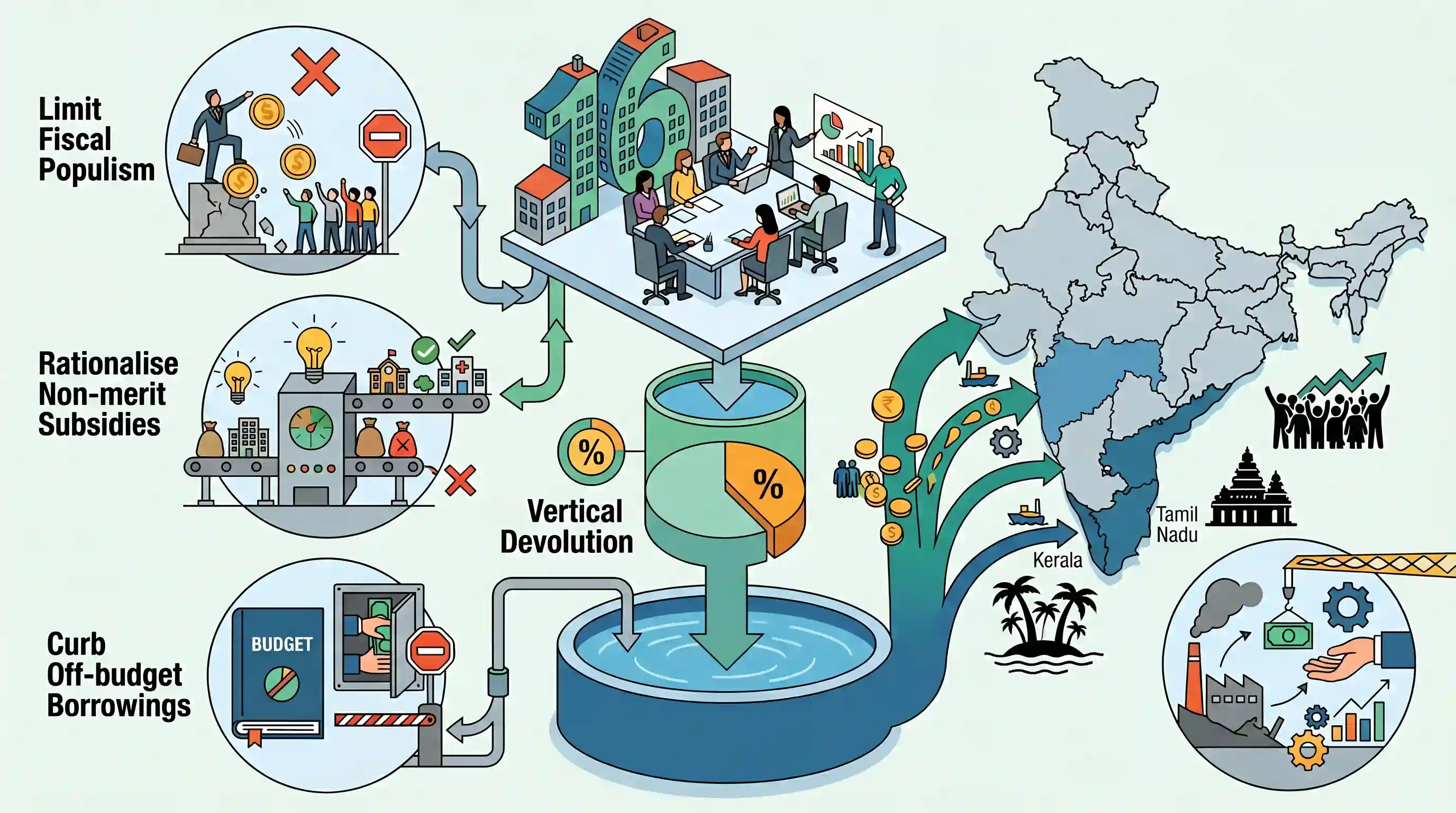
The 16th Finance Commission has retained states' vertical devolution at 41% but modified horizontal devolution criteria, increasing the share of southern and industrialized states to address equity and population concerns. The Commission highlighted the need to limit fiscal populism, curb off-budget borrowings, rationalise non-merit subsidies, and privatise loss-making public sector enterprises.
Key Points
- The 16th Finance Commission maintained the states' share in the divisible pool (vertical devolution) at 41%.
- Horizontal devolution criteria were reworked by adjusting population weights and including a state's contribution to GDP, raising the southern states' share from 15.8% to 17%.
- The increased levy of cesses and surcharges by the Centre, which are not shared with states, remains a significant structural concern for state governments.
- The Commission advised states to discontinue off-budget borrowings and cap their fiscal deficit at 3% of GSDP.
- It recommended tackling "fiscal populism" by introducing "sunset clauses" for non-merit subsidies and accelerating the privatization of power DISCOMs and inactive PSEs.
Important Terms
16th Finance Commission

A constitutional body (Article 280) chaired by Arvind Panagariya, recommending tax distribution for 2026-2031. It retained vertical devolution at 41% and introduced 'Contribution to GDP' as a horizontal criterion.
UPSC context
GS Paper II (Polity) and III (Economy). Tests knowledge of fiscal federalism and recent policy shifts in Centre-State relations.
15th Finance Commission
Chaired by N.K. Singh, it recommended a 41% vertical share for states (2021-2026) and used 2011 Census data for horizontal distribution, sparking debates over demographic performance.
UPSC context
GS Paper II/III. Vital for comparing historical devolution trends and understanding the shift to the 2011 Census.
Vertical Devolution
The percentage of the Centre’s 'divisible pool' of taxes shared with all states collectively. It addresses the vertical fiscal imbalance between central revenue powers and state expenditure responsibilities.
UPSC context
GS Paper II/III. Core concept in Indian fiscal federalism; distinguishes between Union and State tax rights.
Horizontal Devolution
The formula-based distribution of the states' 41% share among individual states. It uses criteria like income distance, population, and area to ensure inter-state equity.
UPSC context
GS Paper II/III. Tests understanding of 'equity vs. efficiency' and how regional disparities are addressed through fiscal transfers.
Fiscal Populism
Policy approach prioritizing short-term voter benefits (e.g., unconditional cash transfers, subsidies) over long-term fiscal health, often resulting in high deficits and reduced capital expenditure.
UPSC context
GS Paper III (Economy). Relevant for discussions on 'Quality of Expenditure' and the Fiscal Responsibility and Budget Management (FRBM) Act.
Divisible Pool
The portion of Gross Tax Revenue (GTR) shared with states, excluding the cost of collection, cesses, and surcharges. States often demand including cesses to increase their actual receipts.
UPSC context
GS Paper III. Critical for understanding the actual quantum of funds transferred to states versus the Headline GTR.
Prelims Trap
The 16th Finance Commission increased vertical devolution to 41% to reward southern states for their contribution to the national GDP.
Vertical devolution remains unchanged at 41%. The FC addressed southern states' concerns entirely through changes to the horizontal devolution formula (e.g., adding a 10% weight for 'contribution to GDP').
Static Concepts Connected
What is the constitutional framework governing the Finance Commission and tax devolution?
- Article 280: Mandates the President to constitute a Finance Commission every 5 years to recommend the distribution of net tax proceeds.
- Article 270: Defines the divisible pool of taxes, explicitly excluding cesses and surcharges from mandatory sharing with states.
- Article 271: Grants the Centre exclusive power to levy surcharges on certain taxes and duties for Union purposes only.
What are Off-Budget Borrowings (OBBs) and how do they bypass fiscal rules?
- Definition: Loans taken by state-owned entities (SPVs, PSUs) where principal and interest are serviced directly from the state budget.
- FRBM Loophole: They historically bypassed state debt metrics, artificially lowering the reported fiscal deficit to comply with the 3% FRBM cap.
- Regulatory Crackdown: Recent Finance Commissions and the Centre mandate treating OBBs as direct state debt, aggressively curbing their usage.
Cross-Topic Patterns
Demographic penalty & 2026 delimitation fears
The FC's population weighting intersects with the impending 2026 delimitation freeze expiration, exacerbating southern states' fears of being penalized both financially and politically for successful population control.
Power sector drag on state FRBM targets
State finances are persistently dragged down by DISCOM losses. The 16th FC's push for DISCOM privatization ties directly to earlier federal bailouts like UDAY and conditional borrowing limits.

Expect a 2026 Prelims question comparing the exact horizontal devolution criteria (and their weights) between the 15th and 16th FCs.
Linked PYQs · 5
Linked PYQs · 5
- 2013MainsGS3
What were the reasons for the introduction of Fiscal Responsibility and Budget Management (FRBM) Act, 2003 ? Discuss critically its salient features and their effectiveness.
- 2018MainsGS2
How is the Finance Commission of India constituted? What do you know about the terms of reference of the recently constituted Finance Commission? Discuss.
- 2019MainsGS3
The public expenditure management is a challenge to the Government of India in the context of budget making during the post-liberalization period. Clarify it.
- 2024MainsGS2
What changes has the Union Government recently introduced in the domain of Centre-State relations ? Suggest measures to be adopted to build the trust between the Centre and the States and for strengthening federalism.
- 2025MainsGS2
Examine the evolving pattern of Centre-State financial relations in the context of planned development in India. How far have the recent reforms impacted the fiscal federalism in India?
